Software Quality Assurance (SQA)
In the previous chapter, we looked at Software Project Management, covering how a project is planned, scheduled, and monitored from start to finish. Even a perfectly planned and scheduled project can still produce software that is unreliable, difficult to use, or full of defects if quality itself is never explicitly managed. Software Quality Assurance exists specifically to address this gap, making sure that quality is treated as a continuous, deliberate activity throughout a project, rather than something checked only once at the very end.
Software Quality Assurance, commonly abbreviated as SQA, refers to the planned and systematic set of activities carried out throughout the software development process to ensure that the final product meets defined quality requirements. Rather than being a single step that happens after coding is complete, SQA is woven into every phase of the Software Development Life Cycle covered earlier in this series, from requirement analysis all the way through to maintenance.
Kinds of Quality
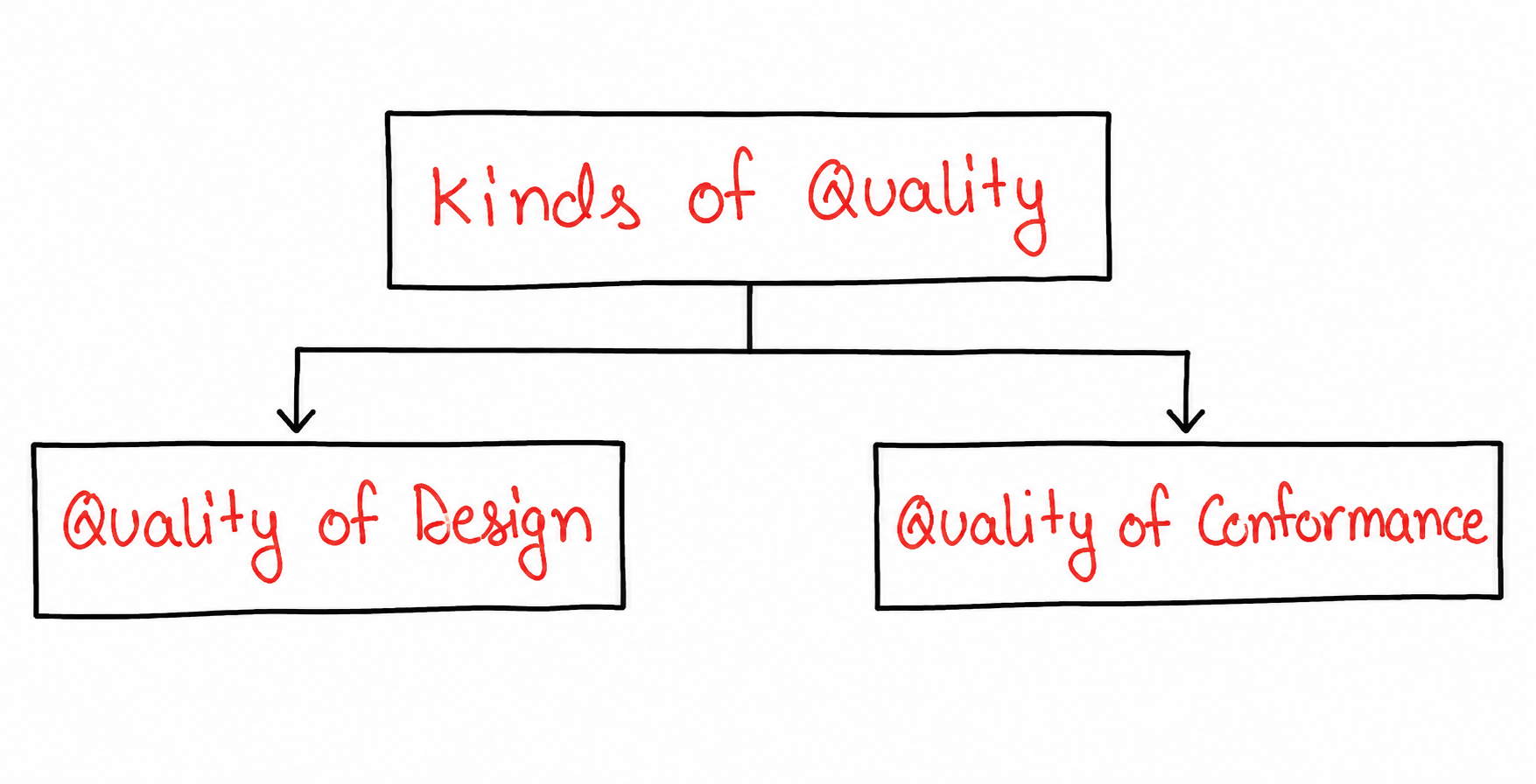
The diagram above shows that quality, in the context of software, is generally understood in two distinct ways: Quality of Design and Quality of Conformance. Even though both are labelled simply as "quality," they measure two genuinely different things, and confusing them is a common source of misunderstanding for beginners.
Quality of Design refers to how well the software has actually been planned and architected to meet the requirements it was intended for. This includes decisions such as which features are included, how the system is structured, and whether the chosen design will genuinely satisfy the customer's needs. A software product can have an excellent design on paper, thoughtfully addressing every requirement, long before a single line of code has actually been written.
Quality of Conformance, by contrast, refers to how closely the final, built software actually matches that original design. Even a superbly designed system can suffer from poor quality of conformance if the implementation introduces bugs, deviates from the design specification, or fails to correctly build the features that were planned. In simple terms, Quality of Design asks "was this planned well?" while Quality of Conformance asks "was this built the way it was planned?" — and both need to be strong for the final software product to genuinely be considered high quality.
Quality Characteristics
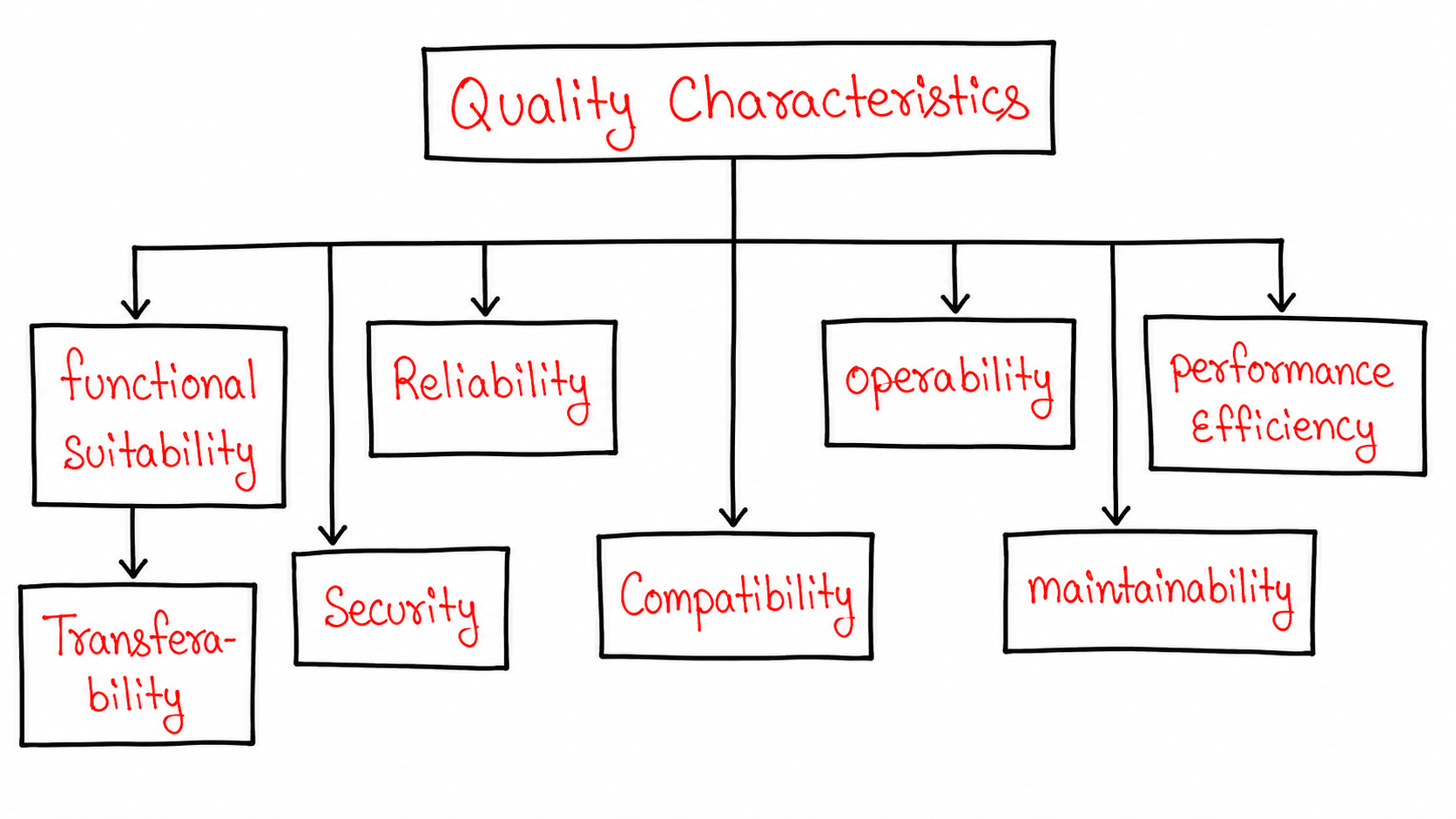
Beyond the two broad kinds of quality, software quality is also evaluated using a specific set of measurable characteristics. The diagram above lists eight such characteristics branching out from a central "Quality Characteristics" node: Functional Suitability, Reliability, Operability, Performance Efficiency, Transferability, Security, Compatibility, and Maintainability. Each of these represents a distinct angle from which a piece of software's quality can be judged, and together they form a much more complete picture than any single measure could provide on its own.
Functional Suitability refers to whether the software actually provides the functions it was designed to provide, and whether those functions correctly meet the stated and implied needs of its users. Software can be beautifully built and highly reliable, but if it doesn't actually do what the user needs it to do, its functional suitability is poor.
Reliability refers to the software's ability to perform its required functions correctly and consistently under stated conditions for a specified period of time, without unexpected failures or crashes interrupting normal use.
Operability, sometimes discussed under the broader term usability, refers to how easily users can learn to operate the software, understand its behaviour, and use it effectively to achieve their goals without excessive effort or confusion.
Performance Efficiency refers to how well the software performs relative to the resources it consumes, such as processing time, memory usage, and system resources, especially under specified conditions like a heavy user load.
Transferability, shown branching separately in the diagram, refers to how easily the software can be transferred from one environment to another, such as moving it to a different hardware platform, operating system, or organisational setting, without requiring extensive rework.
Security refers to the software's ability to protect data and functionality from unauthorized access or malicious interference, connecting directly back to the Security Management concepts introduced earlier in this series under Operating System services.
Compatibility refers to the software's ability to exchange information with other systems, or to perform its required functions correctly while sharing a common hardware or software environment with other products, without causing conflicts.
Maintainability refers to how easily the software can be modified in the future, whether to correct defects, improve performance, or adapt to a changed environment, a concept explored in much greater depth in the earlier Software Maintenance chapter of this series.
Elements of Software Quality Assurance
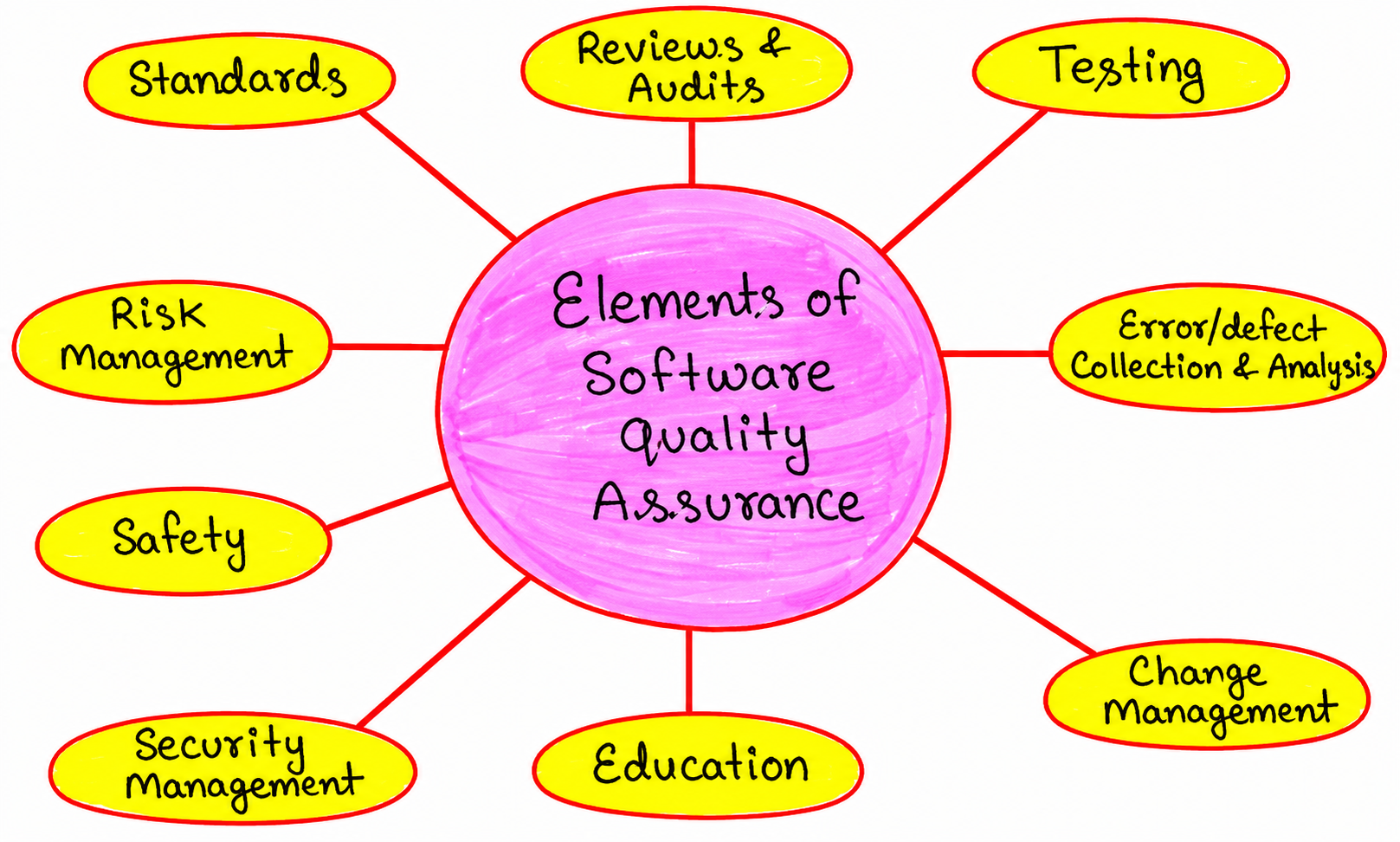
The diagram above lays out nine core elements that together make up a complete Software Quality Assurance program, arranged around a central "Elements of Software Quality Assurance" node: Standards, Reviews & Audits, Testing, Errors/Defect Collection Analysis, Change Management, Education, Security Management, Safety, and Risk Management. Each of these elements addresses a different aspect of maintaining quality throughout a project, and the sections below explain each one in the same order shown in the diagram.
1. Standards
Standards refer to the documented guidelines, coding conventions, and organisational or industry benchmarks that a software project is expected to follow. Standards create a consistent baseline that every team member can be measured against, connecting directly to the Coding Standards chapter covered earlier in this series, and they make it far easier to judge whether a particular piece of work genuinely meets the expected level of quality.
2. Reviews and Audits
Reviews and Audits involve systematically examining project artefacts, such as requirement documents, design documents, or source code, to check whether they meet defined standards and correctly fulfil their intended purpose. Reviews are typically carried out by peers or team members during development, while audits are often more formal evaluations, sometimes carried out by an independent party, to verify that proper processes were actually followed.
3. Testing
Testing involves systematically executing software to uncover defects and verify that it behaves correctly, directly connecting to the Software Testing, White Box Testing, and Black Box Testing chapters covered earlier in this series. Testing remains one of the most direct and widely used ways to confirm that a software product's actual behaviour matches its intended, designed behaviour.
4. Errors/Defect Collection & Analysis
This element involves systematically recording every defect discovered during development and testing, and then analysing that collected data to understand patterns, such as which parts of the system tend to produce the most errors, or which types of mistakes occur most frequently. This analysis helps a team continuously improve its own processes, rather than simply fixing each defect in isolation without learning from it.
5. Change Management
Change Management refers to the controlled process of handling requested changes to a software system, ensuring that every change is properly evaluated, approved, documented, and tracked before being implemented. This connects closely to the Software Configuration Management chapter covered earlier in this series, since uncontrolled changes are one of the most common sources of new defects and inconsistencies in a software project.
6. Education
Education refers to training team members in quality practices, relevant standards, and proper development techniques. A quality assurance program is only as effective as the people carrying it out, so ongoing education ensures that every team member genuinely understands why particular standards and practices exist, rather than simply following them mechanically without understanding their purpose.
7. Security Management
Security Management, in the context of SQA, involves ensuring that appropriate security practices are followed throughout development, protecting the software and its data from unauthorized access or malicious interference, directly connecting back to the Security characteristic covered earlier in this chapter.
8. Safety
Safety refers to ensuring that the software does not lead to situations that could cause harm, whether to users, data, or, in systems like embedded or real-time software, to physical equipment or people. This element becomes especially critical in software controlling safety-sensitive systems, such as medical devices or industrial automation, concepts introduced earlier in the Real-Time Operating System discussion in this site's Operating System notes.
9. Risk Management
Risk Management, shown as its own branch in the diagram, involves identifying potential risks to a project's quality or success early, assessing how serious each risk might be, and planning mitigation strategies in advance, connecting directly to the dedicated Risk Management chapter covered elsewhere in this series.
Summary Table of Quality Characteristics
| Characteristic | What It Measures |
|---|---|
| Functional Suitability | Whether the software provides the functions users actually need |
| Reliability | Consistent, correct performance without unexpected failures |
| Operability | How easily users can learn and operate the software effectively |
| Performance Efficiency | How well the software performs relative to the resources it consumes |
| Transferability | How easily the software can move to a different environment |
| Security | Protection of data and functionality from unauthorized access |
| Compatibility | Ability to work correctly alongside other systems and software |
| Maintainability | How easily the software can be modified in the future |
Best Practices While Learning Software Quality Assurance
- Keep Quality of Design and Quality of Conformance clearly separated in your notes — one is about planning, the other is about execution matching that plan.
- Learn the eight quality characteristics by relating each one to a real-world example of software failing to meet it, since a concrete example is easier to recall under exam pressure than an abstract definition.
- Group the nine elements of SQA into themes — process-related (Standards, Change Management), verification-related (Reviews & Audits, Testing, Defect Analysis), and people-related (Education, Risk Management, Safety, Security Management) — to make them easier to remember together.
- Connect this chapter back to Software Testing and Software Configuration Management, since SQA is really the umbrella activity that ties those individual practices together into one coherent quality program.
Common Mistakes Beginners Make
| Mistake | Correct Practice |
|---|---|
| Treating Quality Assurance and Testing as exactly the same activity. | Understand that Testing is just one element within the broader SQA program, which also includes standards, reviews, audits, and risk management. |
| Assuming Quality of Design automatically guarantees Quality of Conformance. | Remember that a well-designed system can still suffer from poor conformance if the implementation introduces defects or deviates from the plan. |
| Overlooking Education as a "soft" element compared to Testing or Reviews. | Recognise that a quality program is only as effective as the team's genuine understanding of the standards and practices behind it. |
Frequently Asked Interview Questions
-
What is Software Quality Assurance?
Software Quality Assurance is the planned and systematic set of activities carried out throughout the software development process to ensure the final product meets defined quality requirements. -
What is the difference between Quality of Design and Quality of Conformance?
Quality of Design refers to how well the software has been planned to meet requirements, while Quality of Conformance refers to how closely the actual built software matches that original design. -
What are the main quality characteristics used to evaluate software?
The main characteristics are Functional Suitability, Reliability, Operability, Performance Efficiency, Transferability, Security, Compatibility, and Maintainability. -
What is the difference between Reviews and Audits in SQA?
Reviews are typically carried out by peers or team members during development to check specific artefacts, while audits are more formal evaluations, often by an independent party, verifying that proper processes were followed overall. -
How is Testing related to Software Quality Assurance?
Testing is one specific element within the broader SQA program, used to verify that software behaves correctly and to uncover defects before release. -
Why is Risk Management considered part of Software Quality Assurance?
Because identifying and mitigating risks early helps prevent problems that could otherwise compromise the quality or successful delivery of the software. -
Why does Education matter as an element of SQA?
Because a quality program depends on team members genuinely understanding the standards and practices they're expected to follow, rather than applying them mechanically without real understanding.
Summary
Software Quality Assurance ensures that quality is treated as a continuous, planned activity throughout a software project, rather than something checked only after development is complete. We looked at the two fundamental kinds of quality — Quality of Design and Quality of Conformance — the eight measurable quality characteristics used to evaluate software, from Functional Suitability to Maintainability, and the nine core elements that together make up a complete SQA program, from Standards and Testing to Risk Management and Education.
With a solid understanding of what quality assurance actually involves, you're now ready to explore Software Metrics in the next chapter, which looks at how software size, complexity, and quality can actually be measured numerically to support the kind of quality assurance activities covered in this chapter.