Risk Management in Software Engineering
In the previous chapter, we looked at Software Metrics and how measurable data supports better decision-making throughout a software project. One of the most important uses of that data is spotting trouble before it actually derails a project, which brings us to Risk Management, the final chapter in this Software Engineering series. Every software project, no matter how carefully planned, faces some degree of uncertainty, and risk management is the discipline of dealing with that uncertainty in a structured, proactive way rather than simply reacting once something has already gone wrong.
A risk, in the context of software engineering, is any potential future event or condition that could negatively affect a project's schedule, budget, quality, or overall success. Risk management doesn't attempt to eliminate every possible risk, since that's rarely realistic, but instead focuses on identifying risks early, understanding how serious each one could be, and preparing a sensible response in advance, rather than being caught off guard when something eventually goes wrong.
Why Risk Management Matters
Without a deliberate risk management process, teams tend to discover problems only once they've already become serious, at which point options for handling them are far more limited and far more costly. A key requirement that quietly changes midway through development, a critical team member becoming unavailable, or a chosen technology turning out to be less mature than expected are all risks that, if identified early, can often be planned around with comparatively little disruption. Left unmanaged, the very same issues can derail a project's schedule or budget entirely, connecting directly back to the project tracking concerns covered in the earlier Software Project Management chapter.
The Risk Management Process
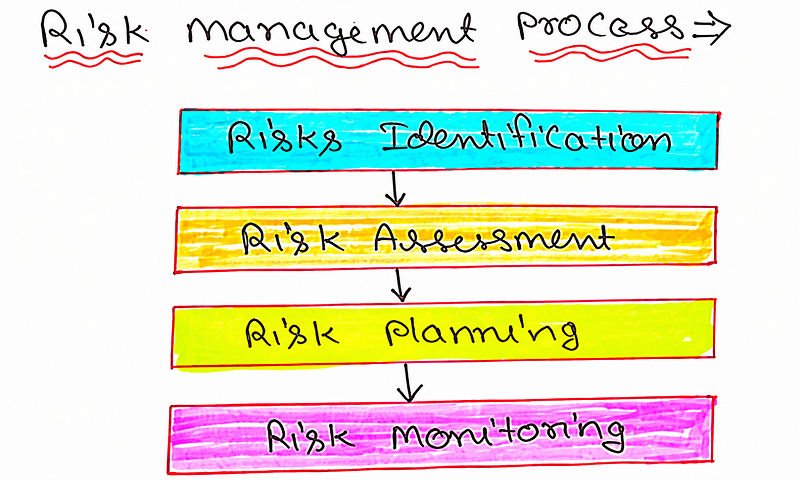
The diagram above lays out the risk management process as four sequential steps, each flowing into the next: Risk Identification, Risk Assessment, Risk Planning, and Risk Monitoring. This ordering reflects a logical progression — a risk first needs to be recognised before it can be evaluated, evaluated before a response can be planned, and planned for before that plan can actually be tracked over the life of the project. The sections below walk through each step individually, in the same order shown in the diagram.
1. Risk Identification
Risk Identification is the first step shown in the diagram, and it involves systematically recognising and listing every potential risk that could affect the project, before any of those risks have actually occurred. This is typically done through techniques such as brainstorming sessions with the project team, reviewing risks that affected similar past projects, and carefully examining the project's requirements, schedule, and chosen technologies for any obvious sources of uncertainty. The goal at this stage is simply to build as complete a list of potential risks as possible, without yet worrying about how serious each one is.
2. Risk Assessment
Risk Assessment, the second step in the diagram, involves evaluating each identified risk to understand how likely it is to actually occur, and how severe its impact would be on the project if it did. This is often done by estimating a probability for each risk alongside an estimate of its potential impact, and combining these two figures to arrive at an overall sense of how much attention a particular risk deserves compared to the others on the list. A risk that is both highly likely and highly damaging clearly needs far more immediate attention than one that is unlikely and only mildly disruptive, so this step essentially prioritises the list produced during Risk Identification.
3. Risk Planning
Risk Planning, the third step, involves deciding in advance exactly how the team will respond to each significant risk identified and assessed in the earlier steps. This might involve planning to avoid a risk entirely, such as choosing a more mature, well-tested technology instead of an experimental one; planning to reduce its likelihood or impact, such as adding extra testing around a particularly complex module; or planning a contingency response to be carried out only if the risk actually occurs, such as having a backup team member ready to step in if a key contributor becomes unavailable. This step turns a list of prioritised risks into a concrete, actionable plan the team can actually follow.
4. Risk Monitoring
Risk Monitoring, the final step shown in the diagram, involves continuously tracking identified risks throughout the life of the project, watching for early warning signs that a particular risk is becoming more likely, and checking whether the plans developed during Risk Planning are actually being followed and remain effective. Since new risks can also emerge as a project progresses, this step often loops back into Risk Identification, making risk management an ongoing activity throughout the entire project rather than a task completed just once at the very beginning.
Types of Risks in a Software Project
Beyond the four-step process shown in the diagram, it's useful to understand the different categories of risk a software project can face, since this affects how each risk is best identified and handled.
Project risks threaten a project's schedule or resources, such as delays caused by inaccurate estimation, loss of a key team member, or requirements that keep changing throughout development, connecting directly to the estimation and scheduling concerns covered in the earlier Software Project Management chapter.
Technical risks threaten the quality or feasibility of the software itself, such as choosing a technology that turns out to be poorly suited to the problem, underestimating the complexity of a particular feature, or discovering a design flaw only after significant development work has already been completed.
Business risks threaten the viability or value of the software project from an organisational perspective, such as building a product that no longer matches what the market actually wants, losing management support partway through the project, or a competitor releasing a similar product first.
Summary Table of the Risk Management Process
| Step | What It Involves |
|---|---|
| Risk Identification | Recognising and listing every potential risk that could affect the project |
| Risk Assessment | Evaluating each risk's likelihood and potential impact to prioritise it |
| Risk Planning | Deciding in advance how the team will avoid, reduce, or respond to each risk |
| Risk Monitoring | Continuously tracking risks and plans throughout the life of the project |
Best Practices While Learning Risk Management
- Remember the four steps as a logical sequence — you cannot assess a risk you haven't identified, plan for a risk you haven't assessed, or monitor a plan that was never made.
- Keep the three risk categories — Project, Technical, and Business — in mind when identifying risks, since thinking through each category separately helps produce a more complete risk list.
- Remember that Risk Monitoring loops back into Risk Identification, since risk management is an ongoing activity throughout a project rather than a one-time task.
- Connect this chapter back to Software Metrics, since the kind of measurable data covered there is often exactly what makes Risk Monitoring possible in practice.
Common Mistakes Beginners Make
| Mistake | Correct Practice |
|---|---|
| Treating risk management as a single task completed only at the start of a project. | Understand that Risk Monitoring is continuous, and new risks can be identified at any point throughout the project. |
| Assuming every identified risk deserves equal attention. | Remember that Risk Assessment exists specifically to prioritise risks based on their likelihood and potential impact. |
| Confusing Technical Risks with Project Risks. | Recognise that Technical Risks threaten the software's quality or feasibility, while Project Risks threaten the schedule or resources needed to build it. |
Frequently Asked Interview Questions
-
What is a risk in software engineering?
A risk is any potential future event or condition that could negatively affect a project's schedule, budget, quality, or overall success. -
What are the four steps of the risk management process?
The four steps are Risk Identification, Risk Assessment, Risk Planning, and Risk Monitoring. -
What is the difference between Risk Identification and Risk Assessment?
Risk Identification involves recognising and listing potential risks, while Risk Assessment involves evaluating each identified risk's likelihood and potential impact to prioritise it. -
Why does Risk Monitoring loop back into Risk Identification?
Because new risks can emerge as a project progresses, making risk management an ongoing activity rather than something completed only once at the start of a project. -
What are the three main categories of software project risk?
The three main categories are Project risks, which threaten schedule and resources, Technical risks, which threaten software quality or feasibility, and Business risks, which threaten the project's organisational viability. -
What does Risk Planning actually produce?
Risk Planning produces a concrete, actionable plan describing how the team will avoid, reduce, or respond to each significant identified risk. -
How does risk management connect to software metrics?
Software metrics provide the measurable data that often makes Risk Monitoring possible, allowing a team to track early warning signs using real numbers rather than guesswork.
Summary
Risk Management gives a software project a structured, proactive way of dealing with the uncertainty every project inevitably faces. We looked at the four-step process shown in the diagram — Risk Identification, Risk Assessment, Risk Planning, and Risk Monitoring — and how each step builds logically on the one before it, along with the three broad categories of risk a project can encounter: Project, Technical, and Business risks.
This chapter completes the Software Engineering series covered on this site, bringing together everything from the Software Development Life Cycle and process models through requirement engineering, design, testing, maintenance, quality assurance, metrics, and finally risk management — the full set of disciplines that together make up a systematic, engineering-driven approach to building software.