Software Requirement Specification (SRS)
After requirements have been gathered, analyzed, and validated through the requirement engineering process, they need to be recorded somewhere clear, complete, and authoritative, a place that every developer, tester, and stakeholder can refer back to throughout the entire project. This is exactly the purpose of the Software Requirement Specification, commonly known as the SRS.
An SRS is far more than a simple list of features. It is a formal, structured document that captures precisely what a software system is expected to do, how it should behave under various conditions, and the constraints it must operate within, all written in a way that avoids ambiguity and misinterpretation.
In this tutorial, you will learn what an SRS document actually contains, why it plays such a critical role in software projects, the key characteristics that make an SRS effective, how IEEE standards guide its structure, and the common pitfalls teams should avoid when writing one.
What is a Software Requirement Specification?
A Software Requirement Specification is a comprehensive document that describes the intended behavior, features, and constraints of a software system, serving as a formal agreement between stakeholders and the development team about what will actually be built.
Once approved, the SRS becomes the primary reference point throughout the rest of the project. Designers use it to plan the system's architecture, developers use it to understand what needs to be implemented, and testers use it to verify whether the finished product actually behaves as intended.
Why is an SRS Important?
- It creates a single, authoritative source of truth for what the system must do, reducing miscommunication between stakeholders and developers.
- It provides a clear basis for estimating project cost, timeline, and required resources.
- It serves as a reference point for verifying whether the final system meets its intended requirements during testing.
- It helps identify gaps, conflicts, or ambiguities in requirements before development begins, when changes are far less expensive to make.
- It acts as a legal or contractual reference in situations where software is being built for an external client.
Characteristics of a Good SRS
Not every requirement document is equally useful. A well-written SRS follows a specific set of characteristics that determine how effective it will be throughout the software development lifecycle.
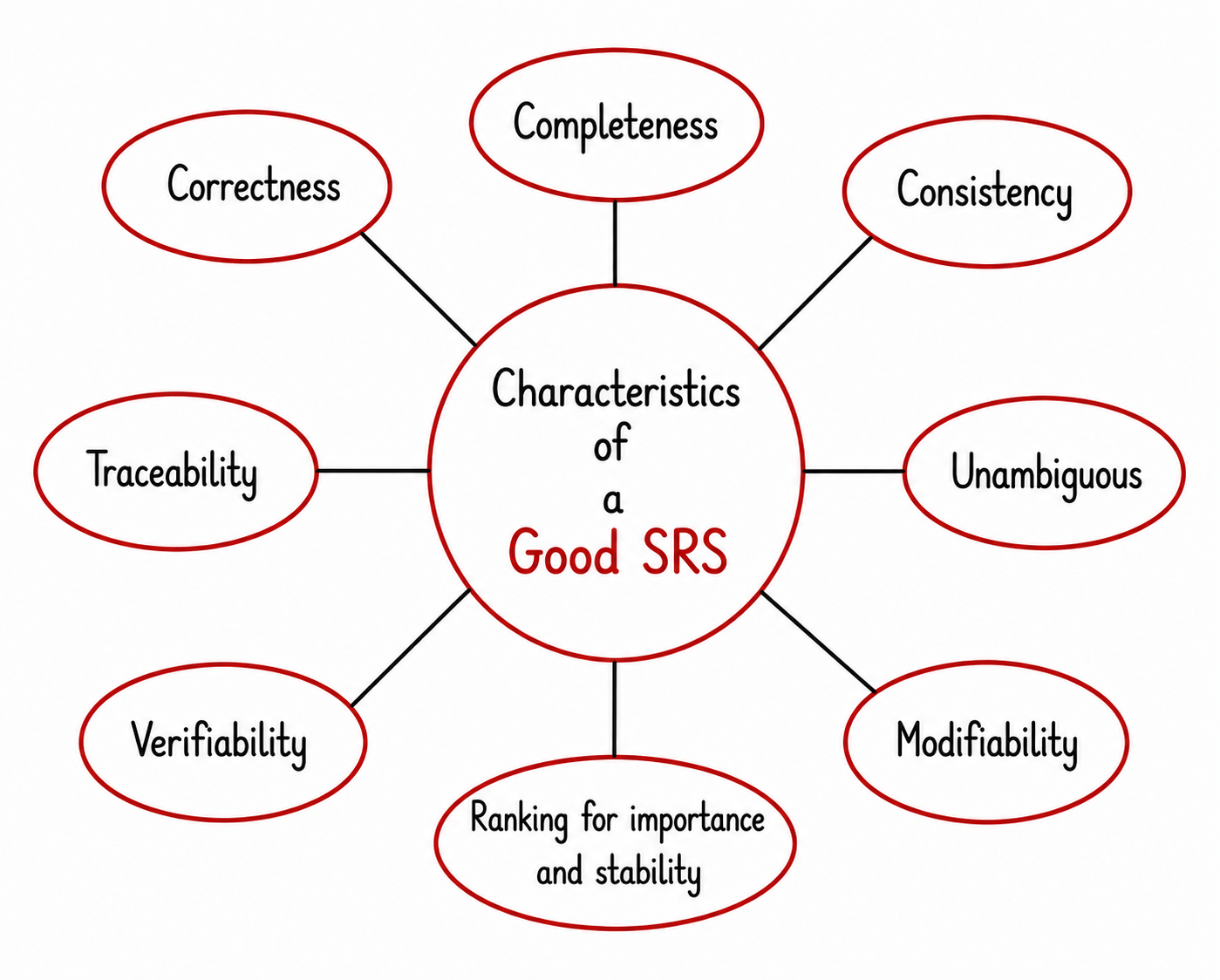
| Characteristic | Description |
|---|---|
| Correct | Every requirement listed accurately reflects an actual need of the stakeholders. |
| Unambiguous | Each requirement can be interpreted in only one possible way by any reader. |
| Complete | All necessary requirements are included, with no significant gaps left unaddressed. |
| Consistent | No requirement contradicts or conflicts with any other requirement in the document. |
| Ranked for Importance | Requirements are prioritized, distinguishing essential features from optional ones. |
| Verifiable | Each requirement can be objectively tested to confirm whether it has been satisfied. |
| Modifiable | The document is structured in a way that allows changes to be made cleanly, without disrupting unrelated sections. |
| Traceable | Each requirement can be linked back to its origin and forward to its implementation and test cases. |
These characteristics work together to ensure the SRS remains a reliable, practical tool throughout the project, rather than becoming an outdated or confusing document that teams stop referring to.
IEEE Standard for SRS
To bring consistency across the software industry, the Institute of Electrical and Electronics Engineers, commonly known as IEEE, published a widely recognized standard outlining the recommended structure and content of an SRS document. While organizations often adapt this structure to their own needs, it remains a strong foundational reference for writing requirement documents.
Typical Structure Recommended by the IEEE Standard
| Section | Purpose |
|---|---|
| Introduction | Provides an overview of the document's purpose, scope, and intended audience. |
| Overall Description | Describes the general context, assumptions, and constraints affecting the system. |
| Specific Requirements | Lists detailed functional and non-functional requirements in a structured format. |
| Appendices | Contains supporting information such as diagrams, glossaries, or reference materials. |
| Index | Helps readers quickly locate specific sections within a lengthy document. |
Detailed Breakdown of SRS Sections
1. Introduction
This section sets the stage for the entire document, explaining why the SRS exists, who it is intended for, and how it should be used. It typically includes a purpose statement, the scope of the project, definitions of important terms, and references to any related documents.
2. Overall Description
Rather than diving straight into detailed requirements, this section provides broader context about the system, including how it fits into any existing environment, the general characteristics of its intended users, and any assumptions or limitations that shaped how requirements were defined.
3. Specific Requirements
This is typically the largest and most detailed section of the entire document, listing every functional and non-functional requirement individually, often organized by feature area or system module. Each requirement is usually assigned a unique identifier, making it easy to reference throughout design, development, and testing.
4. Appendices
Supporting materials that help clarify the main content are placed here, such as diagrams illustrating system workflows, a glossary of technical terms used throughout the document, or references to external standards the system must comply with.
5. Index
For lengthy SRS documents, an index helps readers quickly navigate to the specific section they need, without having to search through the entire document manually.
Functional vs Non-Functional Requirements in an SRS
The specific requirements section of an SRS is generally organized around two main categories, each describing a different aspect of the system's expected behavior.
| Requirement Type | Focus |
|---|---|
| Functional Requirements | Describe specific features and behaviors the system must perform. |
| Non-Functional Requirements | Describe quality attributes such as performance, security, and usability that apply across the system. |
Clearly separating these two categories within the SRS helps different teams focus on what matters most to their role, with developers often referencing functional requirements closely during implementation, while performance and security teams pay closer attention to non-functional requirements.
How an SRS is Prepared
Writing an effective SRS is not a single, isolated task but rather the culmination of the entire requirement engineering process discussed in earlier stages of a project.
| Step | Description |
|---|---|
| Gathering Inputs | Collecting elicited and analyzed requirements from stakeholders as the foundation for the document. |
| Organizing Content | Structuring gathered requirements into clear sections, following a standard format such as the IEEE structure. |
| Writing Requirements Clearly | Expressing each requirement in precise, unambiguous, and testable language. |
| Reviewing and Validating | Circulating the draft document among stakeholders to confirm accuracy and completeness. |
| Finalizing and Approving | Formally approving the document, establishing it as the authoritative reference for the project. |
Who Uses the SRS Document?
| Role | How They Use the SRS |
|---|---|
| Project Managers | Use it to plan schedules, allocate resources, and estimate project scope. |
| System Designers | Use it as the basis for designing the system's architecture and components. |
| Developers | Use it to understand exactly what functionality needs to be implemented. |
| Testers | Use it to design test cases that verify whether the system meets its documented requirements. |
| Clients and Stakeholders | Use it to confirm that the planned system aligns with their actual business needs. |
Advantages of a Well-Written SRS
- Reduces misunderstandings between stakeholders and the development team by clearly documenting expectations.
- Provides a stable reference point that remains consistent even as team members change throughout the project.
- Makes it easier to estimate project cost and timeline accurately, based on clearly defined scope.
- Supports better test planning, since requirements are already documented in a verifiable format.
- Reduces the risk of scope creep by clearly defining what is, and is not, part of the agreed system.
Best Practices for Writing an SRS
- Use simple, precise language, avoiding overly technical jargon that stakeholders may not understand.
- Assign a unique identifier to every requirement, making it easy to reference throughout the project.
- Avoid combining multiple requirements into a single statement, since this makes tracking and testing difficult.
- Review the document with both technical and non-technical stakeholders before finalizing it.
- Keep the document updated as approved changes occur, rather than letting it become outdated.
Common Mistakes Teams Make
| Mistake | Correct Practice |
|---|---|
| Writing requirements using vague, subjective language. | Use specific, measurable language that can be objectively verified. |
| Skipping stakeholder review before finalizing the document. | Always circulate the draft SRS for review and validation before approval. |
| Treating the SRS as a document that never needs updating. | Update the SRS whenever approved requirement changes occur during the project. |
| Mixing functional and non-functional requirements without clear organization. | Clearly separate and label different requirement categories for easier reference. |
Frequently Asked Questions
-
What is a Software Requirement Specification?
An SRS is a formal document that describes the intended behavior, features, and constraints of a software system. -
Why is the SRS considered important in software projects?
It serves as a single, authoritative reference that guides design, development, testing, and stakeholder communication throughout the project. -
What does it mean for a requirement to be verifiable?
A verifiable requirement can be objectively tested to confirm whether it has actually been satisfied. -
What is the IEEE standard for SRS documents?
It is a widely recognized guideline outlining a recommended structure for writing clear and complete requirement specification documents. -
What sections are typically included in an SRS?
Common sections include an introduction, overall description, specific requirements, appendices, and an index. -
Who typically uses the SRS document during a project?
Project managers, designers, developers, testers, and stakeholders all rely on the SRS for different purposes throughout the project. -
What is the difference between functional and non-functional requirements within an SRS?
Functional requirements describe specific system behaviors, while non-functional requirements describe quality attributes like performance and security. -
Should an SRS document be updated after it is first approved?
Yes, it should be updated whenever formally approved requirement changes occur, so it remains an accurate reference throughout the project.
Summary
The Software Requirement Specification transforms the outcomes of requirement engineering into a formal, structured document that guides every later stage of a software project. By following recognized characteristics such as correctness, completeness, and verifiability, and often referencing established structures like the IEEE standard, teams can produce an SRS that remains a reliable, trusted reference throughout development.
A well-prepared SRS benefits every role involved in a project, from project managers planning schedules to testers designing verification cases, ensuring that everyone shares a consistent understanding of what the final system must accomplish. Investing effort into writing a clear, well-organized SRS significantly reduces the risk of miscommunication and costly rework later in the development process.
With a solid understanding of the Software Requirement Specification, you are now ready to explore Feasibility Study, which examines whether a proposed software project is practically achievable before significant resources are committed to it.