Programming Tools, Types of Languages & Translators
Programming is the foundation of modern software development. To build applications, developers use different programming languages and tools that help in writing, testing, and executing code efficiently.
This chapter explains programming tools, different types of programming languages, and translators such as compilers, interpreters, and assemblers in a simple and clear manner.
What are Programming Tools?
Programming tools are essential software applications that assist developers in designing, writing, testing, debugging, and maintaining computer programs. These tools create a structured and efficient environment where developers can transform their ideas into functional software systems. Instead of dealing directly with complex hardware instructions, programmers use these tools to simplify coding and improve accuracy.
In modern computing, programming tools play a vital role in speeding up the development process. They provide intelligent features such as syntax highlighting, auto-completion, real-time error checking, and code suggestions, which help developers write clean and error-free code. By reducing manual effort and minimizing mistakes, these tools significantly enhance productivity and efficiency.
Programming tools are useful for both beginners and experienced developers. Beginners benefit from guided interfaces and error detection, while professionals use advanced tools to manage large-scale projects, collaborate with teams, and maintain complex software systems. These tools also support testing and debugging, ensuring that programs run correctly and efficiently.
Without programming tools, developers would need to write instructions in low-level machine code, making the development process extremely slow and difficult. Managing large applications without proper tools would also increase the chances of errors and reduce overall software quality. Therefore, programming tools are a fundamental part of modern software development.
Key Features of Programming Tools
- Code Editing Support: Provides a user-friendly environment for writing and organizing source code.
- Error Detection: Identifies syntax and logical errors during coding.
- Debugging Capabilities: Helps track and fix issues step by step.
- Execution Environment: Allows developers to run and test their programs easily.
- Automation: Reduces repetitive tasks such as compiling and testing.
Examples of Programming Tools
- Code Editors: Code editors are basic tools used to write and modify source code. They often include helpful features like syntax highlighting, indentation, and auto-completion (e.g., Visual Studio Code).
- Compilers: Compilers convert an entire program written in a high-level language into machine code before execution. This improves performance and allows programs to run faster.
- Debuggers: Debuggers are used to identify and fix errors in programs. They allow developers to execute code step by step, inspect variables, and understand program behavior.
- Interpreters: Interpreters translate and execute code line by line. They are useful for quick testing and debugging, especially during development.
- IDEs (Integrated Development Environments): IDEs combine multiple programming tools into a single platform, including a code editor, compiler, debugger, and build tools, providing a complete development environment.
Importance of Programming Tools
Programming tools are crucial for building reliable and efficient software systems. They help developers save time, reduce errors, and improve code quality. With the advancement of technology, modern tools now include features like cloud integration, version control, and AI-based code suggestions, making development faster and smarter.
Programming Languages
A programming language is a structured way of communicating with a computer system. It allows developers to write instructions that a machine can understand and execute to perform specific tasks. These tasks can range from simple calculations to building complex software applications, websites, games, and artificial intelligence systems.
Each programming language follows a set of rules known as syntax and semantics. Syntax defines how code should be written, while semantics describes the meaning of that code. By following these rules, developers can create efficient and error-free programs that solve real-world problems.
Programming languages act as a bridge between human thinking and machine execution. Since computers only understand binary (0s and 1s), programming languages make it easier for humans to write readable and manageable instructions, which are later converted into machine-level code using translators such as compilers or interpreters.
Over time, programming languages have evolved to become more powerful, flexible, and user-friendly. Modern languages support features like object-oriented programming, automation, cross-platform development, and rapid application building, making them essential tools in today’s digital world.
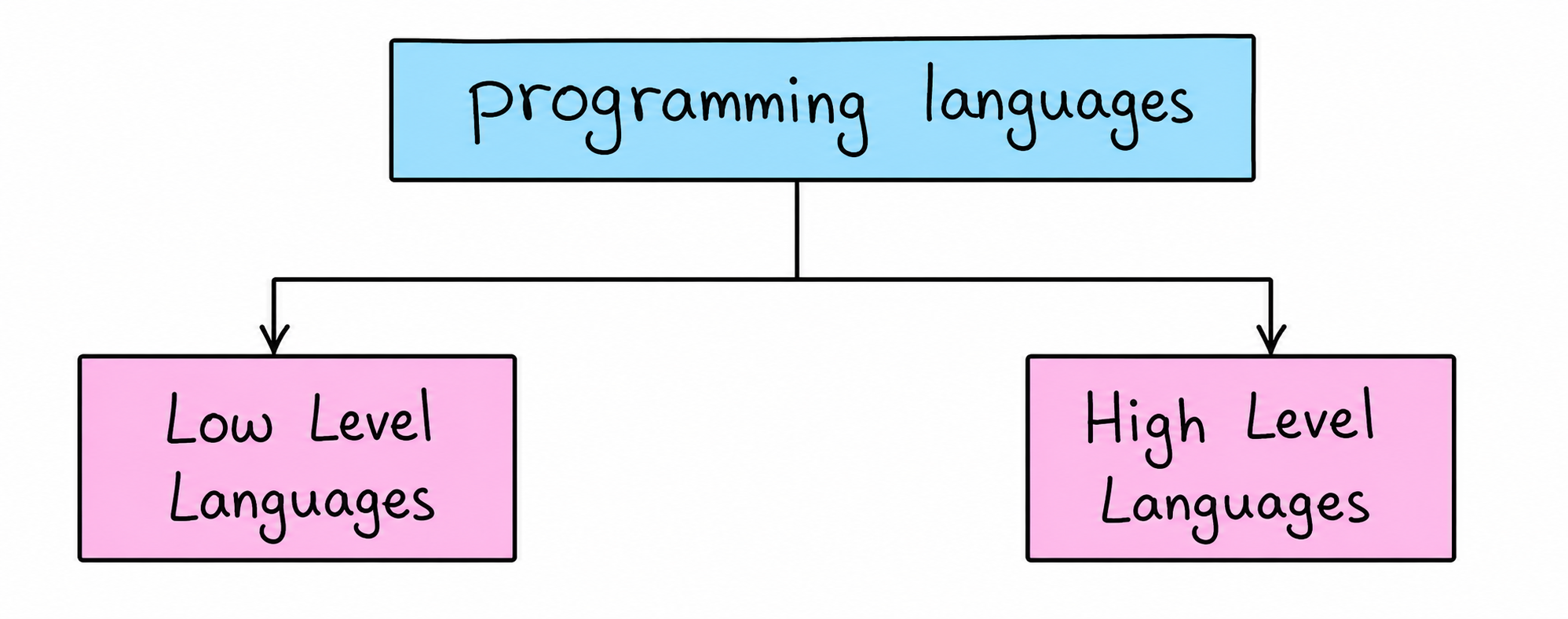
Programming languages are generally classified into two main categories based on how closely they interact with computer hardware and how easy they are for humans to understand:
- Low-Level Languages: These languages are very close to the hardware and provide minimal abstraction. They include machine language and assembly language. While they offer high performance and direct control over the system, they are difficult to write, understand, and maintain.
- High-Level Languages: These languages are designed to be user-friendly and closer to human language. Examples include Python, Java, and C++. They are easier to read, write, and debug, making them ideal for developing modern software applications.
In conclusion, programming languages are the foundation of software development. They enable developers to turn ideas into functional programs and play a crucial role in shaping the technology we use every day.
Types of Programming Languages
Programming languages are used to communicate instructions to a computer. They are broadly classified based on their level of abstraction.
1. Low-Level Languages
Low-level languages are closer to machine hardware and are difficult for humans to understand. These languages provide high performance and direct control over hardware.
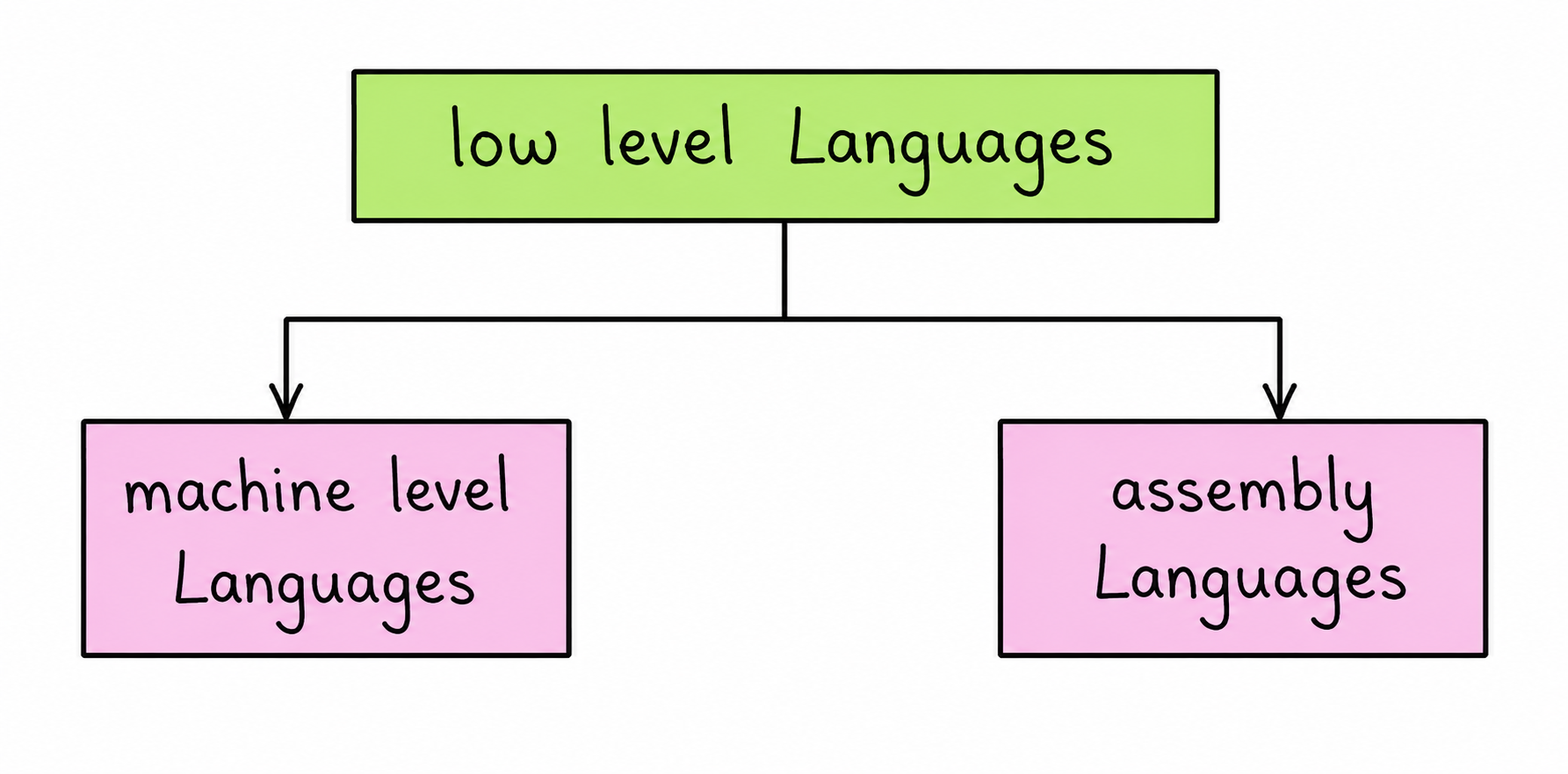
Low-level languages are closer to machine hardware and provide better control over system resources.
- Machine Language: Written in binary (0s and 1s), directly executed by CPU.
- Assembly Language: Uses mnemonics and requires an assembler to convert into machine code.
- Machine Language: Binary code (0s and 1s)
- Assembly Language: Uses symbolic instructions like ADD, MOV
2. High-Level Languages
High-level languages are easy to read, write, and understand. They are closer to human language and widely used for application development.
- Python
- Java
- C++
- JavaScript
3. Middle-Level Languages
Middle-level languages combine features of both low-level and high-level languages. They provide flexibility and performance.
- C Language
Language Translators
Computers only understand machine language, so translators are used to convert programming code into machine-readable form.
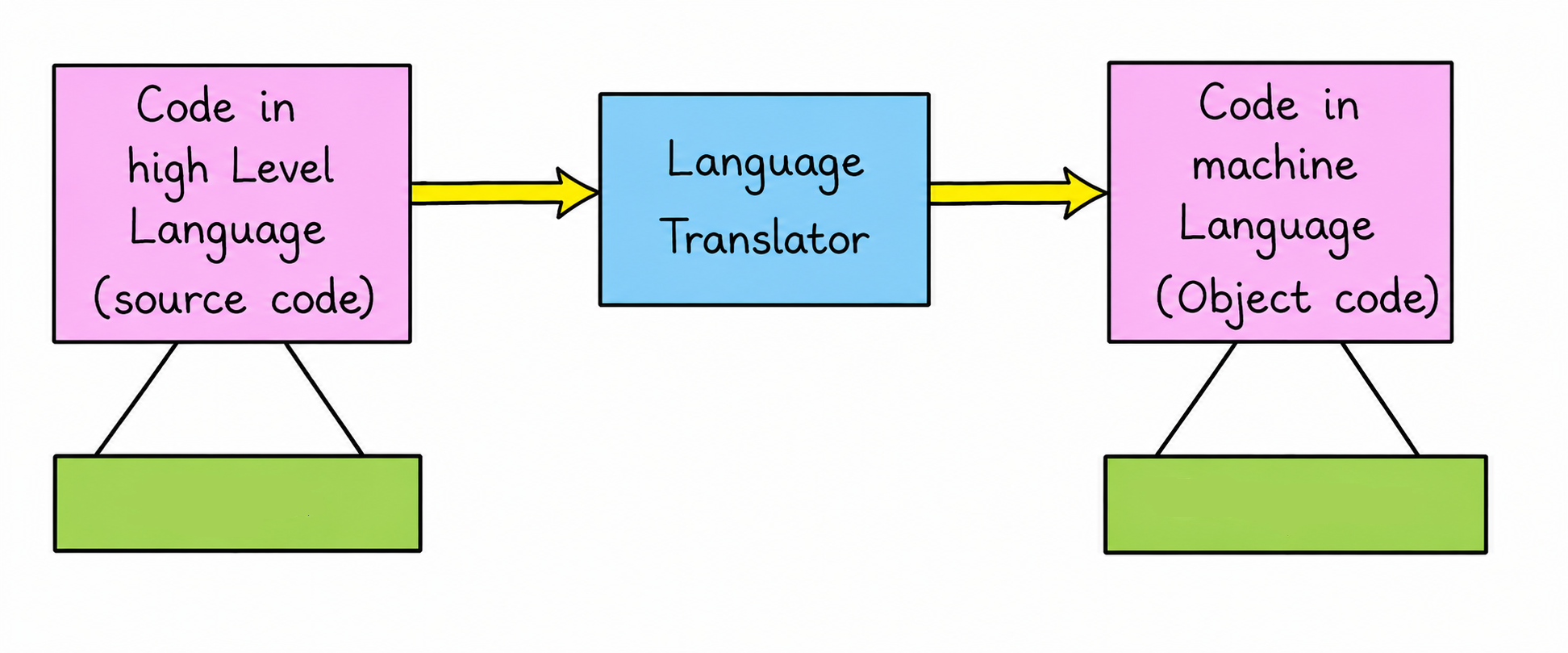
A language translator is a system software that converts source code into machine code so that a computer can execute it.
It acts as a bridge between human-readable code and machine-executable instructions.
Types of Language Translators
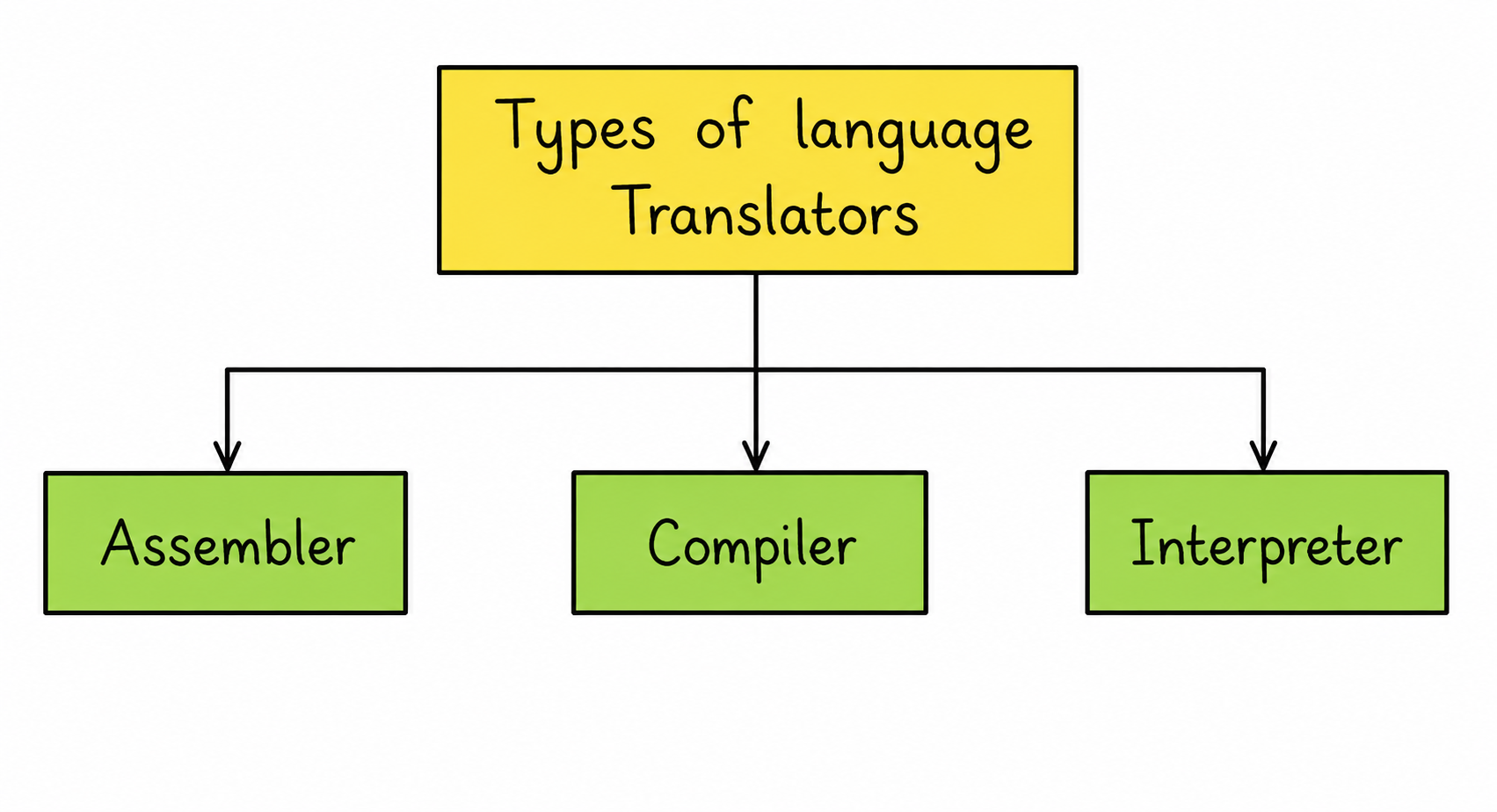
- Assembler – Converts assembly language into machine code.
- Compiler – Converts entire high-level program into machine code.
- Interpreter – Converts and executes code line by line.
1. Compiler
A compiler converts the entire program into machine code at once before execution. It checks errors and generates an executable file.
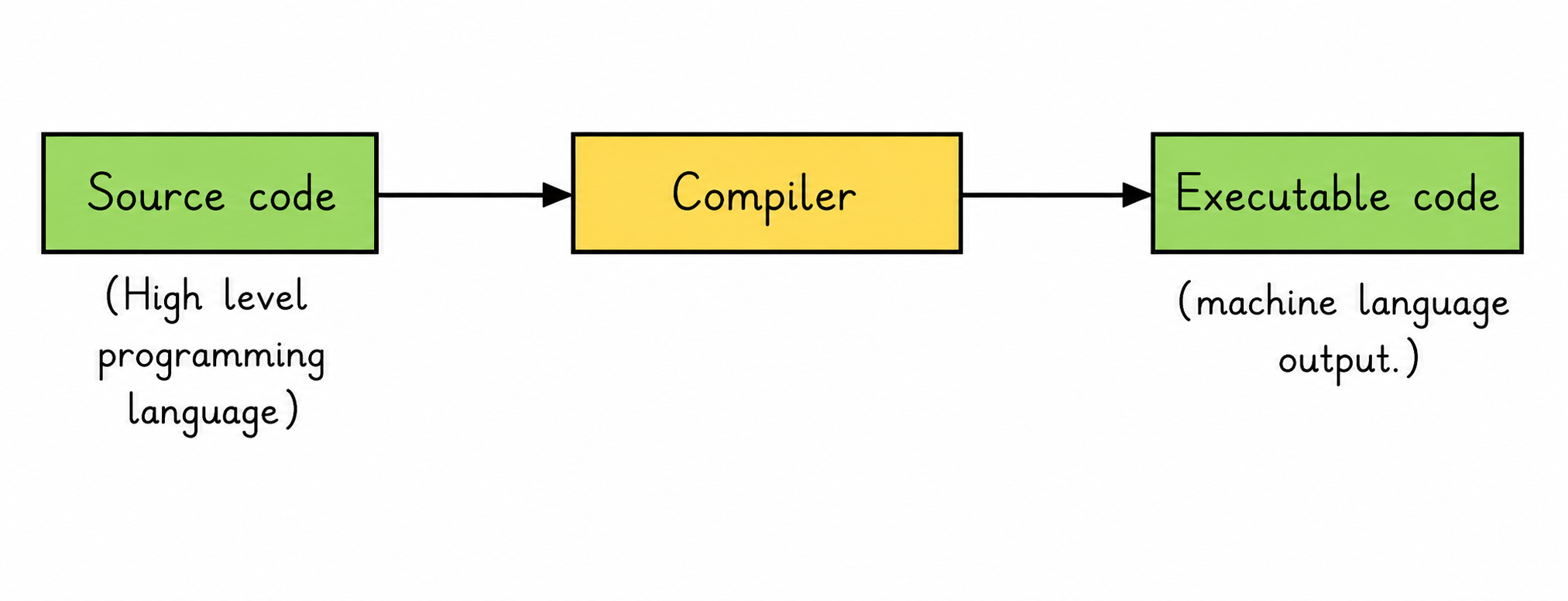
A compiler translates the entire program written in a high-level language into machine code at once.
- Faster execution after compilation
- Errors are shown after complete compilation
Features of Compiler
- Fast execution after compilation
- Detects errors before execution
- Generates object code
2. Interpreter
An interpreter translates and executes code line by line. It does not create a separate executable file.
Interpreter
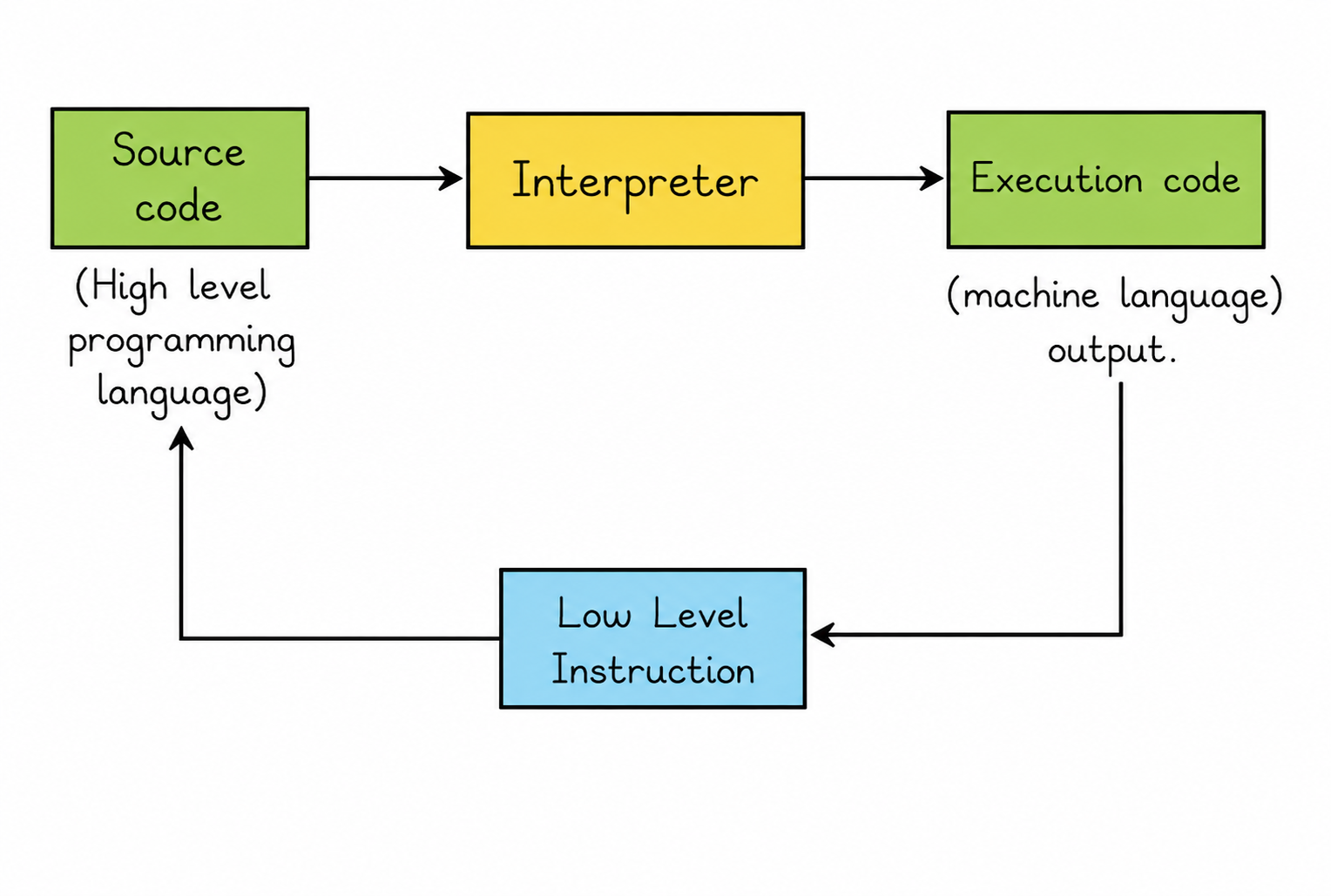
An interpreter translates high-level language into machine code line by line.
- Slower execution
- Errors detected line by line
Features of Interpreter
- Easy debugging
- Slower execution
- No object code generated
3. Assembler
An assembler converts assembly language into machine code. It is used for low-level programming.
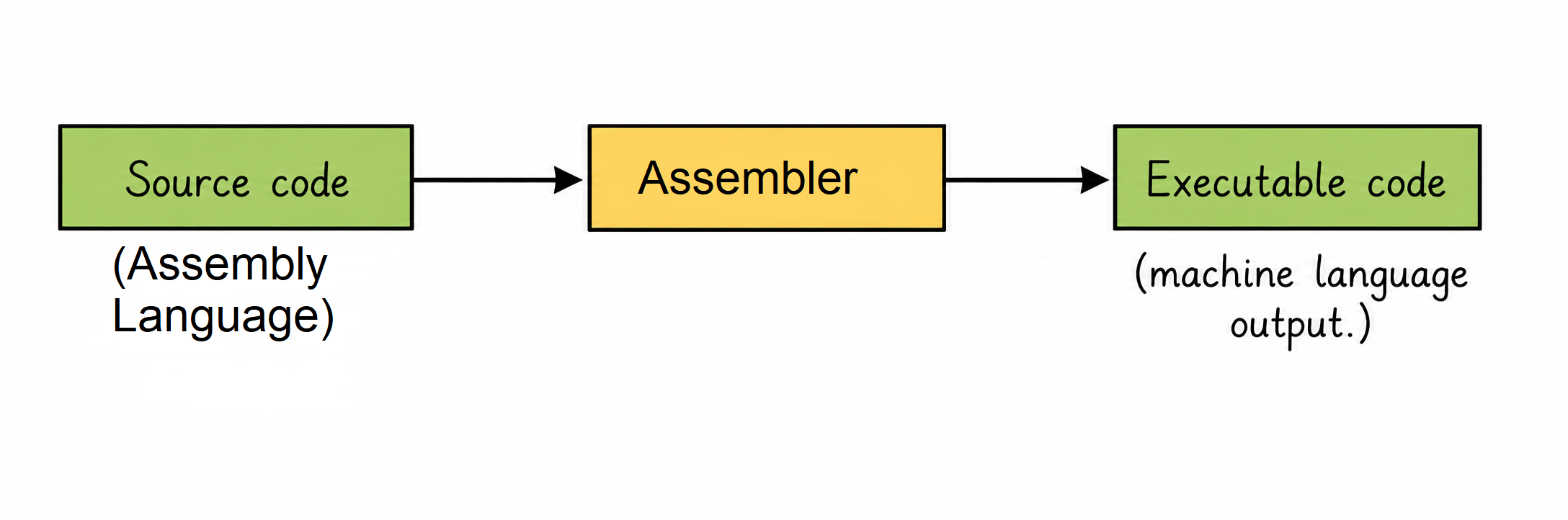
An assembler is a translator that converts assembly language into machine language.
It takes source code written in assembly language and produces executable machine code.
Features of Assembler
- Works with assembly language
- Fast and efficient
- Hardware-specific
Difference Between Compiler and Interpreter
Both compilers and interpreters are language processing tools used to convert high-level programming code into machine-understandable instructions. However, they work in different ways and are suited for different development needs. The table below highlights their key differences in a clear and structured manner.
| Basis of Comparison | Compiler | Interpreter |
|---|---|---|
| Definition | A compiler is a program that translates the entire source code into machine code in one go before execution. | An interpreter is a program that translates and executes code line by line at runtime. |
| Translation Method | It processes the whole program at once and generates a complete executable file. | It processes one statement at a time and executes it immediately without creating a separate executable. |
| Execution Speed | Faster execution since the entire code is already compiled into machine language. | Slower execution because each line is translated during runtime. |
| Error Detection | Displays all errors after the complete compilation process, making debugging slightly more complex. | Stops execution and reports errors immediately when encountered, making debugging easier. |
| Memory Usage | Requires more memory as it generates object code or executable files. | Uses less memory since it does not store compiled code permanently. |
| Examples | Commonly used in languages like C and C++. | Commonly used in languages like Python and JavaScript. |
| Portability | Compiled code is platform-dependent and may not run on different systems without recompilation. | Interpreted code is generally more portable across platforms with the appropriate interpreter. |
| Development Time | Takes longer initially due to full compilation but runs faster afterward. | Requires less initial time as execution starts immediately without full compilation. |
In summary, compilers are best suited for applications where performance is critical, while interpreters are ideal for development environments where flexibility and ease of debugging are more important.
Advantages of Programming Tools
- Improves development speed
- Reduces coding errors
- Provides debugging support
- Enhances productivity
Limitations
- Learning curve for beginners
- Some tools require high system resources
- Dependency on software updates
Conclusion
Programming tools, languages, and translators are essential for software development. They help developers write efficient code and convert it into machine-understandable form. Understanding these concepts is important for every computer science student.