Introduction to Problem Solving
Problem solving is one of the most important skills in computer science, programming, education, and everyday life. Every task we perform involves identifying a challenge, understanding its causes, finding possible solutions, and selecting the most suitable approach. In the field of computing, problem solving serves as the foundation for developing software, applications, websites, and intelligent systems.
Before writing any program, a programmer must clearly understand the problem. A computer can only execute instructions that are provided to it. Therefore, if the problem is not analyzed correctly, even the most advanced programming language cannot produce the desired results. Effective problem solving helps developers create efficient, reliable, and user-friendly software solutions.
Problem solving is a systematic process that involves identifying a problem, gathering information, analyzing possible solutions, implementing the best solution, and evaluating the results. This structured approach minimizes errors and increases the chances of success.
The diagram above represents the major stages involved in the problem-solving process. Each stage contributes to creating a logical and effective solution. Instead of directly jumping into coding, programmers follow these steps to ensure that the final program works correctly and efficiently.
What is Problem Solving?
Problem solving is the process of identifying a problem, understanding its requirements, designing a solution, and implementing that solution to achieve a desired outcome. In programming, problem solving refers to transforming a real-world problem into a sequence of logical instructions that a computer can execute.
For example, suppose a school wants to calculate the percentage of students automatically. Instead of manually calculating percentages for hundreds of students, a programmer can create a software application that performs the calculations instantly. The process of understanding the requirement and designing a solution is known as problem solving.
Why is Problem Solving Important?
Problem solving is essential because it enables individuals and organizations to overcome challenges effectively. In software development, proper problem solving helps developers create optimized applications, reduce errors, save development time, and improve overall system performance.
- Helps in understanding complex situations.
- Improves logical and analytical thinking.
- Reduces development errors.
- Increases efficiency and productivity.
- Supports better decision-making.
- Creates structured and maintainable solutions.
- Enhances programming skills.
Characteristics of a Good Problem Solver
A good problem solver possesses several important qualities that help in identifying and resolving issues efficiently. These characteristics are valuable not only in programming but also in academic and professional environments.
- Strong analytical thinking.
- Logical reasoning ability.
- Patience and persistence.
- Attention to detail.
- Creativity in finding solutions.
- Ability to evaluate alternatives.
- Continuous learning mindset.
Steps of Problem Solving
Problem solving follows a systematic sequence of activities. Each step contributes to achieving an accurate and effective solution.
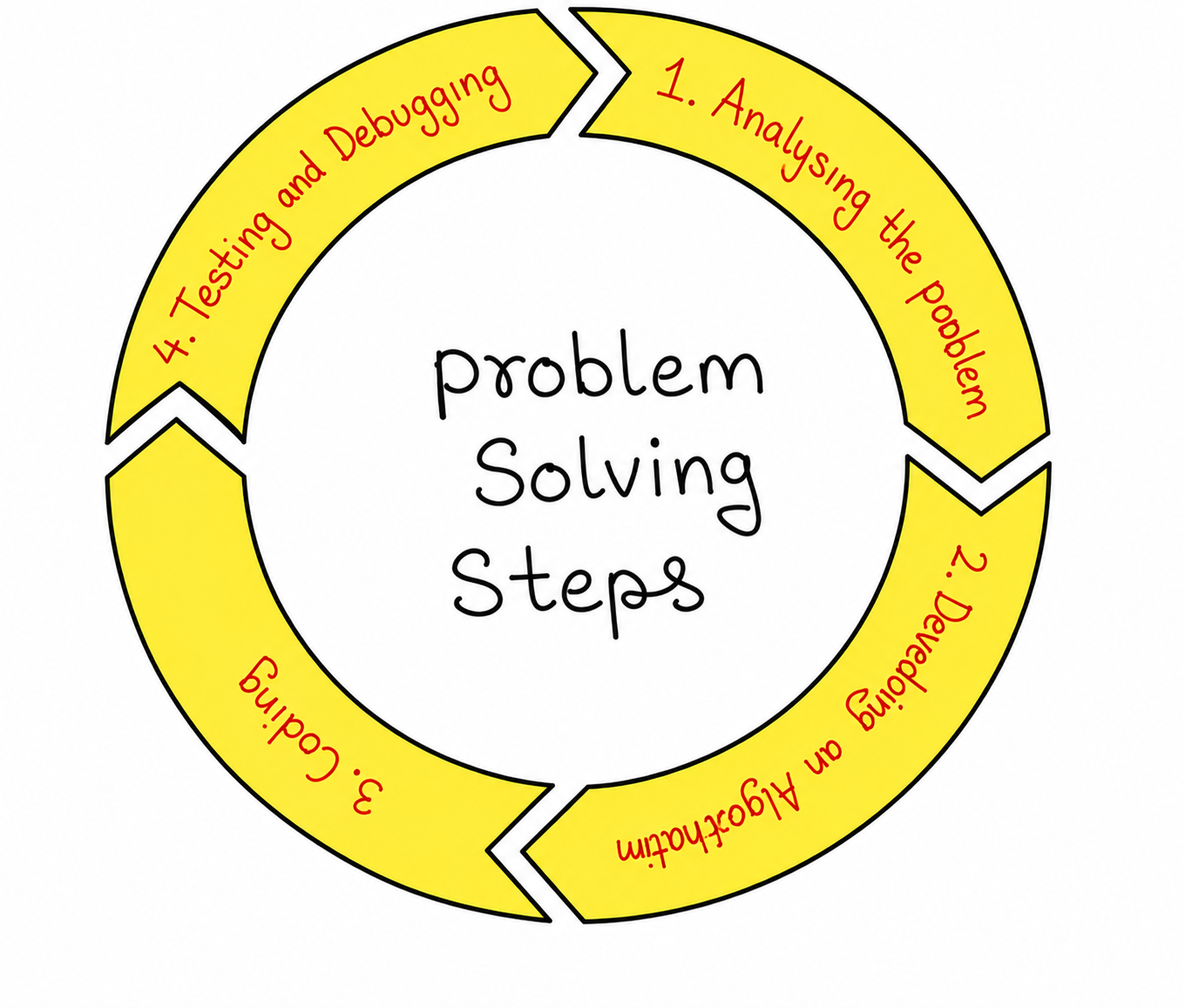
1. Analyzing the Problem
The first step is understanding the problem completely. A programmer must determine what needs to be accomplished, what inputs are available, and what outputs are expected. Without proper analysis, the solution may fail to meet requirements.
Questions commonly asked during analysis include:
- What is the problem?
- What are the inputs?
- What outputs are required?
- What constraints exist?
- Who will use the solution?
2. Developing an Algorithm
An algorithm is a step-by-step procedure used to solve a problem. It provides a logical sequence of instructions that can later be converted into a program. Algorithms help programmers visualize the solution before writing actual code.
For example, an algorithm to find the largest number among three numbers may involve comparing values one by one until the largest value is identified.
3. Coding
Once the algorithm is prepared, the next step is converting it into a programming language such as Python, Java, C++, or JavaScript. This process is known as coding.
The quality of code depends heavily on how well the problem has been analyzed and how effectively the algorithm has been designed.
4. Testing and Debugging
Testing ensures that the program works correctly under different conditions. Debugging is the process of identifying and fixing errors within the code.
Errors may occur due to incorrect logic, syntax mistakes, or unexpected user inputs. Proper testing helps improve software reliability and performance.
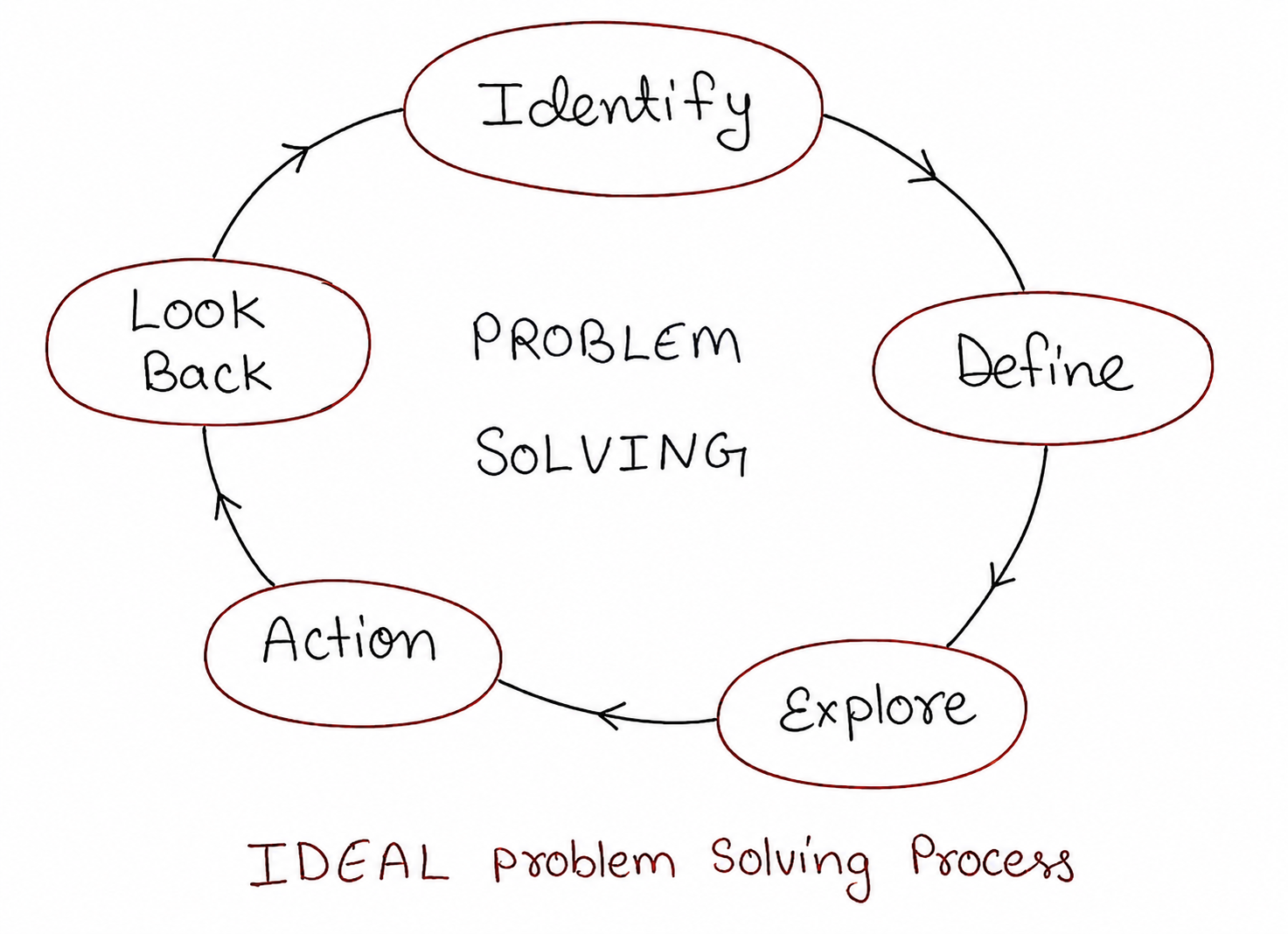
The ideal problem-solving cycle begins with identifying the problem, defining its scope, exploring possible solutions, taking action, and reviewing the results. This continuous cycle helps improve future solutions and supports continuous learning.
Ideal Problem Solving Process
Identify
The first step is identifying the actual problem. Many failures occur because people attempt to solve symptoms rather than the root cause. Proper identification ensures that efforts are focused on the real issue.
Define
After identifying the issue, it must be clearly defined. A precise problem statement helps everyone involved understand the objective and expected outcome.
Explore
During this phase, multiple solutions are examined. Brainstorming, research, and discussion help generate possible approaches to solving the problem.
Action
The selected solution is implemented during the action phase. Proper planning and execution are necessary to ensure successful implementation.
Look Back
After implementation, results are reviewed to determine whether the solution achieved the desired objectives. Lessons learned can be applied to future problems.
Problem Solving Techniques
Different techniques can be used depending on the nature and complexity of the problem.
Trial and Error
This method involves trying different solutions until the correct one is found. Although simple, it may not always be efficient for complex problems.
Divide and Conquer
Large problems are divided into smaller, manageable sub-problems. Each sub-problem is solved individually, and the results are combined to form the final solution.
Brainstorming
Brainstorming encourages generating multiple ideas without immediate evaluation. It is useful for finding creative solutions.
Working Backward
This approach starts from the desired outcome and works backward to determine the necessary steps.
Pattern Recognition
Identifying patterns in similar problems can help develop efficient solutions quickly.
Role of Algorithms in Problem Solving
Algorithms play a crucial role in programming because they provide a clear roadmap for solving problems. A well-designed algorithm improves efficiency, reduces errors, and makes code easier to maintain.
Characteristics of a good algorithm include:
- Clearly defined inputs and outputs.
- Finite number of steps.
- Logical sequence of operations.
- Efficiency in execution.
- Easy to understand and modify.
Example of Problem Solving in Programming
Consider a problem where a user wants to calculate the average of five numbers.
Problem Analysis
- Input: Five numbers
- Process: Add all numbers and divide by five
- Output: Average value
Algorithm
- Start
- Input five numbers
- Add all numbers
- Divide sum by 5
- Display average
- Stop
This simple example demonstrates how a real-world requirement is transformed into a structured solution before coding.
Benefits of Problem Solving in Programming
- Improves logical thinking.
- Enhances coding efficiency.
- Reduces debugging time.
- Creates scalable applications.
- Supports teamwork and collaboration.
- Improves software quality.
- Encourages innovation and creativity.
Common Mistakes During Problem Solving
- Starting coding without analysis.
- Ignoring user requirements.
- Choosing inefficient algorithms.
- Skipping testing procedures.
- Not documenting the solution.
- Failing to evaluate results.
Conclusion
Problem solving is the foundation of programming and software development. Every successful application begins with a clear understanding of the problem and a structured plan for solving it. By following systematic steps such as analysis, algorithm development, coding, testing, and evaluation, programmers can create reliable and efficient software solutions.
Developing strong problem-solving skills not only improves programming ability but also enhances decision-making, critical thinking, and creativity. Whether building a simple calculator or a complex enterprise application, effective problem solving remains the key to success in the world of technology.