Transmission Modes in Computer Network
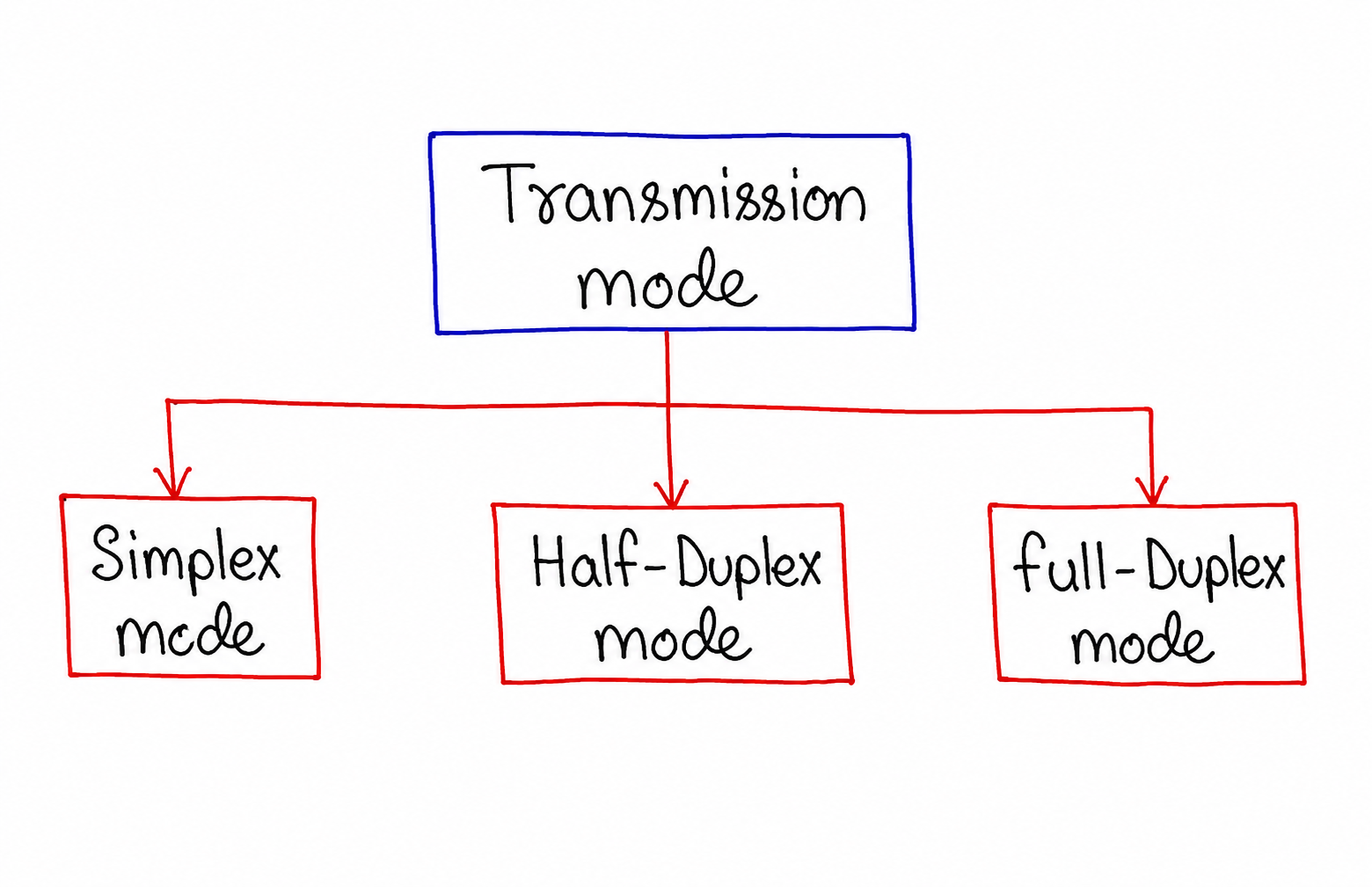
Transmission mode refers to the direction in which data flows between two devices in a network. It defines how communication takes place between sender and receiver. There are three main types of transmission modes: Simplex, Half-Duplex, and Full-Duplex.
1. Simplex Mode
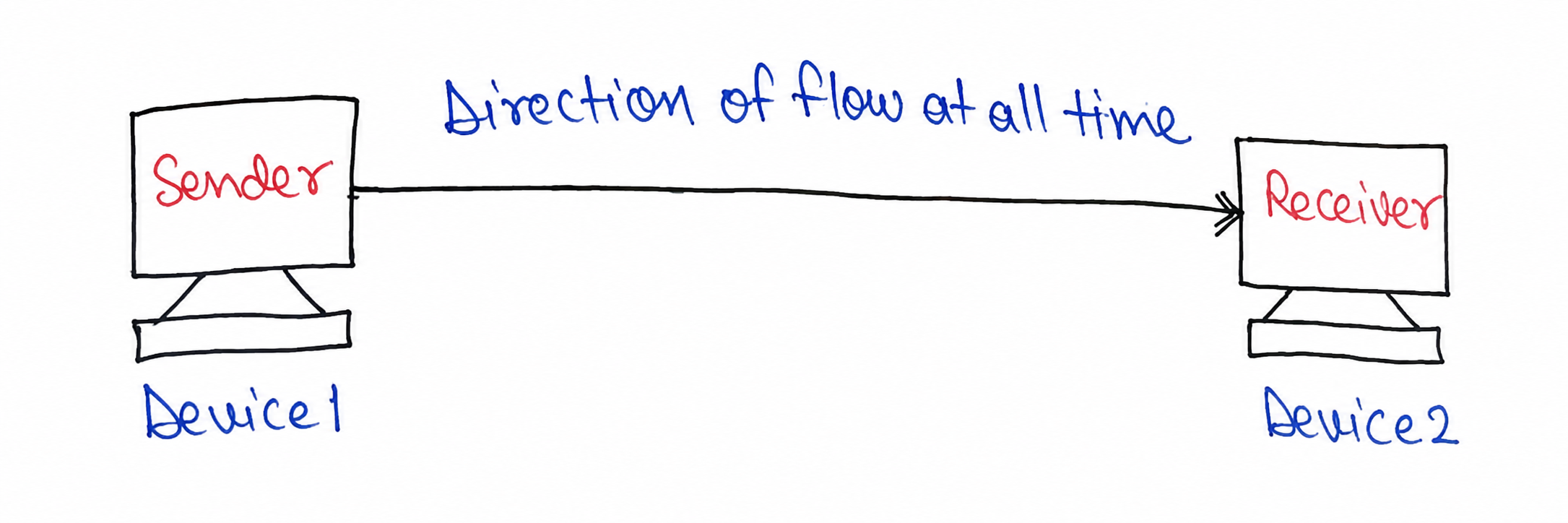
In Simplex transmission mode, communication takes place in only one direction. One device acts as the sender (transmitter), while the other acts only as the receiver. There is no possibility of sending data back from the receiver to the sender.
This is the simplest form of communication because data flows in a single direction only. The entire bandwidth of the communication channel is utilized for transmitting data, which makes it efficient for one-way communication systems.
Common examples of Simplex communication include a keyboard sending data to a computer and television broadcasting, where signals are transmitted from the source to the audience without any feedback.
Advantages of Simplex Mode
- Simple and easy to implement: Requires less complex design.
- No data collision: Only one device transmits data.
- Full bandwidth utilization: Entire channel is used in one direction.
- Cost-effective: Lower hardware and maintenance cost.
- Best for broadcasting: Suitable where feedback is not required.
Disadvantages of Simplex Mode
- No feedback: Receiver cannot respond to the sender.
- Error detection is difficult: No confirmation of received data.
- Not suitable for interaction: Cannot be used for two-way communication.
- Limited modern use: Rarely used in advanced communication systems.
- No control mechanism: Sender cannot adjust transmission based on receiver.
2. Half-Duplex Mode
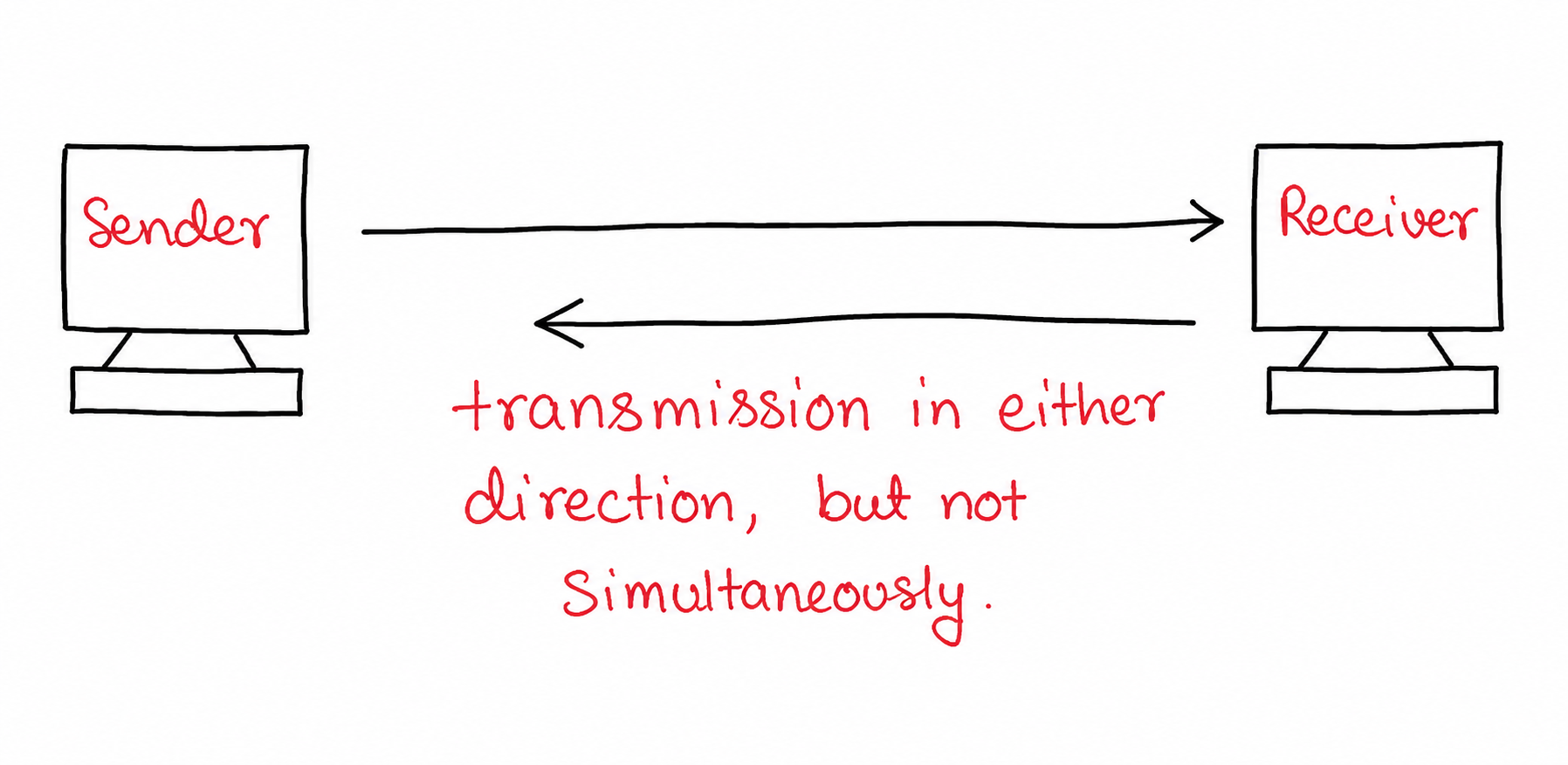
In Half-Duplex transmission mode, communication can occur in both directions, but not at the same time. This means that a device can either send data or receive data at a given moment, but it cannot perform both actions simultaneously. Devices take turns to communicate, making this mode more flexible than Simplex communication.
In this mode, when one device is transmitting data, the other device must wait until the transmission is complete before sending its own data. This switching between sending and receiving introduces a slight delay, but still allows two-way communication.
A common real-life example of Half-Duplex communication is a walkie-talkie. When one person speaks, the other person must wait and listen. Only after the first person finishes speaking can the second person respond. This "push-to-talk" mechanism ensures that only one device transmits at a time.
Half-Duplex mode is widely used in communication systems where full-time two-way communication is not necessary, but interaction between devices is still required. It provides a balance between cost and performance.
Advantages of Half-Duplex Mode
- Two-way communication: Devices can both send and receive data.
- Better than Simplex: Allows interaction between sender and receiver.
- Cost-effective: Less expensive compared to full-duplex systems.
- Efficient for moderate use: Suitable for systems where simultaneous communication is not required.
- Reduced complexity: Simpler than full-duplex communication systems.
Disadvantages of Half-Duplex Mode
- Time delay: Communication is slower due to switching between send and receive modes.
- Bandwidth not fully utilized: Channel remains idle during switching.
- Possible collisions: If control mechanisms fail, data collision may occur.
- Lower performance: Slower compared to full-duplex communication.
- Not suitable for real-time systems: Delay makes it unsuitable for high-speed real-time communication.
3. Full-Duplex Mode
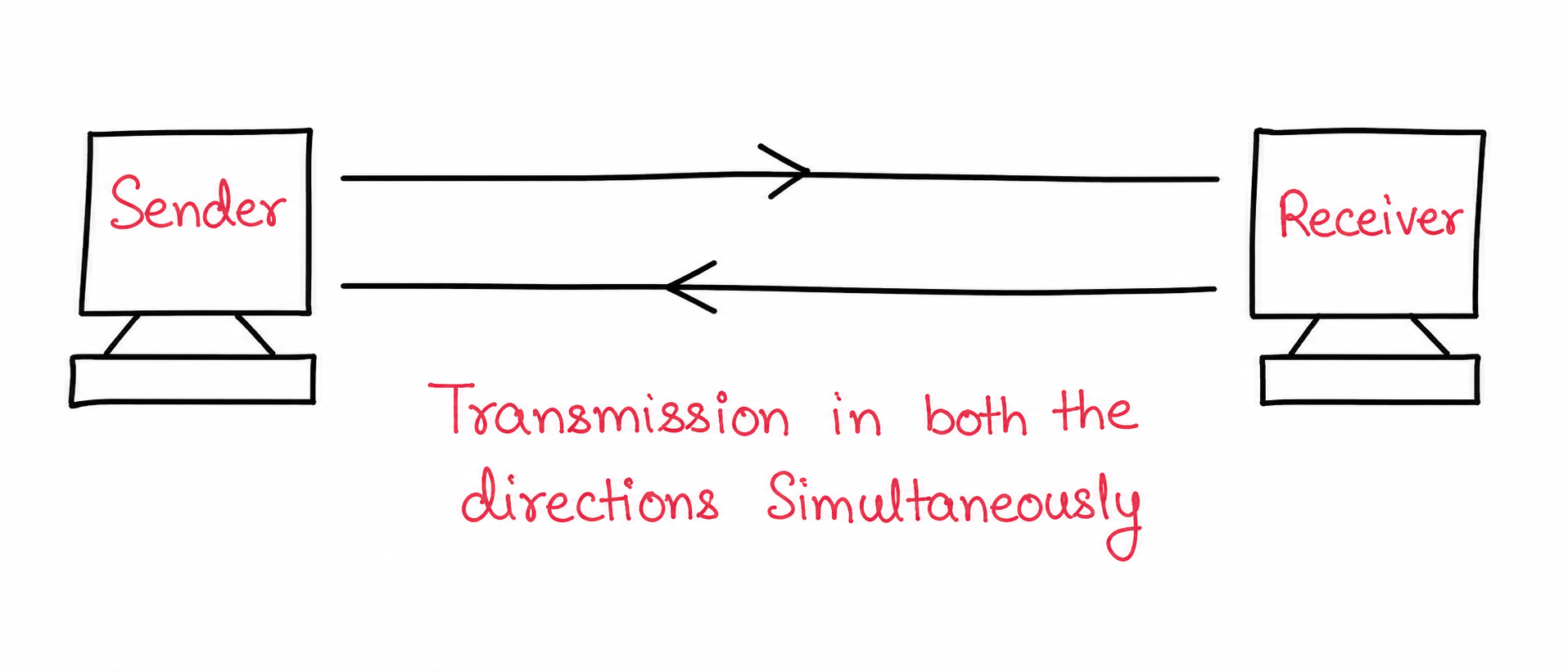
In Full-Duplex transmission mode, communication takes place in both directions at the same time. This means that both devices involved in communication can send and receive data simultaneously without waiting for the other device to finish.
Unlike Half-Duplex mode, there is no need to switch between sending and receiving operations. Both ends of the communication link remain active, which significantly improves the speed and efficiency of data transmission. This is possible because the communication channel is divided into two separate paths or uses advanced techniques that allow simultaneous data flow.
A common real-world example of Full-Duplex communication is a telephone conversation. In a phone call, both people can speak and listen at the same time without interruption. Similarly, modern computer networks and internet communications also use Full-Duplex mode to achieve high-speed data transfer.
Full-Duplex mode is widely used in systems where continuous and real-time communication is required. It provides maximum performance and ensures smooth data exchange between devices.
Advantages of Full-Duplex Mode
- Simultaneous communication: Data can be sent and received at the same time.
- High speed: No waiting time, resulting in faster communication.
- Efficient bandwidth usage: Both channels are utilized effectively.
- No collisions: Separate paths eliminate chances of data collision.
- High performance: Ideal for real-time and high-speed applications.
- Reliable communication: Continuous data flow improves reliability.
Disadvantages of Full-Duplex Mode
- Higher cost: Requires advanced hardware and infrastructure.
- Complex design: Implementation is more complicated than other modes.
- More power consumption: Continuous transmission requires more energy.
- Advanced channel requirement: Needs better communication medium and technology.
- Maintenance difficulty: Troubleshooting and maintenance can be complex.
Difference Between Transmission Modes
Transmission modes define the direction of data flow between two communicating devices. The three main types are Simplex, Half-Duplex, and Full-Duplex. Each mode differs in terms of communication direction, speed, efficiency, and practical usage. The comparison below highlights these differences in a clear and detailed manner.
| Feature | Simplex | Half-Duplex | Full-Duplex |
|---|---|---|---|
| Direction of Communication | Data flows in only one direction. One device always sends, the other only receives. | Data flows in both directions, but only one direction at a time. | Data flows in both directions simultaneously without interruption. |
| Working Mechanism | Only sender is active; receiver remains passive. | Devices take turns to transmit and receive data. | Both devices transmit and receive data at the same time. |
| Speed | Fast for one-way transmission, but limited overall communication. | Moderate speed due to switching between directions. | Very high speed as there is no waiting time. |
| Efficiency | Low efficiency due to lack of feedback and interaction. | Medium efficiency; better than simplex but still has delays. | High efficiency with continuous data exchange. |
| Bandwidth Utilization | Fully used in one direction only. | Partially utilized due to switching delays. | Fully utilized in both directions. |
| Cost | Low cost due to simple design. | Moderate cost. | High cost due to complex hardware and setup. |
| Complexity | Very simple system design. | Moderately complex. | Highly complex system. |
| Examples | Keyboard, Television broadcasting | Walkie-Talkie, CB radio | Telephone, Internet, Video calling |
Summary
In summary, Simplex mode is best suited for one-way communication systems where no response is needed. Half-Duplex mode allows two-way communication but introduces delay due to turn-taking. Full-Duplex mode is the most advanced and efficient, enabling simultaneous communication, making it ideal for modern high-speed networks and real-time applications.
Conclusion
Transmission modes define how data travels between devices. Simplex mode is useful for one-way communication, Half-Duplex supports two-way communication with some delay, and Full-Duplex provides the most efficient and fastest communication. Selecting the right mode depends on system requirements, cost, and performance needs.