Overall Database Structure
The overall database structure in DBMS describes the complete internal design of a Database Management System and explains how different components interact with each other to store, manage, and retrieve data in an organized way.
A DBMS is not just a simple data storage system. It is a powerful software environment that manages data efficiently, ensures security, and provides controlled access to multiple users at the same time. It acts as a bridge between users and the physical storage of data.
In a database system, users never directly interact with the physical storage. Instead, they send requests through applications or query languages, and the DBMS internally processes those requests using different system modules.
The overall database structure is designed in layers so that each component performs a specific task. This layered approach improves performance, increases security, and makes the system easier to manage and scale.
The architecture also ensures data independence, meaning users do not need to worry about how or where data is stored physically. They only focus on retrieving or manipulating data through queries.
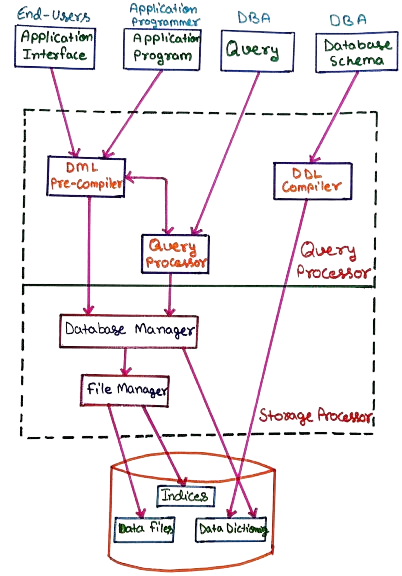
Main Components of Overall Database Structure
The DBMS architecture consists of several important components that work together to process user requests and manage data efficiently.
- Users
- Query Processor
- Database Manager
- Storage Manager
- File Manager
- Data Dictionary
Types of Users in DBMS
A Database Management System (DBMS) is designed to serve different types of users according to their roles and requirements. Each user interacts with the database in a different way and has a specific level of access, responsibility, and control over the data.
Understanding the types of users in DBMS is very important because it helps in knowing how data is accessed, modified, and managed securely within a database environment. The DBMS provides a controlled environment so that users can perform their tasks without directly handling complex internal operations.
1. End Users
End users are the most common users of a database system. They interact with the database indirectly through applications such as mobile apps, web portals, or desktop software. End users are not concerned with how data is stored or processed internally.
Their main focus is to retrieve or update information in a simple and user-friendly way. The DBMS handles all internal processing in the background, making it easy for end users to work with data without technical knowledge.
For example, in a college system, students checking their exam results, attendance, or fees details are considered end users. Similarly, in banking systems, customers checking their account balance or transaction history are also end users.
End users are further divided into different categories such as naive users and casual users depending on how frequently and deeply they interact with the system.
2. Application Programmers
Application programmers are the developers who create software applications that interact with the database system. They play a very important role in designing the interface between users and the DBMS.
These programmers use programming languages like Java, Python, PHP, C#, or JavaScript along with database query languages such as SQL to build applications that store and retrieve data efficiently.
They write code that includes database operations such as inserting data, updating records, deleting entries, and retrieving information. However, they do not directly manage the database structure or system-level configurations.
For example, in an online shopping system, application programmers develop features like product listing, cart management, order processing, and payment integration which all interact with the database behind the scenes.
3. Database Administrator (DBA)
The Database Administrator (DBA) is one of the most important roles in a DBMS environment. The DBA is responsible for the overall management, control, and maintenance of the database system.
The DBA ensures that the database runs efficiently, securely, and without any interruption. This role requires advanced technical knowledge and a deep understanding of database architecture and performance tuning.
Key responsibilities of a DBA include managing user access, defining database structure, monitoring performance, and ensuring data security. The DBA also handles backup and recovery operations in case of system failure or data loss.
In addition, the DBA uses Data Definition Language (DDL) commands to create and modify database structures such as tables, indexes, and relationships. They also ensure that data integrity rules and constraints are properly implemented.
For example, in a banking system, the DBA ensures that all customer data is secure, transactions are processed correctly, and system performance remains stable even under heavy load.
Summary of User Types
In conclusion, DBMS supports multiple types of users including end users, application programmers, and database administrators. Each user type plays a unique role in ensuring smooth operation, efficient data handling, and secure management of the database system.
Query Processor
The Query Processor is one of the most important components of a Database Management System (DBMS). It is responsible for handling user queries and converting them into a form that the database system can understand, process, and execute efficiently.
In simple terms, whenever a user writes a query (for example in SQL), the query processor acts as a translator. It takes the high-level query written by the user and transforms it into low-level instructions that the internal database engine can execute to retrieve or modify data.
The main goal of the query processor is to ensure that database operations are performed in an optimized and efficient manner. It also helps in reducing processing time and improving system performance by selecting the best possible execution strategy for a query.
The query processor plays a very important role in hiding the complexity of the database system from users. Users only write simple queries, while the query processor handles all internal operations such as parsing, optimization, and execution.
Working of Query Processor
When a user submits a query to the DBMS, the query processor performs several internal steps. First, it checks the correctness of the query, then converts it into an internal form, optimizes it for better performance, and finally sends it to the database engine for execution.
This entire process ensures that the system uses minimum resources while providing maximum efficiency in retrieving or updating data.
Main Components of Query Processor
The query processor is divided into different modules, and each module has a specific role in handling database queries.
- DML Compiler
- DDL Compiler
- Query Evaluation Engine
1. DML Compiler (Data Manipulation Language Compiler)
The DML Compiler is responsible for processing queries that manipulate data inside the database. These include operations such as INSERT, UPDATE, DELETE, and SELECT.
When a user writes a DML query, the compiler first checks the syntax and semantics of the query. After validation, it converts the query into an internal form that can be understood by the database system.
The DML compiler also works closely with the query optimizer to ensure that the query is executed in the most efficient way possible, reducing time and system resource usage.
2. DDL Compiler (Data Definition Language Compiler)
The DDL Compiler handles commands that define or modify the structure of the database. These commands include CREATE, ALTER, DROP, and TRUNCATE.
Unlike DML queries that deal with data, DDL queries deal with the schema or structure of the database. The DDL compiler processes these commands and updates the database catalog or metadata accordingly.
For example, when a new table is created, the DDL compiler ensures that the table structure is properly stored in the data dictionary so that the DBMS can recognize and manage it in future operations.
3. Query Evaluation Engine
The Query Evaluation Engine is responsible for executing the optimized query plan generated by the query processor. It acts as the final execution unit that interacts directly with the storage system to retrieve or modify data.
Once the query is optimized, the evaluation engine processes it step-by-step and fetches the required data from disk storage or memory. It then returns the final result to the user.
This component plays a crucial role in improving performance because it ensures that queries are executed in the most efficient sequence possible.
Importance of Query Processor
The query processor is essential for efficient database operations. Without it, users would need to directly interact with complex low-level storage operations, which is not practical.
It simplifies database usage, improves performance, ensures correctness of queries, and optimizes execution time. It also allows multiple users to access and manipulate data simultaneously without conflicts.
Conclusion
The query processor is a core part of DBMS architecture that bridges the gap between user queries and database execution. It ensures that all queries are processed, optimized, and executed efficiently, making the database system fast, reliable, and user-friendly.
Database Manager
The Database Manager is a core component of a Database Management System (DBMS) that is responsible for controlling and coordinating all database activities. It acts as the central control unit that ensures the smooth and efficient working of the entire database system.
In a DBMS environment, multiple users and applications access data simultaneously. The database manager ensures that all these operations are performed in a proper, secure, and organized manner without any conflict or data inconsistency.
It acts as an interface between the query processor and the storage system. Whenever a query is executed, the database manager takes responsibility for processing it in a controlled and reliable way.
One of its main objectives is to maintain the integrity and consistency of the database even when multiple users are accessing or modifying data at the same time.
Working of Database Manager
When a request is received from the query processor, the database manager first checks whether the user is authorized to perform the operation. After verification, it coordinates with other system components like the file manager and storage manager to execute the request.
It ensures that every operation follows the rules and constraints defined in the database system. If any issue occurs during processing, it handles recovery and rollback mechanisms to maintain system stability.
Major Responsibilities of Database Manager
The database manager performs several important tasks to maintain the smooth functioning of the DBMS.
- Transaction Management – It ensures that all database transactions are executed completely and correctly. If any failure occurs, it rolls back the changes to maintain consistency.
- Data Consistency – It maintains the correctness and integrity of data by enforcing rules and constraints defined in the database.
- Concurrency Control – It manages simultaneous access of data by multiple users and ensures that no conflicts occur during read or write operations.
- Authorization Control – It checks user permissions and ensures that only authorized users can access or modify specific data.
- Error Handling and Recovery – It detects system failures and helps in recovering the database to a stable state using backup and recovery techniques.
Role in Multi-User Environment
In modern database systems, many users access the database at the same time. The database manager plays a very important role in managing this multi-user environment by coordinating access and ensuring that operations do not interfere with each other.
It uses concurrency control techniques such as locking and scheduling to ensure that data remains accurate even when multiple transactions are executed simultaneously.
Importance of Database Manager
The database manager is essential for maintaining the reliability, security, and efficiency of a DBMS. Without it, the database system would face issues like data corruption, inconsistent results, and unauthorized access.
It ensures that the database system runs smoothly, supports multiple users, and maintains high performance even under heavy load conditions.
Conclusion
The database manager is a critical component of DBMS architecture that controls transactions, ensures data consistency, manages concurrency, and maintains overall system stability. It plays a key role in making the database system secure, efficient, and reliable for real-world applications.
Storage Manager
The Storage Manager is an important component of a Database Management System (DBMS) that is responsible for managing how data is physically stored, organized, and retrieved from storage devices such as hard disks or SSDs.
It acts as a bridge between the logical view of data (what users see) and the physical storage of data (how data is actually stored in memory). The storage manager ensures that data is stored in an efficient, secure, and structured manner so that it can be accessed quickly whenever required.
In a DBMS, data is not stored randomly. Instead, it is carefully organized into different structures like files, indexes, and metadata. The storage manager controls all these structures and ensures smooth interaction between them.
Its main objective is to improve data access speed, reduce storage complexity, and maintain data integrity at the physical level.
Working of Storage Manager
Whenever a query is executed, the storage manager plays a key role in retrieving the required data from disk storage. It communicates with the file system and locates the exact position of data stored in memory.
It also handles data insertion, deletion, and modification by properly updating files and indexes. This ensures that the database remains consistent and updated at all times.
In addition, the storage manager optimizes data storage techniques to reduce disk input/output operations, which improves overall system performance.
Components Managed by Storage Manager
The storage manager controls and organizes several important database components that are essential for efficient data handling.
- Data Files – These are the actual files where database records are physically stored. All user data is kept in a structured format inside these files.
- Indexes – Indexes are special data structures that improve the speed of data retrieval. They help in quickly locating specific records without scanning the entire database.
- Metadata / Data Dictionary – This stores information about the database structure such as table names, column definitions, relationships, constraints, and user permissions.
Role of Storage Manager in DBMS
The storage manager plays a very important role in ensuring that data is stored efficiently and can be accessed quickly. It manages low-level storage operations that are hidden from users and applications.
It also ensures that data is organized in such a way that minimizes storage space and maximizes performance during query execution.
By managing files, indexes, and metadata properly, the storage manager supports fast data retrieval and smooth database operations.
Importance of Storage Manager
The storage manager is essential for the proper functioning of a DBMS because it directly controls how data is physically stored and accessed.
Without a storage manager, data retrieval would be slow, unorganized, and inefficient. It ensures faster access time, better storage utilization, and improved system performance.
Conclusion
The storage manager is a key component of DBMS architecture that handles physical data storage, manages files and indexes, and maintains metadata. It ensures that data is stored in an organized and optimized manner, making database operations fast, reliable, and efficient.
File Manager
The File Manager is an important component of a Database Management System (DBMS) that is responsible for handling the physical storage of data on disk. It works at a very low level and manages how database files are stored, organized, and accessed in secondary storage devices.
It interacts directly with the operating system to allocate disk space and manage file structures. The file manager ensures that data is stored efficiently and that storage space is used in an optimized way without unnecessary wastage.
Whenever data is inserted, updated, or deleted in a database, the file manager performs the required operations at the physical storage level. It helps in maintaining proper organization of files so that data can be accessed quickly and reliably.
It also plays a key role in improving system performance by reducing the complexity of direct disk operations and providing a structured way to manage database files.
Role of File Manager in DBMS
The file manager acts as a bridge between the database system and the operating system. It ensures that all file-related operations are handled efficiently without affecting the performance of the database.
It manages how data blocks are stored on disk, how they are retrieved, and how space is allocated or deallocated when data changes occur.
By handling these low-level operations, the file manager allows higher-level DBMS components to focus on query processing and data management.
Importance of File Manager
The file manager is essential because it directly controls physical storage operations. Without it, the DBMS would not be able to store or retrieve data efficiently from disk memory.
It improves data access speed, ensures proper storage allocation, and supports smooth interaction between the database and the operating system.
Data Dictionary
The Data Dictionary is a special and very important component of a DBMS that stores metadata (data about data). It contains detailed information about the structure, design, and organization of the entire database system.
It includes information such as table names, column definitions, data types, relationships between tables, constraints, indexes, and user permissions. In simple terms, it describes how the database is structured and how data is organized inside it.
The data dictionary is automatically maintained by the DBMS. Whenever any change is made in the database structure, such as creating a new table or modifying a column, the data dictionary is updated accordingly.
Contents of Data Dictionary
The data dictionary stores a wide range of information that helps in managing and understanding the database structure.
- Table definitions and structures
- Column names and data types
- Primary and foreign key relationships
- Constraints and rules
- Indexes and views
- User access permissions
Importance of Data Dictionary
The data dictionary plays a crucial role in DBMS as it provides a complete overview of the database system. It helps database administrators and developers understand how data is organized and how different components are related.
It also improves data consistency, supports database maintenance, and helps in query optimization by providing structural information to the DBMS.
Conclusion
Both the file manager and data dictionary are essential components of a DBMS. The file manager handles physical storage operations, while the data dictionary stores metadata about the database structure. Together, they ensure efficient data storage, easy management, and smooth database operations.
Working Flow of DBMS
- User sends a request through an application
- Query processor analyzes and converts the request
- Database manager checks permissions and rules
- Storage and file manager retrieve required data
- Final result is sent back to the user
Advantages of Overall Database Structure
- Improves data organization and management
- Ensures high level of data security
- Supports multiple users simultaneously
- Reduces data redundancy
- Provides data abstraction and independence
Conclusion
The overall database structure in DBMS provides a well-organized framework that helps in efficient data storage, processing, and retrieval. Its layered design ensures better performance, security, and scalability for modern applications.