Entity-Relationship (E-R) Model in DBMS
The Entity-Relationship (E-R) Model is a widely used conceptual modeling technique in Database Management Systems (DBMS) that helps in designing a database in a structured and visual form. It focuses on representing real-world objects, the characteristics of those objects, and the relationships that exist between them.
In simple terms, the E-R model acts as a blueprint of a database. Before creating actual tables in a database system, designers first use this model to understand how data will be stored, organized, and connected. It is especially useful in the early stages of database design because it reduces complexity and improves clarity.
The main idea behind the E-R model is to convert real-life scenarios into a graphical representation so that both technical and non-technical users can easily understand the structure of the database.
Meaning of Entity in DBMS
An entity refers to any real-world object, person, place, or concept that can be clearly identified and stored in a database. Each entity has a set of attributes that describe its properties.
Examples of entities:
- Student (in a college database)
- Employee (in an organization database)
- Product (in an e-commerce system)
- Course (in an academic system)
Each entity is usually represented using a rectangular box in an E-R diagram.
Basic Concepts of ER Model
The Entity-Relationship (ER) Model is built on a few fundamental concepts that help in representing data in a clear and structured manner. These basic concepts form the foundation of database design and are essential for understanding how real-world information is stored and organized in a DBMS.
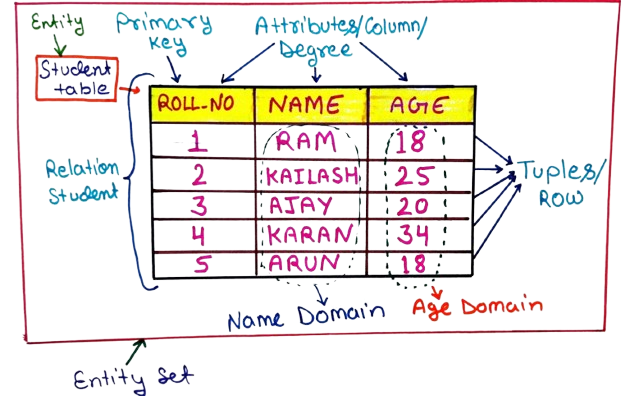
Entity
An entity refers to any real-world object, person, place, event, or concept that has a distinct and independent existence. It is something that can be easily identified and distinguished from other objects in the real world.
In a database context, an entity represents a real item about which data is stored. Each entity has a set of properties that describe it.
Examples of entities include:
- A Student in a college system
- An Employee in an organization
- A Book in a library database
- An Order in an online shopping system
Entities are usually represented using rectangular boxes in ER diagrams.
Entity Set
An entity set is a collection of similar types of entities that share the same structure and common attributes. In other words, it is a group of entities of the same type.
For example, all students in a university form an entity set called Student, and all employees in a company form an entity set called Employee.
Each entity in an entity set has the same attributes but different values. This makes it easier to manage and organize data in large systems.
Attributes
Attributes are the characteristics or properties that describe an entity. They provide detailed information about the entity and define its structure in a database.

For example, a Student entity may have attributes such as Name, Roll Number, Age, Course, and Contact Information.
Attributes help in uniquely identifying an entity and storing meaningful information about it.
Types of Attributes
Attributes in the ER model are classified into different types based on their structure, value nature, and dependency. Each type plays an important role in database design.
-
Simple Attribute:
A simple attribute is an attribute that cannot be further divided into smaller parts. It represents a single value and is atomic in nature.
Example: Age, Gender, or Salary

-
Composite Attribute:
A composite attribute is made up of multiple smaller sub-parts that can be divided further. It helps in representing structured information in a meaningful way.
Example: Name (First Name, Middle Name, Last Name), Address (Street, City, State, Pin Code)

-
Single-Valued Attribute:
A single-valued attribute holds only one value for each entity instance. Each entity has exactly one value for such attributes.
Example: Roll Number or Date of Birth of a student

-
Multi-Valued Attribute:
A multi-valued attribute can have more than one value for a single entity. It represents multiple related values stored together.
Example: Phone Numbers of a person, Skills of an employee

-
Derived Attribute:
A derived attribute is one that is not stored directly in the database but is calculated or derived from other attributes.
Example: Age can be derived from Date of Birth, Total Salary can be derived from basic pay and allowances

These basic concepts of the ER model help in creating a strong foundation for database design. Understanding entities, entity sets, and different types of attributes ensures that the database is well-structured, efficient, and easy to manage in real-world applications.
Domain
In the context of the Entity-Relationship (ER) Model and Database Management Systems, the domain of an attribute refers to the complete set of permissible or valid values that an attribute is allowed to hold. It defines the boundary within which data for a particular attribute must fall.
Every attribute in a database must follow a specific domain rule to ensure data accuracy, consistency, and integrity. If a value does not belong to the defined domain, it is considered invalid and should not be stored in the database.
In simple terms, the domain acts like a restriction or validation rule that controls what kind of data can be entered into an attribute field. It helps in maintaining meaningful and error-free data in database systems.
Importance of Domain in DBMS
The concept of domain plays a very important role in database design because it ensures that only valid and meaningful values are stored. Without domain restrictions, the database may contain incorrect or inconsistent data, which can lead to serious errors in data processing.
- Helps maintain data integrity and accuracy
- Prevents invalid data entry into the database
- Ensures consistency across all records
- Improves reliability of database operations
- Supports proper validation rules in database design
Examples of Domain
The domain of an attribute depends on the type of data it represents. Different attributes have different sets of valid values based on their real-world meaning.
Some common examples are:
- Age: The domain of age can be a range such as 1 to 100 or 0 to 120 depending on system requirements. Any value outside this range is considered invalid.
- Gender: The domain of gender may include values like Male, Female, and Other. Only these predefined values are allowed.
- Marks: In an academic system, marks may have a domain between 0 to 100 or 0 to 1000 depending on the grading system.
- Employee ID: The domain can include a specific format such as numeric or alphanumeric values like E101, E102, etc.
Role of Domain in Database Design
During database design, defining proper domains for attributes is very important. It helps database designers ensure that each field stores only relevant and valid data. This reduces errors during data entry and improves the overall efficiency of the system.
For example, if the domain of age is defined as 0–100, then entering a value like 150 or -5 will be automatically rejected by the system.
Thus, the domain concept is a key part of database design that ensures data remains meaningful, structured, and consistent throughout the system. It acts as a foundation for implementing validation rules in relational databases.
Tuple
In a relational database system, a tuple refers to a single entry or one complete record inside a table. It represents one specific instance of an entity and contains all related information about that entity in a structured format.
Each tuple is made up of multiple values, where every value corresponds to a particular attribute of the relation. Together, these values describe one real-world object in the database.
For example, in a student database, each individual student's complete information such as roll number, name, class, and age is stored as a single tuple in the table.
Understanding Tuple with Example
Consider a table named Student having attributes like Student_ID, Name, and Course. Each row in this table represents a tuple.
- 101, Aman, BCA
- 102, Neha, B.Tech
- 103, Rahul, MCA
Here, each line is a tuple because it contains a complete set of values describing one student.
Key Features of Tuple
- Represents a Single Record: A tuple always represents one complete row in a database table.
- Combination of Attribute Values: It consists of values from all attributes defined in the relation schema.
- Fixed Structure: The number of values in a tuple is fixed according to the number of attributes.
- Atomic Data: Each field in a tuple holds a single, indivisible value.
Role of Tuple in Database
Tuples are the basic units of data storage in relational databases. All data operations such as inserting new records, updating existing data, deleting records, and retrieving information are performed on tuples.
Without tuples, a database table cannot store meaningful real-world information. They help in organizing data in a structured and meaningful way so that it can be easily processed and managed.
In conclusion, a tuple is an essential part of the relational model because it represents a complete and meaningful record of data inside a database table.
Degree and Cardinality in DBMS
In the relational database model, Degree and Cardinality are two important concepts used to describe the structure and size of a table (relation). These terms help in understanding how data is organized and how many elements are present in a database table.
Degree of a Relation
The degree of a relation refers to the number of attributes (columns) present in a table. It defines how many different types of data fields are stored in a relation.
In simple words, degree tells us the structure of a table in terms of columns.
For example, if a table contains Student_ID, Name, Age, and Course, then the degree of that table is 4 because it has four attributes.
Example of Degree
Consider a Student table:
- Student_ID
- Name
- Age
- Course
Here, the total number of attributes is 4, so the degree = 4.
Importance of Degree
- Helps in understanding table structure
- Shows how many fields are present in a relation
- Useful in database design and normalization
Cardinality of a Relation
The cardinality of a relation refers to the number of tuples (rows) present in a table at a given time. It represents the total number of records stored in the relation.
In simple terms, cardinality tells us how many entries are stored in a database table.
Example of Cardinality
Consider a Student table with the following records:
- 101, Aman, BCA
- 102, Neha, B.Tech
- 103, Rahul, MCA
- 104, Priya, BBA
Here, there are 4 rows (tuples), so the cardinality = 4.
Importance of Cardinality
- Indicates size of the database table
- Helps in performance optimization and query processing
- Useful in estimating storage and resource requirements
Difference Between Degree and Cardinality
- Degree: Number of columns (attributes) in a table
- Cardinality: Number of rows (tuples) in a table
In summary, degree defines the structure of a relation in terms of attributes, while cardinality defines the size of the relation in terms of records. Both are essential for understanding and managing database tables effectively.
E-R Diagram Notation/Symbols
An Entity-Relationship (ER) Diagram uses different symbols to visually represent the structure of a database. These symbols help in showing entities, their attributes, and the relationships between them in a simple and understandable way.
Each symbol in an ER diagram has a specific meaning, and together they form a complete graphical representation of database design. This makes it easier for developers and designers to plan databases before implementation.
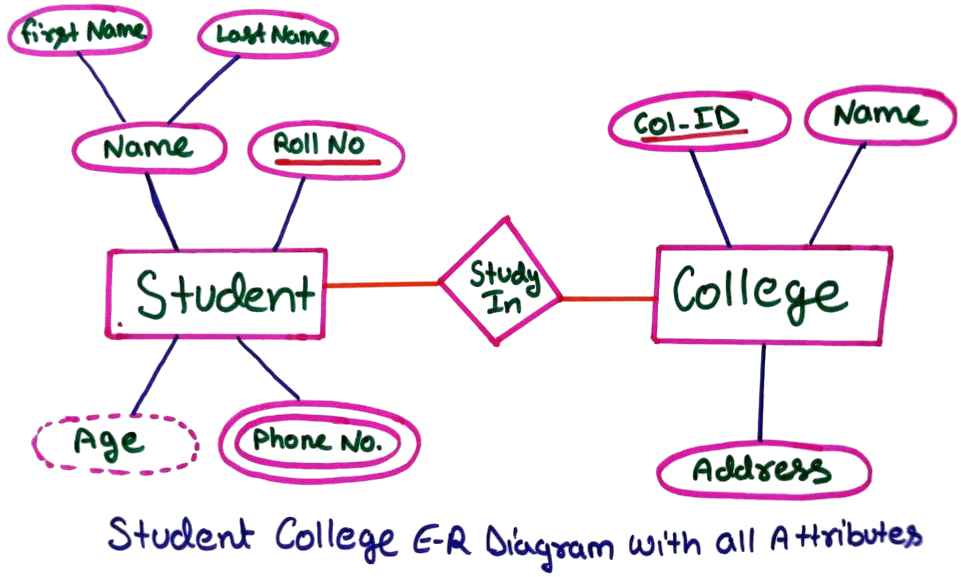
1. Rectangle (Entity)
A rectangle in an ER diagram is used to represent an entity. An entity refers to any real-world object such as a student, employee, product, or course that has a distinct existence and can be uniquely identified in a database system.
For example, a Student entity or an Employee entity is normally shown using a rectangular box in an ER diagram to represent its presence in the database structure.
Strong Entity Set
A strong entity set is an entity set that has a primary key and can exist independently in the database without relying on any other entity. It has its own unique identifier that helps to distinguish each record uniquely.
Strong entities are represented using a single rectangle in an ER diagram.

Example: A Student entity with Student_ID as a primary key is a strong entity because each student can be uniquely identified without depending on any other entity.
Weak Entity Set
A weak entity set is an entity set that does not have a primary key of its own. It cannot be uniquely identified by its own attributes and depends on a related strong entity for its identification.
Weak entities are represented using a double rectangle in an ER diagram.

A weak entity is always associated with a strong entity through a relationship called an identifying relationship.
Example: An "Dependent" entity of an Employee is a weak entity because it depends on Employee_ID to be uniquely identified.
Difference Between Strong and Weak Entity
- Strong Entity: Has its own primary key and exists independently.
- Weak Entity: Does not have a primary key and depends on another entity.
- Representation: Strong entity uses a single rectangle, while weak entity uses a double rectangle.
2. Ellipse (Attribute)
An ellipse (oval shape) is used to represent an attribute. Attributes describe the properties or characteristics of an entity.
For example, attributes like Name, Age, or Salary are drawn using oval shapes connected to their respective entity.
3. Diamond (Relationship)
A diamond shape represents a relationship between two or more entities. It shows how entities are connected to each other.

For example, a relationship like "Enrolls" between Student and Course is represented using a diamond.
4. Lines (Connection)
Lines are used to connect entities with attributes and relationships. They show how different components of an ER diagram are linked together.

These lines do not represent data but only define structural connections.
5. Double Ellipse (Multivalued Attribute)
A double ellipse is used to represent a multivalued attribute, which means an attribute that can have more than one value for a single entity.
For example, a person may have multiple phone numbers or skills.
6. Dashed Ellipse (Derived Attribute)
A dashed ellipse is used for a derived attribute. These attributes are not stored directly in the database but are calculated from other attributes.
For example, Age can be derived from Date of Birth.
7. Underlined Attribute (Key Attribute)
An underlined attribute represents a key attribute. It uniquely identifies each entity in a set.

For example, Student_ID or Employee_ID is used as a key attribute.
Importance of ER Diagram Symbols
- Helps in visualizing database structure clearly
- Makes database design easy and understandable
- Improves communication between developers and users
- Useful for designing complex database systems
- Acts as a blueprint before actual implementation
In conclusion, ER diagram symbols provide a simple and graphical way to represent entities, attributes, and relationships. Understanding these symbols is essential for effective database design and development.
Importance of ER Model
- Simplifies database design process
- Helps in visualizing data structure
- Reduces design complexity
- Improves understanding of relationships
Conclusion
The Entity-Relationship model is an essential part of DBMS design. It provides a clear and visual representation of data, making database development structured, efficient, and easy to understand.