Architecture of DBMS
The architecture of a Database Management System (DBMS) describes the overall structure of the database system and explains how different components of the database interact with each other. It defines the way data is stored, accessed, processed, and presented to users. A well-planned DBMS architecture helps in handling large volumes of data efficiently while maintaining accuracy, security, and reliability.
In simple terms, DBMS architecture acts as a blueprint that shows how users, applications, database software, and storage systems are connected. It ensures that users can access data smoothly without worrying about how the data is physically stored or managed internally.
A good DBMS architecture improves overall system performance by reducing data redundancy, providing controlled access, and supporting multiple users at the same time. It also makes database systems scalable, meaning they can grow easily as data size and user count increase.
Types of DBMS Architecture
DBMS architecture is generally divided into two main categories based on functionality and design. Each type focuses on a different aspect of database management and plays an important role in building reliable database systems.
- Application Architecture
- Schema Architecture
1. Application Architecture in DBMS
Application architecture in a Database Management System (DBMS) explains how users, application programs, and database servers are connected with each other. It focuses on how data is accessed and processed rather than how data is stored internally.
This architecture defines the communication path between the user interface and the database. Depending on the number of layers involved between the user and the database, application architecture is classified into different types. Each type is designed to handle specific requirements related to performance, security, scalability, and ease of maintenance.
Application architecture plays a crucial role in real-world systems such as banking software, web applications, enterprise systems, and cloud-based platforms.
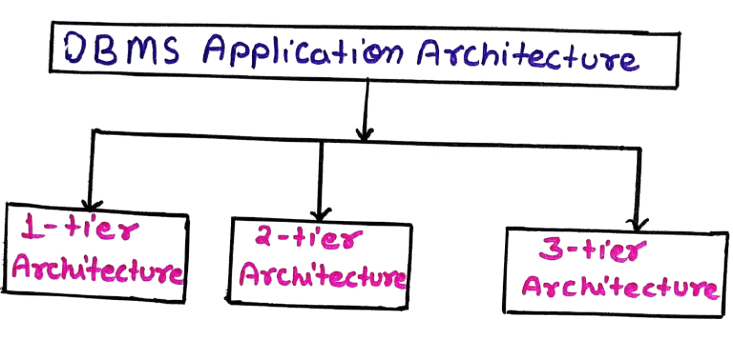
1.1 One-Tier Architecture
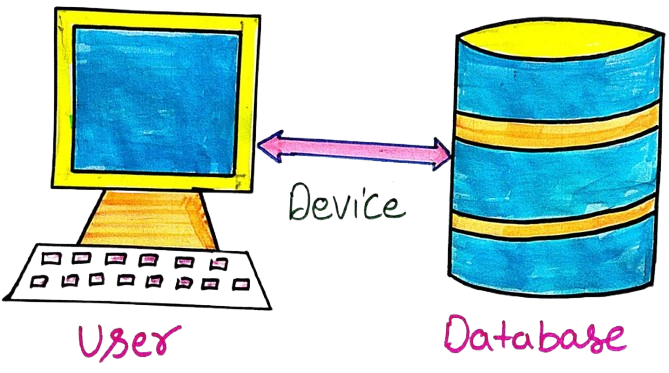
In one-tier architecture, the user, application program, and database all exist on the same system. There is no separate server or network involved. The user interacts directly with the database through a single interface.
This architecture is mainly used for learning purposes or for running small standalone applications where only one user accesses the data at a time.
Since all components are located on one machine, the system is easy to design and manage. However, it is not suitable for real-world applications that require multi-user access and high security.
Key Features of One-Tier Architecture:- All components run on a single system
- No network communication required
- Low cost and easy to maintain
- Used for testing, training, and small projects
- Not suitable for large or distributed systems
1.2 Two-Tier Architecture
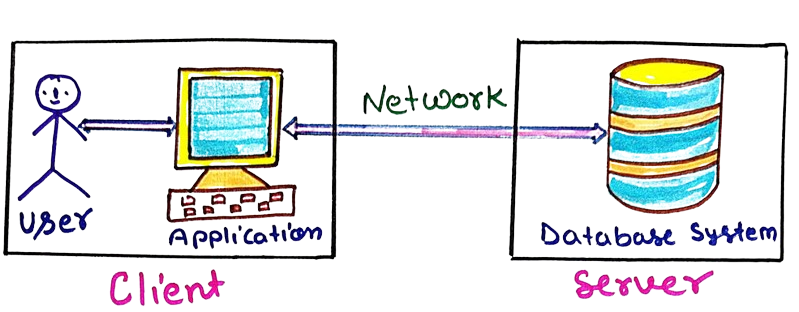
In two-tier architecture, the system is divided into two layers: the client layer and the database server layer. The client application provides the user interface and sends requests directly to the database server.
The database server processes queries, manages data storage, and sends results back to the client. This model is commonly known as a client-server architecture.
Two-tier architecture improves security and performance compared to one-tier architecture. However, as the number of users increases, system performance may degrade due to heavy load on the database server.
Key Features of Two-Tier Architecture:- Client directly communicates with the database server
- Better security than one-tier architecture
- Used in small-scale organizational systems
- Easy to design but difficult to scale
- Performance decreases with many users
1.3 Three-Tier Architecture
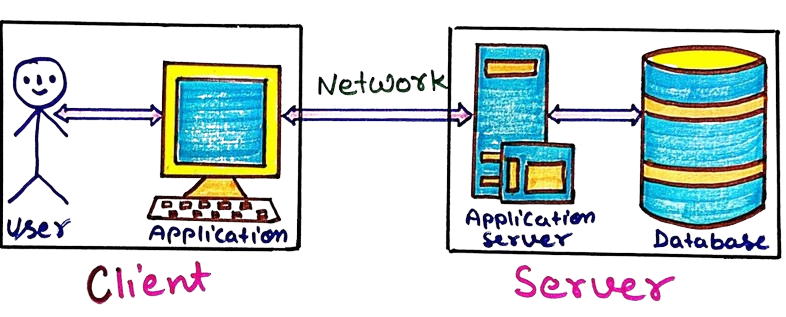
Three-tier architecture is the most widely used architecture in modern applications. It introduces an additional layer called the application server between the client and the database server.
In this model:
- Presentation Layer: Handles user interface (web browser or app)
- Application Layer: Processes business logic and rules
- Database Layer: Stores and manages data
This separation of layers improves security, scalability, and maintainability. Changes in one layer do not affect other layers, making system upgrades easier.
Three-tier architecture is widely used in web applications, enterprise software, online banking systems, and cloud-based platforms.
Key Features of Three-Tier Architecture:- Highly secure and scalable
- Supports large number of users
- Easy to maintain and upgrade
- Improved performance and flexibility
- Commonly used in modern web applications
Among all application architectures, three-tier architecture provides the best balance between performance, security, and scalability, making it the preferred choice for real-world systems.
2. Schema Architecture in DBMS
Schema architecture in a Database Management System (DBMS) explains how data is logically designed, organized, and viewed inside the database system. Unlike application architecture, which focuses on user–server interaction, schema architecture focuses on data abstraction.
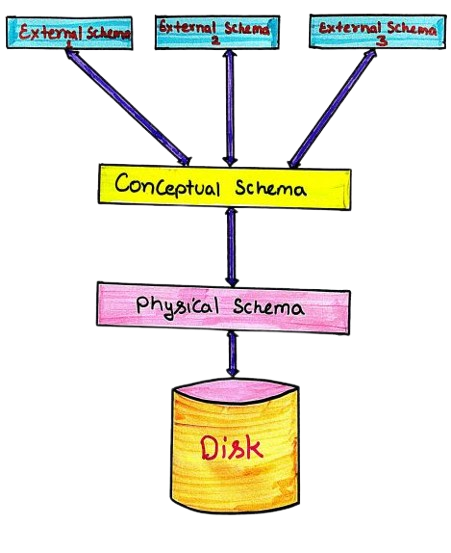
The main purpose of schema architecture is to hide the complexity of physical data storage from users and application programs. Users do not need to know how or where the data is actually stored on disk. Instead, they interact with data through different abstract levels.
Schema architecture divides the database system into multiple levels. Each level provides a specific view of data and separates user interaction from internal storage details. This separation improves security, flexibility, and data independence.
2.1 External Schema (View Level)
The external schema represents the user's view of the database. It defines how individual users or groups of users see the data. Different users may have different external schemas depending on their roles and needs.
For example, in a university database, a student may only see their personal details and marks, while an administrator can see complete student records. Both access the same database, but their views are different.
This level helps in maintaining data security because users can access only the data that is relevant to them. Changes made at this level do not affect the actual database structure.
Key Points of External Schema:- User-specific data views
- Enhances data security and privacy
- Multiple external schemas can exist
- Does not store actual data
2.2 Conceptual Schema (Logical Level)
The conceptual schema describes the complete logical structure of the database. It defines what data is stored in the database and the relationships between different data items.
This level includes details such as tables, attributes, data types, relationships, constraints, and integrity rules. It acts as a bridge between the external and internal schemas.
The conceptual schema provides a single, unified view of the entire database. It is independent of physical storage and is mainly used by database designers and administrators.
Key Points of Conceptual Schema:- Defines overall logical structure of the database
- Independent of physical storage
- Represents entire database in one view
- Helps in maintaining data consistency
2.3 Internal Schema (Physical Level)
The internal schema explains how data is physically stored on storage devices. It deals with low-level details such as file organization, indexing methods, record placement, and data compression.
This level is concerned with performance and storage efficiency. Any changes made at this level do not affect the conceptual or external schemas, which ensures physical data independence.
The internal schema is hidden from end users and is managed by the DBMS itself.
Key Points of Internal Schema:- Defines physical data storage details
- Focuses on performance and efficiency
- Hidden from users
- Supports physical data independence
Difference Between Application Architecture and Schema Architecture
| Application Architecture | Schema Architecture |
|---|---|
| Defines how users and applications interact with the database | Defines how data is logically and physically structured |
| Focuses on system layers and communication | Focuses on data abstraction and organization |
| Includes 1-tier, 2-tier, and 3-tier architecture | Includes external, conceptual, and internal schemas |
| Main concern is performance and scalability | Main concern is data independence and security |
Together, application architecture and schema architecture make a DBMS powerful, secure, and flexible. While application architecture handles how users access data, schema architecture ensures that data remains well-structured, independent, and easy to manage.
Exam-Oriented Short Answer
DBMS architecture defines how database components are organized and how users interact with the database system to ensure efficiency, security, and scalability.