Data Independence in DBMS
Data Independence is one of the most important features of a Database Management System (DBMS). It refers to the ability of the database system to modify data structure or storage details without affecting application programs.
In traditional file processing systems, data and programs are tightly connected. Any change in file structure requires changes in all related programs. DBMS overcomes this limitation by separating data definition from data usage.
In simple words, data independence means: Changes in the database should not require changes in application programs.
Why Data Independence is Needed
Modern software systems continuously evolve. New attributes may be added, storage techniques may change, or performance improvements may be required. If every small database change forced developers to rewrite programs, system maintenance would become costly and inefficient.
Data independence allows database administrators to modify the database internally while applications continue to work normally.
Benefits of Data Independence:- Reduces application maintenance cost
- Improves flexibility and scalability
- Allows easy database upgrades
- Supports long-term system growth
Types of Data Independence
Data independence in DBMS is broadly classified into two types:
- Physical Data Independence
- Logical Data Independence
1. Physical Data Independence
Physical data independence refers to the ability to change the physical storage of data without affecting the conceptual schema or application programs.
It includes changes related to file organization, indexing techniques, data compression, and storage location.
For example, adding indexes to improve query performance or moving data from one disk to another should not require changes in applications.
Examples of Physical Data Independence:- Changing file structure
- Adding or removing indexes
- Changing data storage devices
- Using data compression
Physical data independence is easier to achieve because it mainly affects the internal schema.
2. Logical Data Independence
Logical data independence refers to the ability to change the logical structure of the database without affecting application programs.
Logical changes include adding new attributes, creating new tables, modifying relationships, or splitting tables.
For example, adding an "email" column to a student table should not affect programs that use only roll number and name.
Examples of Logical Data Independence:- Adding new fields to a table
- Creating new relations
- Splitting or merging tables
- Changing relationships
Logical data independence is more difficult to achieve because it affects the conceptual schema.
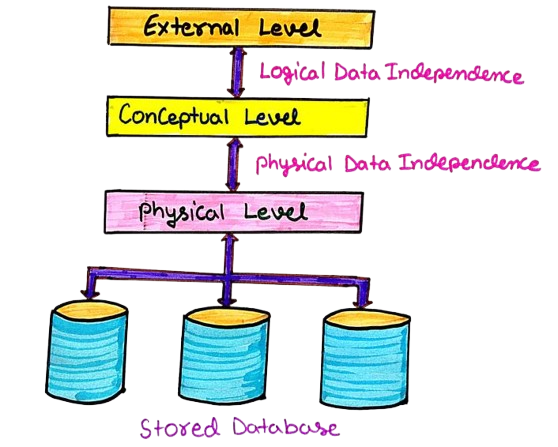
The above diagram explains the concept of Data Independence in a Database Management System (DBMS) using the three-level architecture. This architecture separates the database system into different levels so that changes at one level do not affect the other levels.
Data independence ensures flexibility, easy maintenance, and long-term stability of database applications by clearly dividing user views, logical structure, and physical storage.
1. External Level (User View Level)
The External Level represents how users interact with the database. Different users may have different views of the same database depending on their role and requirements.
For example, a student may see only their personal details and marks, while an administrator can view complete academic records. These user-specific views are created without changing the actual database structure.
Changes made at this level do not affect the conceptual or physical levels. This separation provides Logical Data Independence.
2. Conceptual Level (Logical Structure Level)
The Conceptual Level defines the overall logical structure of the database. It describes what data is stored, relationships between data items, constraints, and data types.
This level acts as a bridge between user views and physical storage. It provides a single, unified view of the entire database.
Any changes made in the conceptual schema should not affect user views. This protection is known as Logical Data Independence.
3. Physical Level (Storage Level)
The Physical Level describes how data is actually stored on storage devices. It includes details such as file organization, indexing, data compression, and storage location.
Changes at this level are related to performance optimization and storage efficiency. These changes should not affect the conceptual or external levels.
Difference Between Physical and Logical Data Independence
In a Database Management System (DBMS), data independence plays a vital role in making applications flexible and easy to maintain. It allows changes in the database without interrupting the working of application programs. Based on the type of changes allowed, data independence is divided into two categories: Physical Data Independence and Logical Data Independence.
Although both aim to separate data from application programs, they operate at different levels of the database architecture and handle different kinds of changes. Understanding the difference between them helps in designing efficient, scalable, and reliable database systems.
Physical data independence deals with changes in the internal storage of data, such as how data is stored on disks, whereas logical data independence deals with changes in the logical design of the database, such as tables and relationships. Logical data independence is generally harder to achieve because it directly affects the conceptual structure of the database.
| Physical Data Independence | Logical Data Independence |
|---|---|
| Allows changes at the physical storage level, such as file structure, indexing methods, or storage devices. | Allows changes at the logical structure level, such as tables, attributes, and relationships. |
| Does not affect the conceptual schema or the way data is logically organized. | May affect the conceptual schema but should not affect application programs. |
| Easier to implement because changes are handled internally by the DBMS. | More difficult to implement because logical changes impact database design. |
| Examples include adding indexes, changing file organization, or moving data to a new storage device. | Examples include adding new columns, creating new tables, or modifying relationships between tables. |
Role of Data Independence in DBMS Architecture
Data independence is achieved through the three-level DBMS architecture:
- External Level: User views
- Conceptual Level: Logical structure
- Internal Level: Physical storage
The separation between these levels allows changes at one level without impacting other levels.
Advantages of Data Independence
Data independence is one of the most valuable features of a Database Management System (DBMS). It allows changes to be made in the database structure or storage methods without requiring modifications in application programs. This separation between data and applications provides several long-term benefits for organizations and developers.
-
Applications Remain Unaffected by Database Changes:
One of the biggest advantages of data independence is that application programs continue to work normally even when changes are made in the database. Whether it is a change in storage location, indexing method, or table structure, applications do not need to be rewritten, saving time and effort. -
Improves System Reliability:
Since database changes are handled independently of application programs, the chances of system failure are reduced. Applications are less likely to break due to database modifications, which makes the overall system more stable and reliable. -
Reduces Development and Maintenance Effort:
Without data independence, even small database changes would require changes in multiple programs. Data independence eliminates this problem by reducing dependency, which significantly lowers development cost and maintenance workload. -
Allows Database Optimization:
Database administrators can optimize performance by adding indexes, changing file organization, or upgrading storage hardware without affecting users or applications. This flexibility helps in improving system performance without downtime. -
Supports Future Expansion and Scalability:
As organizations grow, databases need to expand by adding new data fields, tables, or relationships. Data independence supports such growth by allowing database changes without disrupting existing applications, making systems future-ready.