Types of Database
A database is a structured collection of data that is stored electronically and managed using a database management system (DBMS). It allows users and applications to efficiently store, retrieve, modify, and analyze large amounts of information. Databases play a critical role in almost every modern system, including educational platforms, banking systems, healthcare applications, e-commerce websites, government records, and mobile applications.
In the early days of computing, data was stored in simple files, which made data management difficult, slow, and error-prone. With the growth of data volume and complexity, databases were developed to provide better organization, faster access, data security, and reliability. Today, databases support millions of users and handle huge amounts of data in real time.
Databases can be classified into different types based on how data is stored, how relationships are maintained, how users access the data, and the nature of applications they support. Each type of database is designed to fulfill specific requirements such as high performance, scalability, flexibility, fault tolerance, and ease of maintenance.
Understanding the different types of databases is essential for students, developers, and database administrators because choosing the right type of database directly affects the efficiency, speed, and success of an application. Some databases are best suited for small-scale applications, while others are designed for large, distributed, and data-intensive systems.
The classification of databases helps in understanding their working principles, advantages, limitations, and real-world use cases. For example, traditional databases are commonly used in banking and academic systems, while modern databases are widely used in big data analytics, cloud computing, and social media platforms.
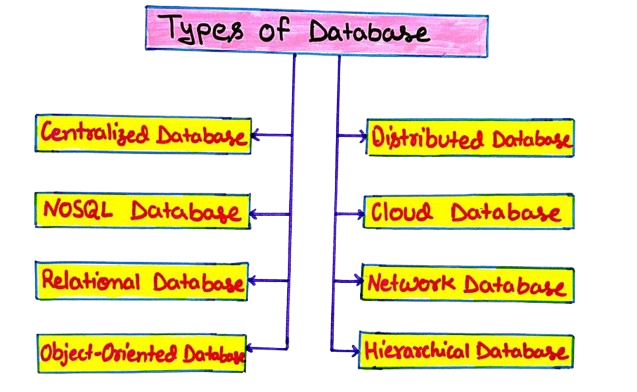
In the following sections, we will explore various types of databases in detail, including their structure, features, advantages, disadvantages, and practical applications. This knowledge will provide a strong foundation for learning advanced database concepts and selecting appropriate database technologies for real-world projects.
1. Centralized Database
A centralized database is a type of database in which all data is stored, managed, and maintained at a single central location, usually on one main server or computer system. All users, applications, and departments access the database through this central server, either locally or via a network.
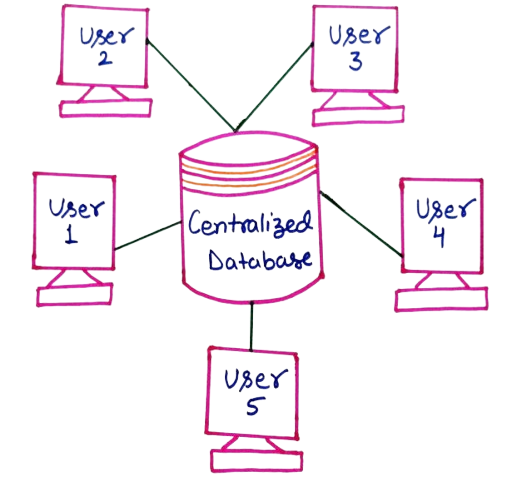
In this model, data control is handled by a central authority such as a database administrator (DBA). Any updates, modifications, or security policies are applied at one place, which helps in maintaining uniformity and consistency of data across the entire organization. Because the data resides at a single location, it is easier to monitor, manage, and secure.
Centralized databases are commonly used in environments where data integrity and strict control are more important than high availability or scalability. Examples include small organizations, educational institutions, libraries, and early banking systems where all operations are performed from a central office.
In a centralized database system, client machines send requests to the central server, which processes the queries and returns the required results. This architecture simplifies database design and administration but can become a limitation as the number of users grows.
Advantages of Centralized Database:- Easy data management since all data is stored at one location
- High data consistency because there is only one copy of data
- Better data security due to centralized access control
- Simplified backup and recovery process
- Reduced data redundancy
Since there is a single source of data, problems such as data duplication and inconsistency are minimized. Backup operations are straightforward because only one database needs to be backed up and maintained.
Disadvantages of Centralized Database:- Single point of failure—if the central server fails, the entire system stops
- Performance issues when many users access the database simultaneously
- Limited scalability compared to distributed systems
- High dependency on network availability
If the central server crashes or the network connection fails, users may not be able to access the database at all. As the organization grows and the number of users increases, centralized databases may struggle to handle heavy workloads efficiently.
Despite these limitations, centralized databases are still useful in scenarios where data volume is manageable, system simplicity is required, and strong centralized control is necessary.
2. Distributed Database
A distributed database is a type of database in which data is stored at multiple physical locations, also known as sites, that are connected through a computer network. Even though the data is spread across different locations, the system is designed in such a way that it appears as a single unified database to the end users.
In a distributed database system, each site may store a portion of the database or a replicated copy of data. The database management system (DBMS) is responsible for managing data distribution, maintaining consistency, and ensuring that users can access data transparently without needing to know where it is physically stored.
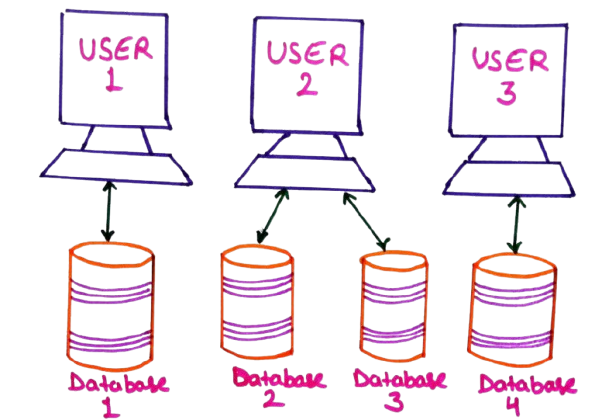
This type of database is widely used in large organizations, multinational companies, banking systems, airline reservation systems, and cloud-based applications where data must be accessible from different geographical locations with minimal delay.
Distributed databases improve system performance by allowing users to access data from the nearest location. At the same time, they enhance reliability because the failure of one site does not stop the entire system from functioning.
Advantages of Distributed Database:- High availability since data is stored at multiple locations
- Improved reliability as failure of one site does not shut down the system
- Faster data access due to local availability of data
- Better scalability by adding new sites as the organization grows
- Supports geographically distributed users efficiently
Because data can be replicated or fragmented across sites, users experience reduced latency and improved response time. This makes distributed databases suitable for real-time and mission-critical applications.
Disadvantages of Distributed Database:- System design and implementation are more complex
- Data synchronization and consistency maintenance can be challenging
- Higher cost due to networking and infrastructure requirements
- Security management becomes more difficult across multiple locations
Maintaining data consistency across all sites requires sophisticated control mechanisms. Issues such as network failure, data conflicts, and synchronization delays must be handled carefully to ensure correct and reliable database operations.
Despite these challenges, distributed databases are essential for modern applications that require high availability, fault tolerance, and efficient data access across multiple geographical regions.
3. Relational Database
A relational database is one of the most widely used types of databases in modern applications. In this database model, data is organized in the form of tables (relations), where each table consists of rows (records) and columns (attributes). Each row represents a single entity, while each column represents a specific property of that entity.
Relationships between different tables are established using keys. A primary key uniquely identifies each record in a table, while a foreign key is used to create a relationship between two tables. These key-based relationships help maintain data accuracy and consistency across the database.
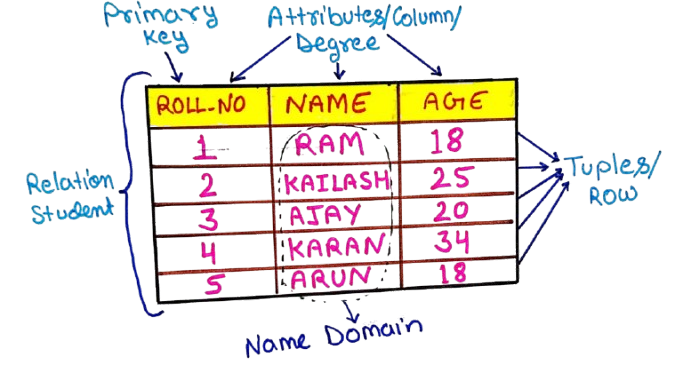
Relational databases follow a well-defined schema, which means the structure of the database is clearly defined before data is stored. This makes relational databases highly suitable for applications that require structured data, strong consistency, and reliable transaction processing.
Most relational databases use Structured Query Language (SQL) for data definition, manipulation, and querying. SQL allows users to perform complex operations such as joins, aggregations, filtering, and sorting with ease.
Relational databases are commonly used in banking systems, student management systems, inventory control, enterprise resource planning (ERP) software, and many web-based applications where data relationships are critical.
Advantages of Relational Database:- High data integrity through constraints, keys, and relationships
- Easy-to-understand table-based structure
- Supports complex and powerful queries using SQL
- Ensures data consistency using ACID properties
- Widely supported by tools and platforms
The strict structure and rule-based design of relational databases help prevent data anomalies and ensure reliable data storage and retrieval.
Disadvantages of Relational Database:- Not suitable for handling unstructured or semi-structured data
- Limited horizontal scalability compared to NoSQL databases
- Schema changes can be difficult in large databases
- Performance may degrade with very large datasets
As data volume and variety increase, relational databases may face scalability challenges. However, they remain the preferred choice for applications that demand accuracy, consistency, and well-defined data relationships.
4. NoSQL Database
A NoSQL database is a modern type of database designed to handle very large volumes of data that may be unstructured, semi-structured, or rapidly changing. Unlike relational databases, NoSQL databases do not rely on fixed table-based schemas with rows and columns.
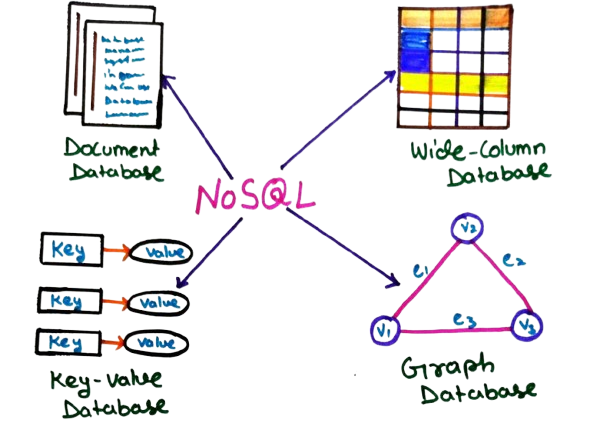
The term NoSQL stands for "Not Only SQL," which means these databases can work without traditional SQL-based relational structures while still supporting high performance and scalability. NoSQL databases store data in various formats such as key-value pairs, documents, columns, or graphs.
NoSQL databases are especially suitable for applications that require fast data access, horizontal scalability, and flexible data models. They are widely used in big data applications, real-time analytics, social media platforms, IoT systems, and cloud-based services.
One of the key strengths of NoSQL databases is their ability to scale horizontally by adding more servers instead of upgrading a single machine. This makes them ideal for handling millions of users and massive data growth.
Advantages of NoSQL Database:- Highly scalable and capable of handling massive data volumes
- Flexible schema allows easy changes in data structure
- High performance for read and write operations
- Well-suited for big data and real-time applications
- Efficient handling of unstructured and semi-structured data
Because NoSQL databases do not enforce strict schemas, developers can easily adapt the database design as application requirements change.
Disadvantages of NoSQL Database:- Limited support for complex transactions compared to relational databases
- Lack of a standard query language across different NoSQL systems
- Weaker consistency models in some implementations
- More responsibility on developers to manage data integrity
Although NoSQL databases provide flexibility and scalability, they may not be suitable for applications that require strict consistency and complex relational queries.
5. Object-Oriented Database
An object-oriented database is a type of database that stores data in the form of objects, similar to the way data is represented in object-oriented programming languages such as Java, C++, or Python.
In this database model, data and the methods that operate on that data are stored together as objects. Each object contains attributes (data) and methods (functions), making it easier to represent complex real-world entities directly within the database.
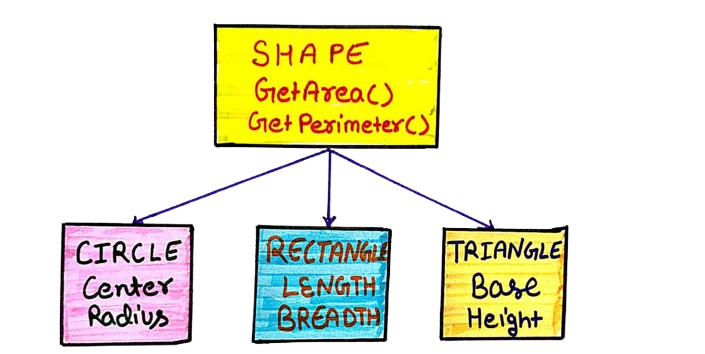
Object-oriented databases are particularly useful for applications that deal with complex data types such as multimedia content, CAD/CAM systems, simulations, and engineering applications. They reduce the mismatch between the database model and object-oriented application code.
Unlike relational databases, object-oriented databases do not require complex joins to retrieve related data, as relationships are maintained through object references.
Key Features of Object-Oriented Database:- Supports complex and user-defined data types
- Stores data and related methods together as objects
- Directly compatible with object-oriented programming concepts
- Reduces impedance mismatch between application and database
Despite their advantages, object-oriented databases are not as widely adopted as relational databases. They are mainly used in specialized domains where complex data modeling is required.
In summary, object-oriented databases provide a natural way to store and manage complex data structures, making them suitable for advanced and specialized software applications.
6. Hierarchical Database
A hierarchical database is a type of database that organizes data in a tree-like structure. In this structure, data is arranged in the form of parent–child relationships, where each parent record can have multiple child records, but each child record is associated with only one parent.
This model closely resembles a real-world hierarchy, such as an organizational chart, file system, or family tree. The top-level record is known as the root, and all other records branch out from it in a downward structure.
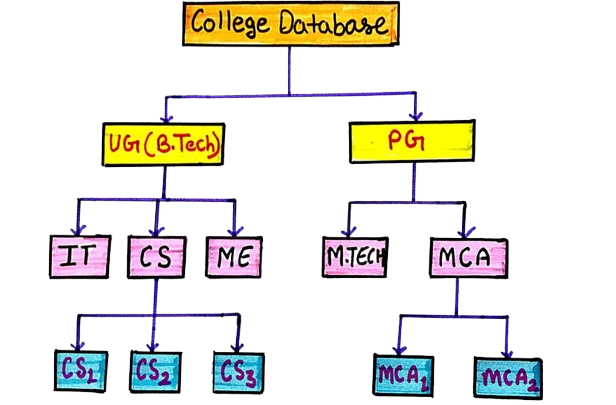
Hierarchical databases were among the earliest database models used in computer systems. They were widely implemented in mainframe environments and legacy enterprise systems where data relationships were naturally hierarchical.
In this database model, data access is very efficient when the structure of the data matches the hierarchy. However, it becomes difficult to modify or reorganize data if the hierarchy changes over time.
Each record in a hierarchical database is connected using pointers, which define the path from the root to the required data. To retrieve a child record, the system must traverse the hierarchy from top to bottom.
Key Characteristics of Hierarchical Database:- Data is organized in a tree-like hierarchical structure
- Supports one-to-many relationships
- Each child has exactly one parent
- Navigation-based data access
- Rigid structure with fixed relationships
Hierarchical databases are commonly used in applications where data naturally follows a strict hierarchy, such as directory systems, XML data storage, and legacy banking or telecom systems.
Advantages of Hierarchical Database:- Simple database design for hierarchical data
- Fast data retrieval for predefined relationships
- High data integrity due to strict parent–child rules
- Easy to understand and implement for tree-structured data
Because relationships are clearly defined, hierarchical databases ensure consistency and reduce ambiguity in data organization.
Disadvantages of Hierarchical Database:- Less flexible database structure
- Difficult to modify relationships once defined
- Does not support many-to-many relationships
- Complex queries for non-hierarchical data access
Due to their rigid structure, hierarchical databases are not suitable for modern applications that require flexible data relationships and frequent schema changes.
In conclusion, hierarchical databases are best suited for systems with stable, well-defined hierarchical relationships, but they are rarely used in modern dynamic applications.
7. Network Database
A network database is an advanced database model that allows many-to-many relationships between records. Unlike the hierarchical database model, a network database permits a record to have multiple parent records as well as multiple child records.
In this model, data is organized in the form of a graph structure, where records are represented as nodes and relationships are represented as links. These links define how different records are connected to each other within the database.
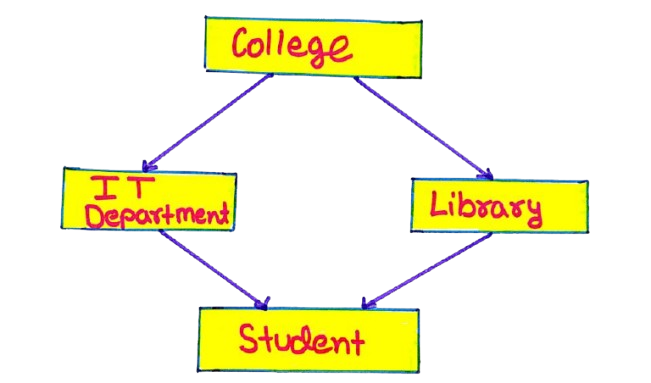
The network database model was developed to overcome the limitations of the hierarchical model, especially its inability to support complex relationships. By allowing multiple connections between records, it provides greater flexibility in representing real-world scenarios.
Each relationship in a network database is defined using pointers or links, which enable fast navigation between related records. However, this also increases the complexity of database design and maintenance.
Network databases are commonly used in applications where relationships between data elements are highly interconnected, such as telecommunications systems, transportation networks, and supply chain management systems.
Key Characteristics of Network Database:- Supports many-to-many relationships
- Records can have multiple parents and children
- Data is organized in a graph-like structure
- Navigation-based data access using pointers
- More flexible than hierarchical databases
Because of its flexible relationship handling, the network database model is suitable for complex data structures that cannot be efficiently represented using a simple hierarchy.
Advantages of Network Database:- Efficient handling of complex relationships
- Faster data access through predefined links
- Reduced data redundancy
- Better representation of real-world data relationships
These advantages make network databases powerful for applications that require high-performance data access and complex interconnections.
Disadvantages of Network Database:- Complex database design and implementation
- Difficult to modify and maintain
- Requires skilled database administrators
- Less user-friendly compared to relational databases
Due to their complexity, network databases are not commonly used in modern applications. Most systems today prefer relational or NoSQL databases, which offer better flexibility and ease of use.
In summary, network databases provide powerful support for complex relationships, but their design complexity and maintenance challenges limit their usage in contemporary database systems.
8. Cloud Database
A cloud database is a modern type of database that is hosted, managed, and maintained on cloud computing platforms instead of on local servers or on-premise infrastructure. Users access the database through the internet using web interfaces, applications, or APIs.
In a cloud database environment, the responsibility of hardware management, software updates, security patches, and system maintenance is handled by the cloud service provider. This allows organizations and developers to focus more on application development rather than infrastructure management.
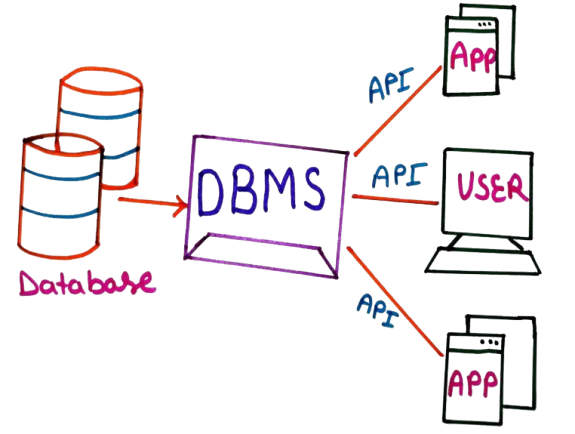
Cloud databases are designed to support high scalability and flexibility. Resources such as storage, memory, and computing power can be increased or decreased based on demand, making cloud databases ideal for applications with variable workloads.
These databases are widely used in web applications, mobile apps, e-commerce platforms, online education systems, and enterprise-level software solutions. They support real-time data access and can handle a large number of concurrent users.
Key Features of Cloud Database:- Hosted and managed on cloud infrastructure
- Scalable storage and computing resources
- Pay-as-you-use pricing model
- High availability and fault tolerance
- Accessible through the internet
Cloud databases often include built-in mechanisms for data replication, load balancing, and disaster recovery, which significantly improve system reliability.
Advantages of Cloud Database:- Automatic backup and recovery mechanisms
- High scalability to handle growing data needs
- Accessible from anywhere and any device
- Reduced infrastructure and maintenance cost
- Fast deployment and easy management
These advantages make cloud databases a preferred choice for startups as well as large enterprises looking for cost-effective and scalable solutions.
Disadvantages of Cloud Database:- Strong dependency on internet connectivity
- Potential security and privacy concerns
- Limited control over physical infrastructure
- Possible vendor lock-in issues
Despite these limitations, cloud databases continue to gain popularity due to their convenience, scalability, and reliability. With proper security measures and provider selection, they can support mission-critical applications efficiently.
In conclusion, cloud databases represent the future of data storage and management, offering flexible, scalable, and cost-efficient solutions for modern digital systems.
Conclusion
Different types of databases are designed for different purposes. Choosing the right database depends on data size, application requirements, performance needs, and security considerations. Understanding database types helps in designing efficient and scalable systems.
Exam-Oriented Short Answer
Types of database refer to different ways of storing and managing data based on structure, usage, scalability, and performance requirements.