Introduction to C++
C++ is a powerful and widely used programming language developed as an extension of the C programming language. It supports both procedural and object-oriented programming concepts, making it suitable for developing system software, applications, games, embedded systems, and high-performance programs.
C++ was designed to provide better structure, code reusability, and improved data security through object-oriented programming features such as classes, objects, inheritance, polymorphism, abstraction, and encapsulation.
Because of its speed, efficiency, and flexibility, C++ is widely used in operating systems, software development, graphics applications, databases, browsers, and competitive programming. It gives programmers both low-level memory control and high-level programming features.
History of C++
C++ was developed by Danish computer scientist Bjarne Stroustrup at Bell Laboratories in the early 1980s. The language was created to improve the capabilities of the C programming language by adding object-oriented programming concepts.
Initially, the language was called "C with Classes" because it introduced classes and objects into the C language. Later in 1983, the name was changed to C++. The "++" symbol comes from the increment operator in C, representing an improved version of C.
Over time, many new features were added to C++, including templates, exception handling, Standard Template Library (STL), and modern programming concepts. Today, C++ remains one of the most popular programming languages used worldwide.
Difference Between C and C++
C and C++ are two of the most important programming languages in computer science. C++ was developed as an enhancement of the C programming language to provide advanced features like object-oriented programming, better data security, and code reusability. Although both languages have similar syntax, they differ in many aspects such as program structure, memory handling, security, and application development approach.
C language mainly focuses on procedural programming where programs are divided into functions. On the other hand, C++ supports both procedural and object-oriented programming, allowing developers to build more secure and scalable software systems.
| Basis of Comparison | C Language | C++ Language |
|---|---|---|
| Development | Developed by Dennis Ritchie in 1972 | Developed by Bjarne Stroustrup in 1983 |
| Programming Paradigm | Procedural Programming Language | Supports Procedural and Object-Oriented Programming |
| Main Focus | Focuses on functions and procedures | Focuses on objects, classes, and data security |
| Approach | Top-down approach | Bottom-up approach |
| Data Security | Provides less data protection | Provides better data security using encapsulation |
| Object-Oriented Features | Not supported | Fully supports OOP concepts |
| Classes and Objects | Classes and objects are not available | Supports classes and objects |
| Inheritance | Not available | Supported for code reusability |
| Polymorphism | Not supported | Supported |
| Abstraction | Not available | Supported |
| Encapsulation | Not supported | Supported |
| Function Overloading | Not available | Supported |
| Operator Overloading | Not supported | Supported |
| Namespace Feature | Namespaces are not available | Supports namespaces |
| Exception Handling | Does not support exception handling | Supports try, catch, and throw for exception handling |
| Input and Output | Uses printf() and scanf() | Uses cin and cout |
| Memory Allocation | Uses malloc() and calloc() | Uses new and delete operators |
| File Handling | Uses standard C library functions | Uses stream-based file handling |
| Code Reusability | Limited code reusability | High code reusability using inheritance and classes |
| Program Size | Suitable for smaller programs | Suitable for both small and large applications |
| Speed | Generally faster for low-level tasks | Fast and efficient for complex applications |
| Software Development | Mainly used for system programming | Widely used for application and software development |
| Standard Library | Smaller standard library | Rich Standard Template Library (STL) |
| Compatibility | Cannot run C++ code directly | Can execute most C programs with little modification |
| Use Cases | Operating systems, embedded systems, drivers | Games, GUI software, applications, browsers, databases |
Translator in C++
A translator is a software tool that converts human-readable source code into machine-readable code so that the computer can understand and execute it.
In C++, the source code written by the programmer is converted into machine code using a compiler. The compiler checks the program for syntax errors and then translates the entire program into executable machine code.
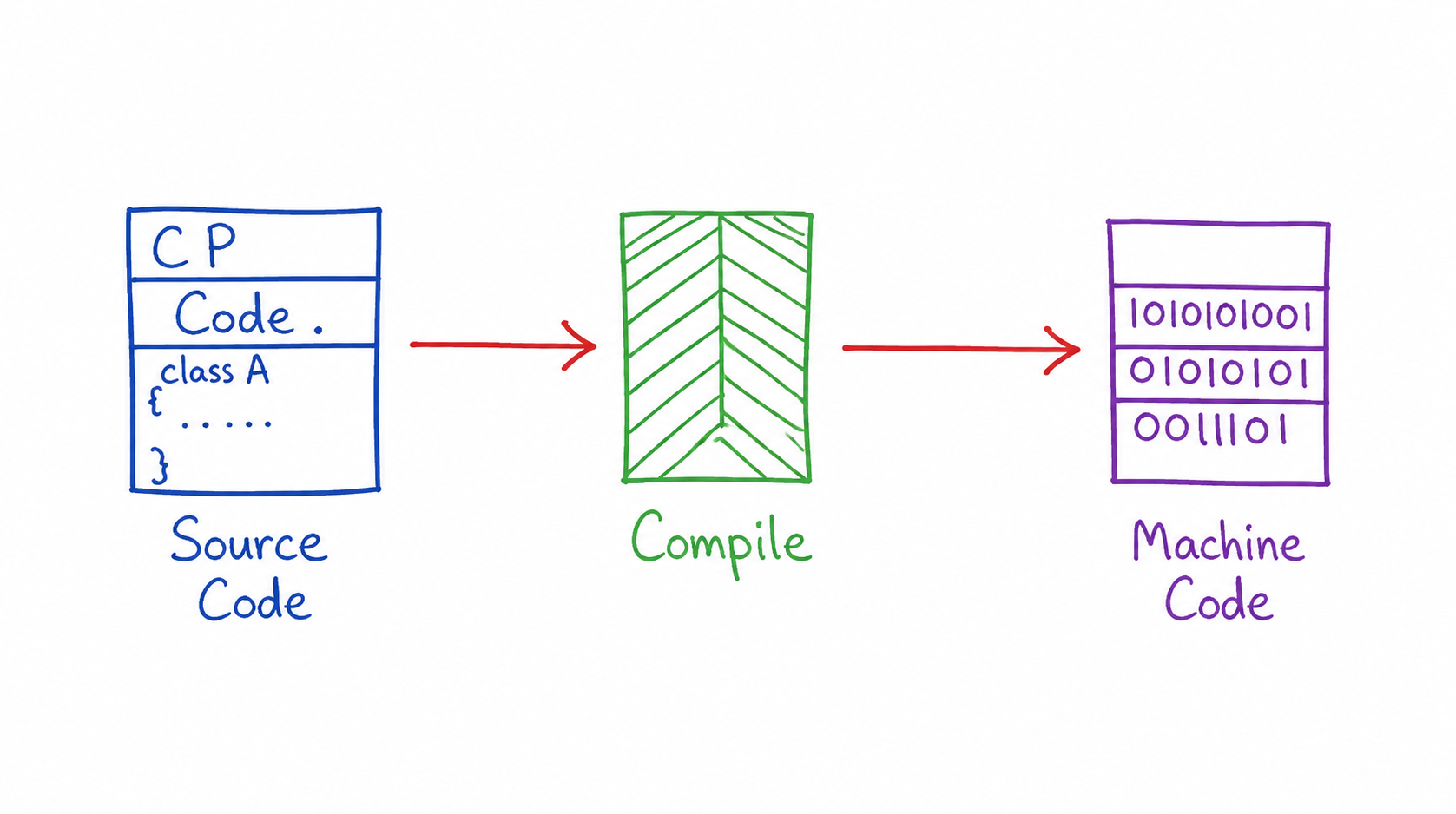
The translation process in C++ generally follows these steps:
- Programmer writes source code in C++ language
- Compiler checks syntax and semantic errors
- Source code gets translated into machine code
- Executable file is generated
- Computer executes the machine code
Some popular C++ compilers include Turbo C++, GCC, Clang, and Microsoft Visual C++.
Basic Syntax of C++
Every C++ program follows a specific structure called syntax. Proper syntax is important because the compiler only understands correctly written programs.
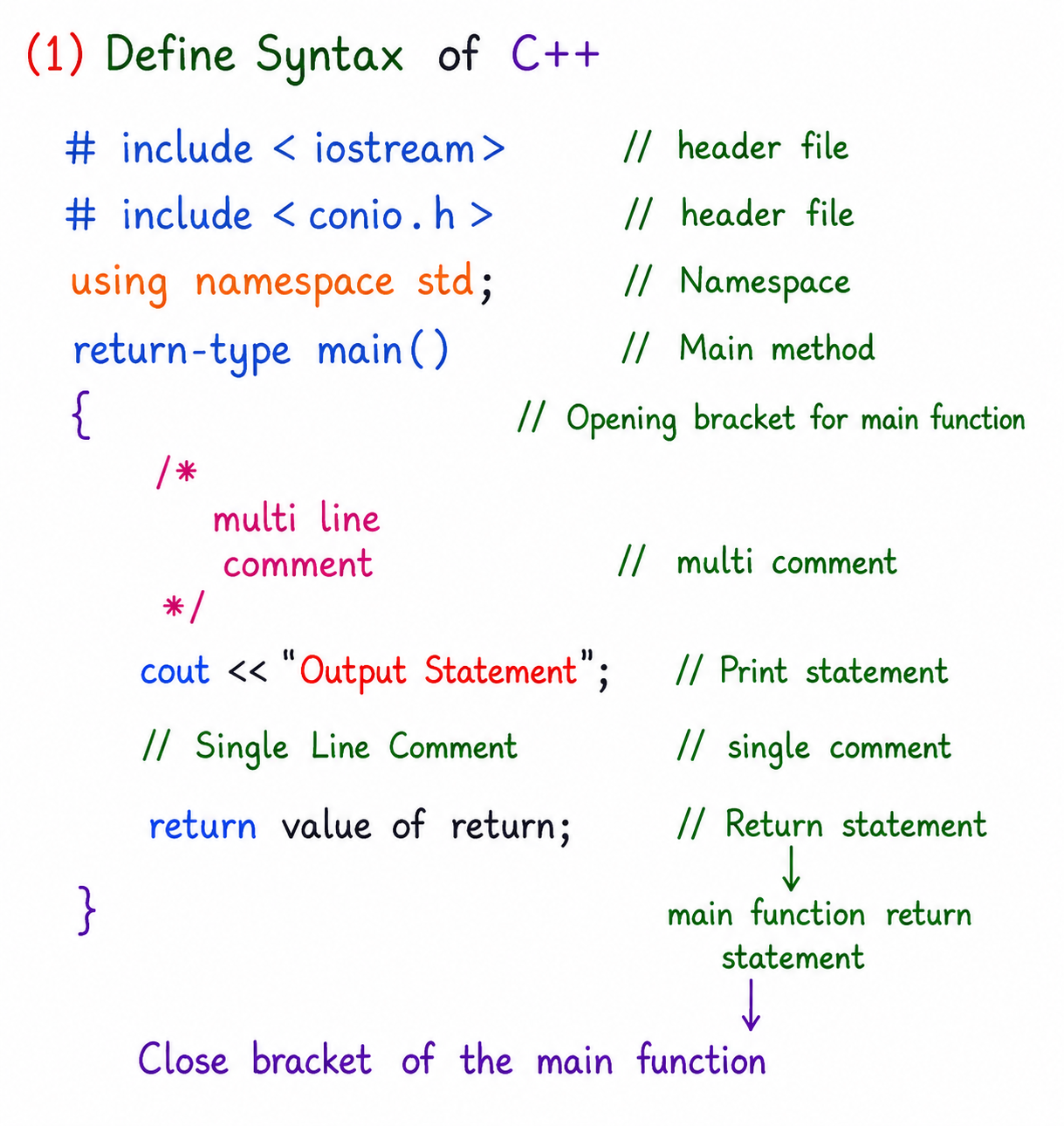
Example of Basic C++ Program:
#include <iostream>
using namespace std;

int main()
{
    cout << "Welcome to C++";

    return 0;
}
Explanation of Syntax:
- #include <iostream> → Header file used for input and output operations
- using namespace std; → Allows use of standard library names without std::
- int main() → Main function where program execution starts
- { } → Curly braces define the body of the function
- cout << → Used to display output on the screen
- return 0; → Indicates successful execution of the program
Features of C++
C++ provides many powerful features that make it one of the most popular programming languages in the world. These features help developers create efficient, secure, reusable, and fast applications.
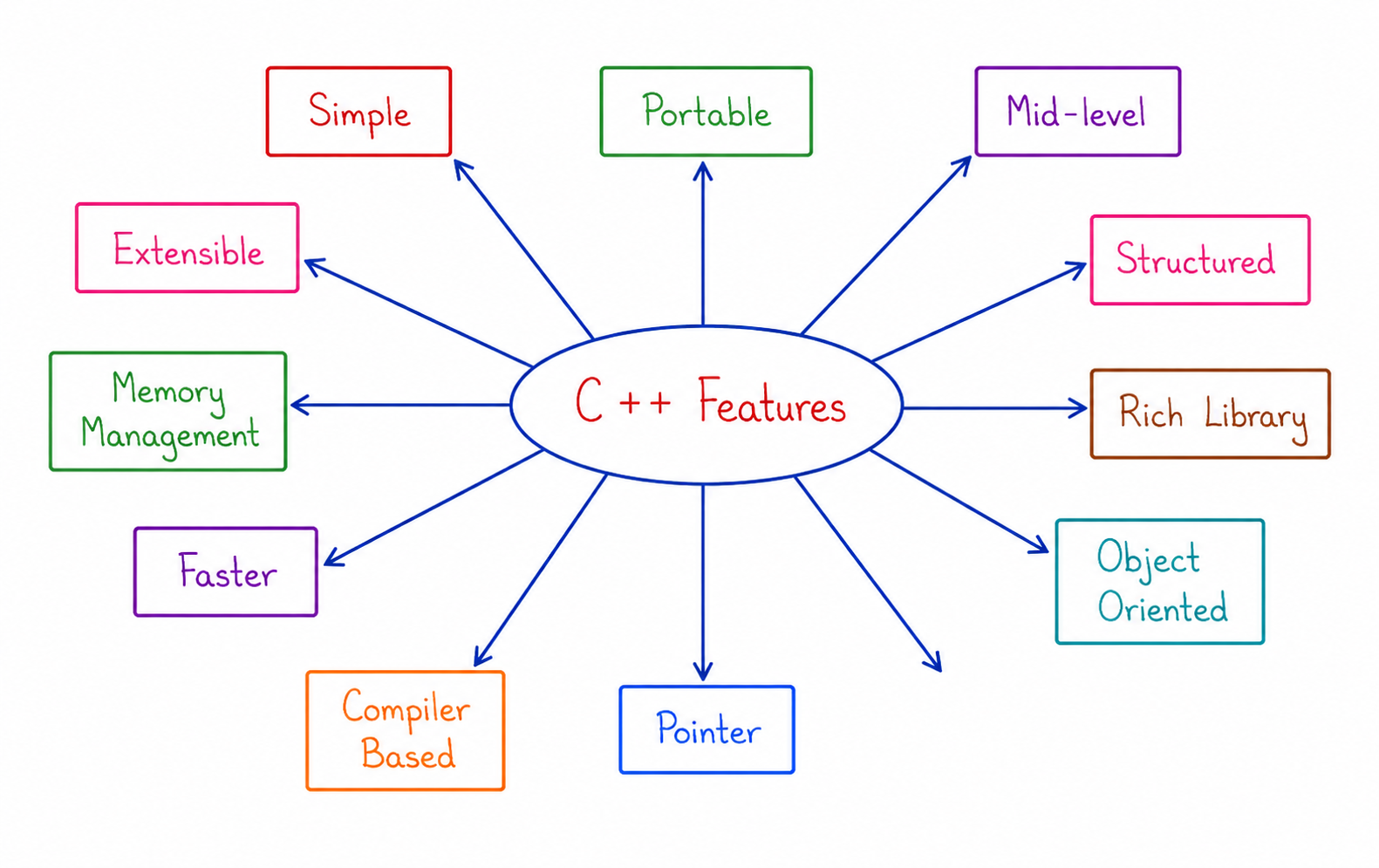
Important Features of C++
C++ is one of the most powerful and flexible programming languages used in modern software development. It combines the efficiency of low-level programming with the advanced features of high-level programming. Because of its speed, portability, and object-oriented capabilities, C++ is widely used for developing operating systems, games, desktop applications, embedded systems, and large-scale software projects.
The following features make C++ a popular and highly demanded programming language among students, developers, and software engineers.
-
Simple and Easy to Learn:
C++ provides a clean and understandable syntax that helps programmers write programs in a structured way. Since it is an extension of the C language, programmers who know C can easily learn C++. The language supports functions, classes, and modular coding, which makes program development easier and more organized. -
Portable Language:
Programs written in C++ can run on different operating systems and hardware platforms with very few modifications. This portability allows developers to create applications that can work on Windows, Linux, macOS, and many other systems without rewriting the entire code. -
Mid-Level Programming Language:
C++ is called a mid-level language because it supports both low-level and high-level programming features. It allows direct memory access using pointers like low-level languages while also providing advanced programming concepts like classes and objects found in high-level languages. -
Object-Oriented Programming Support:
One of the strongest features of C++ is object-oriented programming (OOP). It supports important OOP concepts such as classes, objects, inheritance, polymorphism, abstraction, and encapsulation. These features help in building secure, reusable, and maintainable software applications. -
Structured Programming:
C++ supports structured programming where a large program can be divided into smaller functions and modules. This improves code readability, simplifies debugging, and makes program maintenance easier. -
Rich Standard Library:
C++ provides a large collection of built-in libraries and functions that help programmers perform various tasks efficiently. The Standard Template Library (STL) includes containers, algorithms, iterators, and data structures that reduce programming effort and improve performance. -
High Execution Speed:
C++ programs are compiled into machine code before execution, making them extremely fast and efficient. Because of this high performance, C++ is widely used in game engines, graphics applications, real-time systems, and competitive programming. -
Compiler-Based Language:
C++ uses a compiler to translate source code into machine code. The compiler checks for syntax and logical errors before program execution, which helps improve program reliability and performance. -
Pointer Support:
C++ supports pointers, which allow programmers to directly access and manipulate memory locations. Pointers are useful for dynamic memory allocation, data structures, and system-level programming. -
Dynamic Memory Management:
C++ provides dynamic memory allocation using new and delete operators. This allows memory to be allocated and released during program execution according to the program's requirements, improving memory efficiency. -
Code Reusability:
Using inheritance and classes, C++ allows programmers to reuse existing code instead of writing the same logic repeatedly. This reduces development time and improves software quality. -
Extensible Language:
C++ is highly extensible, meaning developers can add new features and functionalities to programs easily. User-defined functions, classes, and libraries make the language flexible for different types of software development. -
Platform for Large Applications:
C++ is suitable for developing both small and large-scale applications. It is commonly used in operating systems, browsers, database systems, compilers, and enterprise software because of its stability and performance. -
Supports Function Overloading:
C++ allows multiple functions with the same name but different parameters. This feature improves program readability and makes coding more convenient. -
Supports Operator Overloading:
Operators in C++ can be redefined to work with user-defined data types. This improves code flexibility and makes programs easier to understand. -
Secure and Reliable:
C++ provides better security features through data hiding and encapsulation. Access specifiers like private, protected, and public help control unauthorized access to data.
Applications of C++
C++ is used in many real-world applications because of its speed and flexibility.
- Operating Systems Development
- Game Development
- Desktop Applications
- Database Management Systems
- Embedded Systems
- Web Browsers
- Graphics and Animation Software
- Competitive Programming
- Scientific and Engineering Applications
Advantages of C++
- Supports Object-Oriented Programming concepts
- Provides fast execution speed
- Allows code reusability using classes and inheritance
- Offers better memory management
- Suitable for both system and application programming
- Large community and rich standard library support
Conclusion
C++ is a powerful, flexible, and efficient programming language that combines the features of procedural and object-oriented programming. It is widely used in software development, gaming, operating systems, and modern applications. Understanding the basics of C++, its syntax, history, and features provides a strong foundation for learning advanced programming concepts.