Object-Oriented Programming (OOP) Concepts in C++
Object-Oriented Programming (OOP) is a programming methodology that organizes software around objects rather than functions and logic. In C++, OOP helps developers create programs that are modular, reusable, secure, and easier to maintain.
The main idea behind OOP is to represent real-world entities as objects. Each object contains data and functions that operate on that data. This approach simplifies software development and makes large applications easier to manage.
C++ is one of the most popular programming languages that fully supports Object-Oriented Programming concepts. These concepts help reduce code duplication, improve security, and increase software flexibility.
Main Concepts of OOP in C++
Object-Oriented Programming in C++ is built around several important concepts that work together to create efficient and maintainable programs.
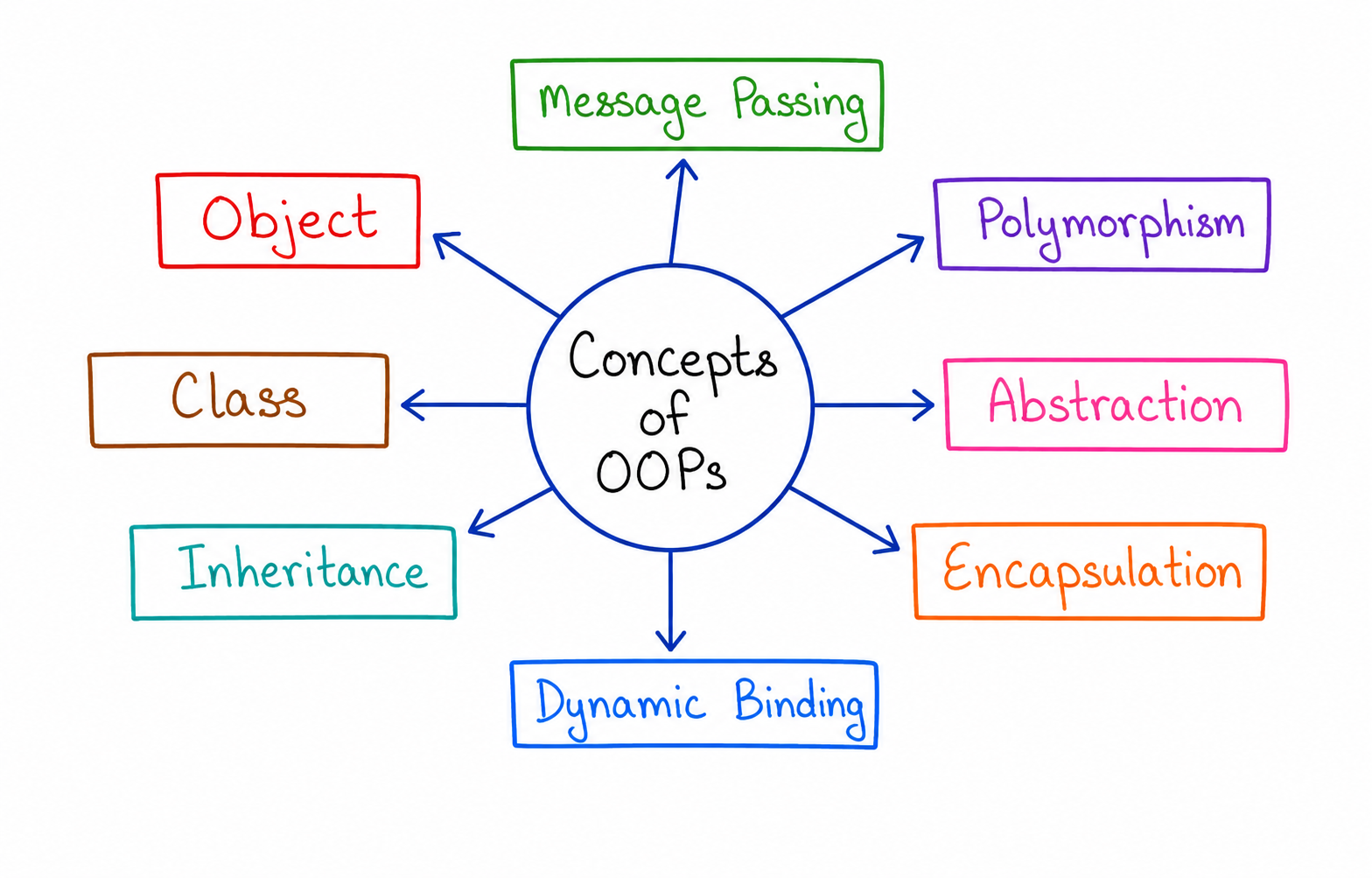
The major OOP concepts in C++ include:
- Class
- Object
- Inheritance
- Polymorphism
- Encapsulation
- Abstraction
- Dynamic Binding
- Message Passing
Class in C++
A class is a user-defined data type that serves as a blueprint for creating objects. It defines the properties (data members) and behaviors (member functions) that objects will have.
A class does not occupy memory until objects are created from it. It simply describes the structure and functionality that the objects will follow.
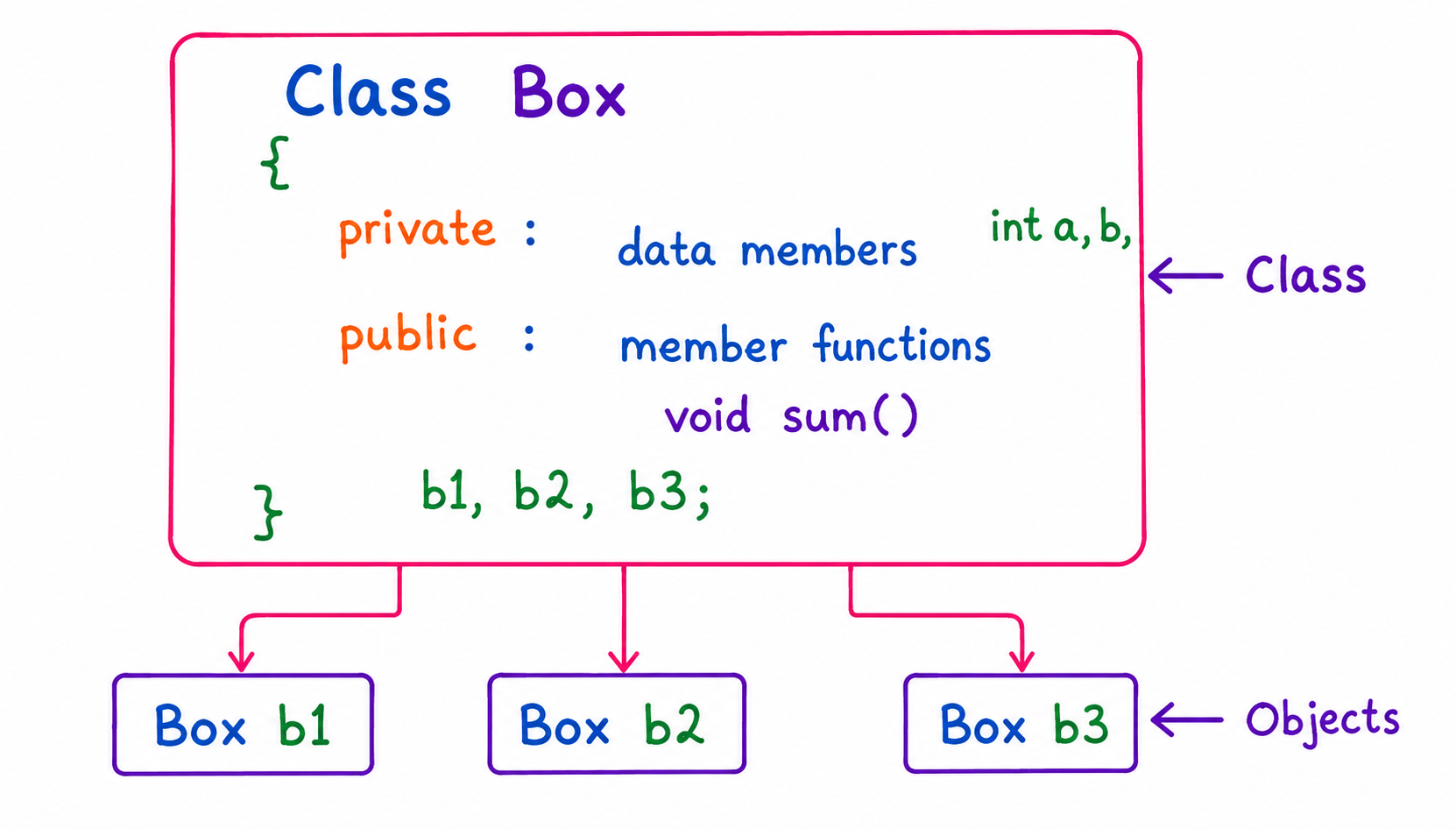
Example:
class Student
{
public:
    string name;

    void display()
    {
        cout << name;
    }
};
In this example, Student is a class that contains one data member and one member function.
Object in C++
An object is an instance of a class. When an object is created, memory is allocated for the data members defined in the class.
Objects represent real-world entities and can access the data and functions of the class to which they belong.
Example:
Student s1;

s1.name = "Rahul";
s1.display();
Here, s1 is an object of the Student class.
Encapsulation
Encapsulation is the process of combining data and the methods that operate on that data into a single unit called a class.
It also helps restrict direct access to sensitive information by using access specifiers such as private, protected, and public.
Benefits of Encapsulation:
- Improves data security
- Prevents unauthorized access
- Makes programs easier to maintain
- Supports data hiding
Example:
class Account
{
private:
    double balance;

public:
    void setBalance(double b)
    {
        balance = b;
    }
};
Abstraction
Abstraction means showing only essential information to the user while hiding unnecessary implementation details.
It helps reduce program complexity and allows users to focus on what an object does instead of how it works internally.
For example, when driving a car, a driver uses the steering wheel and pedals without knowing the internal engine mechanism.
Advantages of Abstraction:
- Reduces complexity
- Improves security
- Makes code easier to understand
- Enhances maintainability
Inheritance in C++
Inheritance is an Object-Oriented Programming (OOP) concept that allows a new class to use the attributes and functions of an existing class. This helps developers build new classes without rewriting the same code repeatedly.
The class whose features are inherited is known as the Base Class (or Parent Class), while the class that receives those features is called the Derived Class (or Child Class).
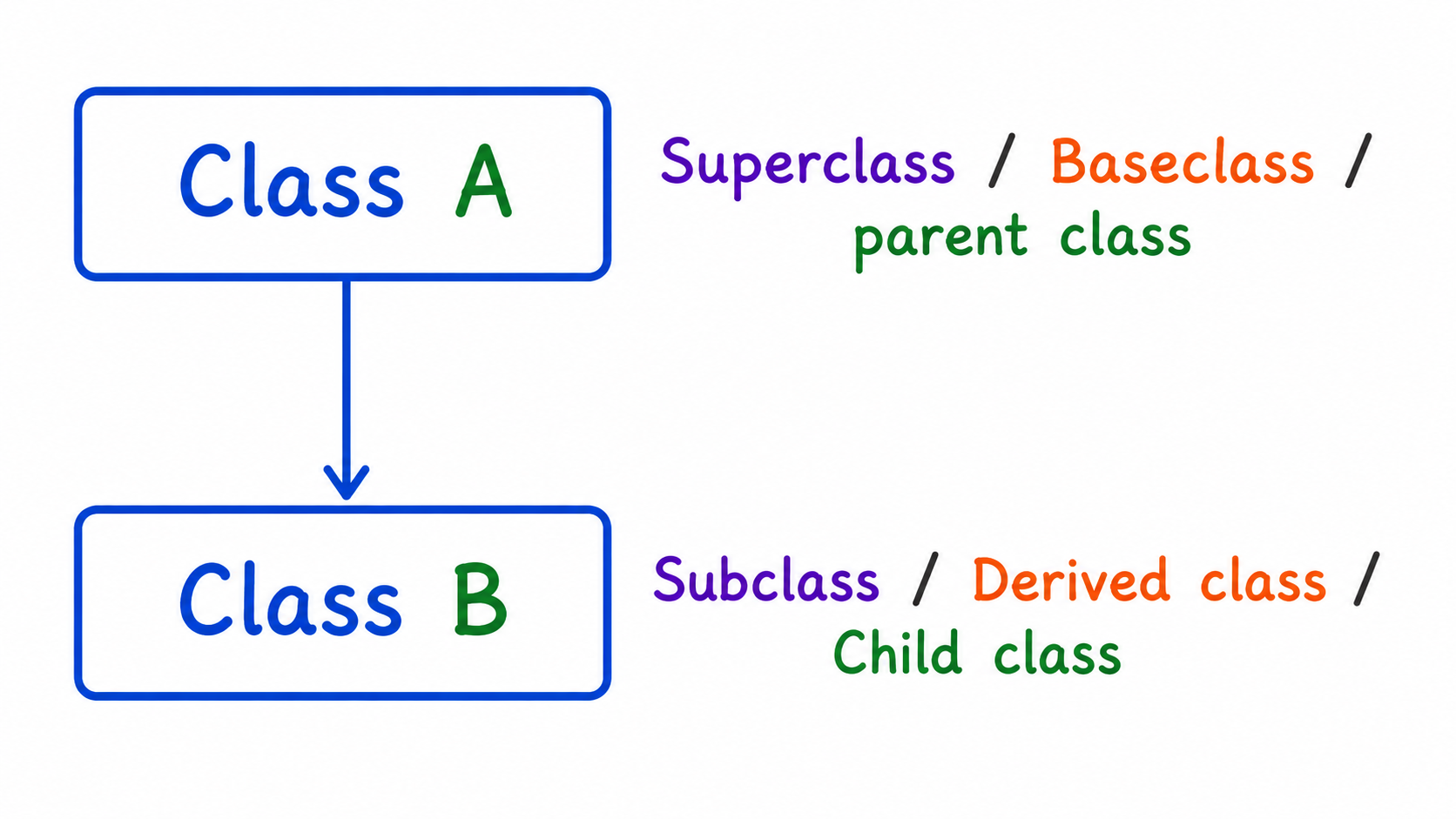
Inheritance improves code reusability, makes programs easier to maintain, and creates a clear relationship between classes.
Example:
#include <iostream>
using namespace std;

class Animal
{
public:
    void eat()
    {
        cout << "Animal is eating" << endl;
    }
};

class Dog : public Animal
{
};

int main()
{
    Dog d;
    d.eat();

    return 0;
}
In the above example, the Dog class inherits the eat() function from the Animal class. Therefore, an object of the Dog class can directly access and use the inherited function without defining it again.
Polymorphism in C++
Polymorphism is one of the core concepts of Object-Oriented Programming (OOP). The word "Polymorphism" means "many forms". It allows the same function, method, or interface to perform different actions depending on the object that uses it.
Using polymorphism, developers can write flexible and reusable code because a single interface can represent multiple behaviors.
Polymorphism enables objects of different classes to be treated through a common base class. The actual behavior is determined by the object's type, making programs easier to extend and maintain.
Types of Polymorphism
- Compile-Time Polymorphism – Achieved through Function Overloading and Operator Overloading. The compiler determines which function to call during compilation.
- Run-Time Polymorphism – Achieved through Function Overriding and Virtual Functions. The function call is resolved while the program is running.
Example:
#include <iostream>
using namespace std;

class Shape
{
public:
    virtual void draw()
    {
        cout << "Drawing a Shape" << endl;
    }
};

class Circle : public Shape
{
public:
    void draw() override
    {
        cout << "Drawing a Circle" << endl;
    }
};

int main()
{
    Shape* s;
    Circle c;

    s = &c;
    s->draw();

    return 0;
}
Explanation:
In this example, the Shape class contains a virtual function named draw(). The Circle class inherits from Shape and provides its own implementation of the draw() function.
A base class pointer (Shape*) is used to store the address of a Circle object. When the draw() function is called through the pointer, the overridden function inside the Circle class is executed instead of the base class version.
This behavior is known as Run-Time Polymorphism because the decision about which function to execute is made while the program is running.
Dynamic Binding
Dynamic Binding refers to linking a function call with its corresponding function body during program execution rather than during compilation.
It is mainly achieved through virtual functions and runtime polymorphism.
Dynamic binding allows the program to decide which function should execute based on the actual object type at runtime.
Advantages:
- Provides flexibility
- Supports runtime polymorphism
- Improves software extensibility
Message Passing
Message Passing is the process through which objects communicate with each other by sending messages.
A message usually consists of a function call sent from one object to another object requesting a specific action.
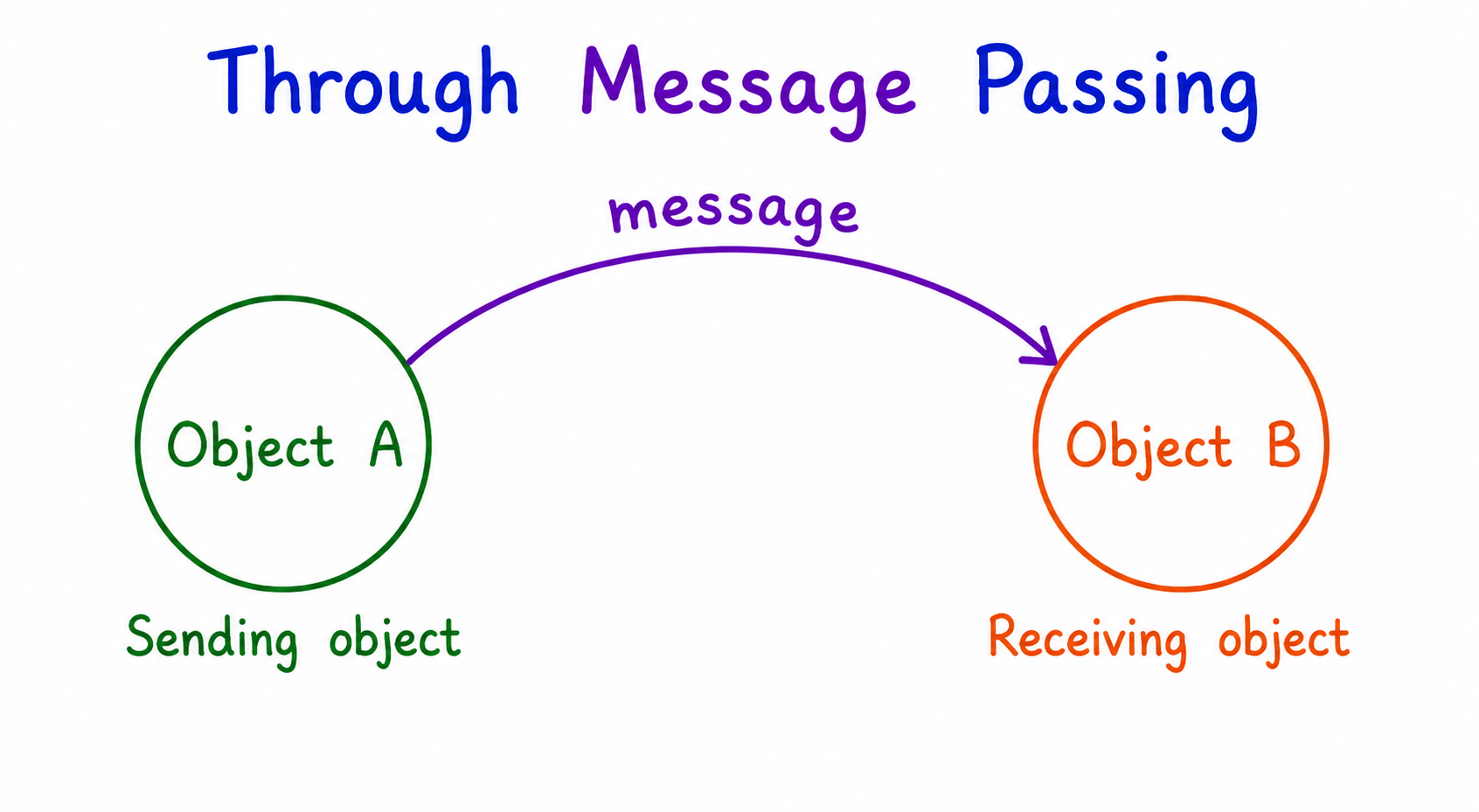
In Object-Oriented Programming, objects collaborate by exchanging messages rather than directly manipulating each other's data.
Benefits of Message Passing:
- Improves modularity
- Enhances communication between objects
- Supports encapsulation
- Reduces dependency between components
Advantages of OOP
- Improves code reusability
- Enhances data security
- Makes maintenance easier
- Supports modular programming
- Reduces development time
- Provides flexibility and scalability
- Improves software quality
Applications of OOP
Object-Oriented Programming is widely used in modern software development and real-world applications.
- Banking Management Systems
- Hospital Management Systems
- Student Information Systems
- Game Development
- Desktop Applications
- Enterprise Software
- Mobile Applications
- Graphics and Simulation Software
Conclusion
Object-Oriented Programming is one of the most important features of C++. It provides a structured approach for designing software by organizing data and functionality into objects. Concepts such as classes, objects, inheritance, polymorphism, encapsulation, abstraction, dynamic binding, and message passing help developers build secure, reusable, and efficient applications. A strong understanding of OOP concepts forms the foundation for advanced C++ programming and modern software development.