Virtual Memory in Memory Management
Virtual memory is an advanced memory management technique used by modern operating systems to overcome the limitation of physical RAM. It allows the system to execute programs that are larger than the available main memory by intelligently managing data between primary memory (RAM) and secondary storage such as a hard disk or SSD.
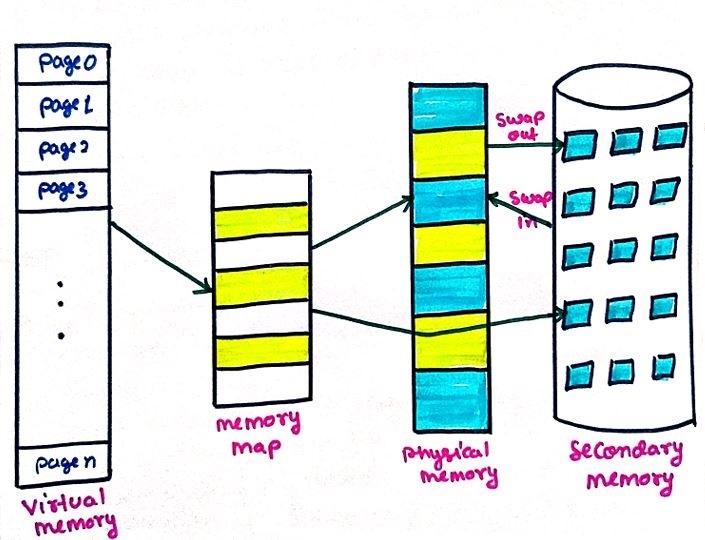
In a virtual memory system, the operating system does not load the entire program into RAM at once. Instead, it divides the program into small fixed-size blocks called pages. Only the pages that are currently required for execution are loaded into main memory, while the remaining pages stay in secondary storage.
When a program tries to access a page that is not present in RAM, a situation known as a page fault occurs. The operating system then retrieves the required page from secondary memory and places it into a free frame in RAM. This process happens transparently, meaning the user and application are unaware of it.
Virtual memory creates an illusion for programs that a large amount of continuous memory is available, even though the actual physical memory may be limited. This abstraction improves system flexibility and allows multiple large applications to run simultaneously without exhausting RAM.
Another key benefit of virtual memory is efficient resource utilization. Since only active parts of programs occupy main memory, RAM is used more effectively. This leads to better CPU utilization, reduced program load time, and improved system performance in multitasking environments.
Overall, virtual memory plays a critical role in modern operating systems by enabling the execution of large programs, improving memory efficiency, and providing a smooth and responsive computing experience even on systems with limited physical memory.
Why Virtual Memory is Important
Virtual memory plays a crucial role in modern operating systems because it removes the dependency on large physical RAM. Without virtual memory, a system would be limited by the size of its main memory, making it difficult to run complex and memory-intensive applications.
- Execution of Large Programs: Virtual memory allows programs that require more memory than the available RAM to run smoothly. Only the necessary parts of a program are loaded into main memory, while the rest remains on disk.
- Efficient Memory Utilization: By loading only active pages into RAM, virtual memory minimizes wastage and ensures that memory resources are used effectively.
- Supports Multitasking: Multiple applications can run at the same time because virtual memory shares RAM among processes intelligently, improving overall system productivity.
- Improved System Performance: Programs start faster since the entire application does not need to be loaded into RAM at once. This results in better responsiveness.
- Better Memory Isolation and Security: Each process gets its own virtual address space, preventing unauthorized access to another process’s memory.
Virtual Memory = Physical RAM + Secondary Storage (Disk used as extended memory)
Demand Paging
Demand Paging is a memory management technique used in operating systems where pages are loaded into
main memory (RAM) only when they are actually required by the CPU. This approach helps in saving memory
space and improves system efficiency.
In demand paging, the operating system does not load the complete program into RAM at once.
Instead, it loads only those pages that are needed during execution. If a required page is not
present in main memory, a page fault occurs.
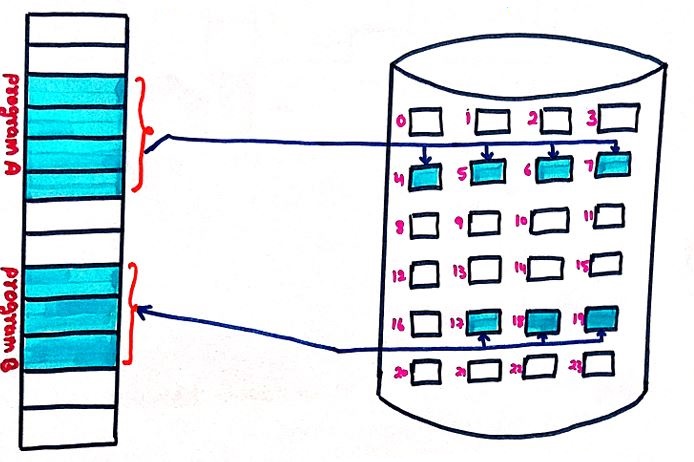
Working Process of Demand Paging
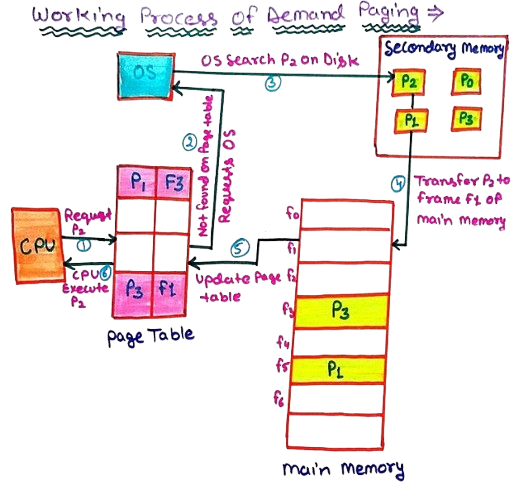
Step-by-Step Working of Demand Paging
Step 1 — CPU Requests a Page
The CPU requests a specific page (for example, page P2) for execution. It first checks whether this page is available in the main memory.
Step 2 — Page Table Lookup
The operating system checks the page table entry for page P2. If the page table indicates that P2 is not present in RAM, a page fault is generated.
Step 3 — OS Searches Secondary Memory
After detecting the page fault, the operating system searches for page P2 in secondary memory such as the hard disk, where inactive pages are stored.
Step 4 — Page Transfer to Main Memory
The operating system selects a free frame in main memory (for example, frame F1) and transfers page P2 from disk to this frame.
Step 5 — Page Table Update
Once the page is loaded into RAM, the operating system updates the page table to reflect the new mapping between page P2 and frame F1.
Step 6 — CPU Resumes Execution
After updating the page table, the CPU resumes execution and successfully accesses page P2 from main memory.
Advantages of Demand Paging
Demand Paging is a modern memory management technique used by operating systems to improve system performance and optimize memory utilization. Instead of loading an entire program into main memory at once, only the required pages are loaded when they are actually needed. This approach provides several important advantages, especially in multitasking and large-scale computing environments.
-
Efficient Utilization of Main Memory:
Demand paging ensures that only actively used pages occupy RAM. Pages that are not required immediately remain in secondary storage, which prevents unnecessary memory consumption and reduces wastage of valuable main memory. -
Faster Program Startup Time:
Since the operating system loads only a small portion of the program initially, applications start executing much faster. The remaining pages are fetched later on demand, improving the overall user experience. -
Supports Execution of Large Programs:
Programs that are larger than the available physical memory can still be executed efficiently. Demand paging allows the system to run such programs by loading only the required pages, making better use of limited RAM. -
Reduced I/O Operations:
Only necessary pages are transferred between secondary memory and main memory. This significantly reduces disk I/O operations, resulting in better system performance and lower access latency. -
Improved System Throughput:
By minimizing memory usage per process, demand paging allows more processes to reside in memory simultaneously. This increases the level of multiprogramming and improves overall system throughput. -
Better CPU Utilization:
Faster page loading and reduced waiting time help keep the CPU busy with useful work. As a result, idle CPU time is minimized and system efficiency improves. -
Cost-Effective Memory Management:
Demand paging reduces the need for large amounts of physical RAM. Systems can efficiently operate with limited memory resources, lowering hardware costs.
In summary, demand paging plays a vital role in modern operating systems by improving memory efficiency, speeding up execution, and enabling the execution of large applications without requiring excessive physical memory.
Conclusion
Demand paging allows the operating system to manage memory efficiently by loading pages only when they are needed. This technique plays a crucial role in virtual memory systems and improves overall system performance.
Summary
- Virtual memory uses disk as extra memory
- Demand paging loads pages only when needed
- Page fault occurs when page is missing
- Improves performance and memory usage