Paging in Memory Management
Paging divides memory into fixed-size pages and frames. A page table maps pages to frames,
eliminating external fragmentation.
Paging is a memory management technique used to store and access data efficiently. It allows a process to be divided into smaller parts so that memory can be used in a flexible way.
In paging, memory is divided into two parts:
- Pages → Fixed-size blocks of a process (stored in secondary memory)
- Frames → Fixed-size blocks of main memory (RAM)
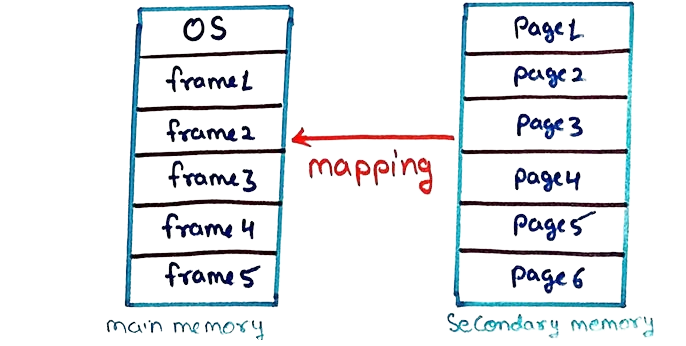
- The left side shows main memory (RAM) divided into frames (frame1, frame2, frame3, etc.)
- The right side shows pages of a process (page1 to page6)
- The Operating System (OS) manages the memory
- The arrow (mapping) shows how pages are placed into available frames
Working of Paging in Operating System
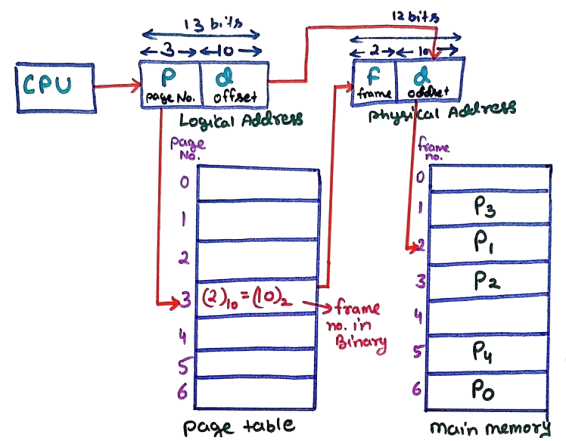
Paging is a memory management method that converts a logical address generated by the CPU into a physical address in main memory. This process helps the operating system use memory efficiently.
1. Logical Address Generation
The CPU generates a logical address which is divided into two parts:
- Page Number (p): Identifies the required page
- Offset (d): Identifies the exact location inside the page
In this example, the logical address is 13 bits:
- 3 bits for Page Number
- 10 bits for Offset
2. Page Table Mapping
The page number is sent to the page table. The page table stores the corresponding frame number where the page is located in RAM.
3. Physical Address Formation
After finding the frame number, the system combines:
- Frame Number (f)
- Offset (d)
In this example:
- 2 bits for Frame Number
- 10 bits for Offset
- Total Physical Address = 12 bits
4. Accessing Main Memory
Using the physical address, the system accesses the correct frame in main memory and fetches the required data.
Segmentation in memory Management
Segmentation in Operating System (OS) is a memory management technique where a program is divided into smaller logical parts called segments.
Segmentation divides a program into logical units such as code, data, and stack segments.
Each segment has its own base and limit.
Segmentation means breaking a program into meaningful sections like:
- Code (instructions)
- Data (variables)
- Stack (function calls)
- Heap (dynamic memory)
Working of Segmentation in Operating System
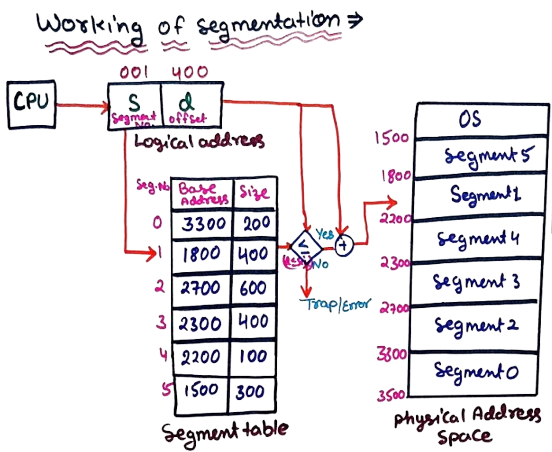
Segmentation is a memory management technique where a logical address generated by the CPU is converted into a physical address using a segment table.
Steps Involved
-
Logical Address from CPU
- Segment Number (s) = 1
- Offset (d) = 400
- Logical Address = (1, 400)
-
Access Segment Table
- Base Address = 1800
- Segment Size = 400
-
Check Validity
- Check if Offset ≤ Segment Size
- 400 ≤ 400 → Valid
- If offset is greater → Segmentation Fault
-
Calculate Physical Address
- Physical Address = Base Address + Offset
- Physical Address = 1800 + 400 = 2200
-
Access Physical Memory
- System accesses memory at address 2200
- Data is retrieved successfully
Invalid Case
- If Offset > Segment Size
- System generates an error
- This error is called Segmentation Fault
Difference Between Paging and Segmentation
Paging and segmentation are two important memory management techniques used by operating systems to manage main memory efficiently. Although both aim to overcome memory-related problems such as fragmentation and inefficient utilization, they differ significantly in concept, structure, and implementation. The detailed comparison below explains these differences clearly.
| Feature | Paging | Segmentation |
|---|---|---|
| Basic Concept | Paging divides the physical and logical memory into fixed-size blocks called pages and frames. | Segmentation divides memory into variable-size logical units called segments based on program structure. |
| Memory Unit Size | All pages and frames are of equal, fixed size. | Segments are of variable size depending on program requirements. |
| View of Memory | Paging provides a physical view of memory, focusing on efficient memory utilization. | Segmentation provides a logical view of memory, matching how programmers think about programs. |
| Fragmentation | Paging suffers from internal fragmentation due to fixed-size pages. | Segmentation suffers from external fragmentation because segments vary in size. |
| Address Structure | Logical address consists of page number and offset. | Logical address consists of segment number and offset. |
| Memory Allocation | Pages can be stored in any available frame, so memory need not be contiguous. | Each segment is stored in a contiguous block of memory. |
| Ease of Implementation | Easier to implement due to fixed-size memory blocks. | More complex to implement due to variable-size segments. |
| Protection and Sharing | Provides limited support for protection and sharing. | Provides better protection and sharing at the segment level. |
| Use Case | Suitable for systems where efficient memory utilization is a priority. | Suitable for systems requiring logical separation of program components. |
In conclusion, paging focuses on efficient physical memory management by eliminating external fragmentation, while segmentation emphasizes logical organization and protection of program components. Many modern operating systems use a combination of both techniques to take advantage of their respective strengths.
Memory management plays a vital role in the performance and reliability of an operating system. By using techniques such as paging, segmentation, and virtual memory, the OS ensures optimal utilization of limited memory resources.