File Allocation Methods in Operating System
File allocation methods describe the strategy used by an operating system to place files onto secondary storage devices such as hard disks or solid-state drives. Since a disk is divided into fixed-size blocks, the operating system must decide how these blocks will be assigned to different files in an organized and efficient manner.
A well-designed file allocation mechanism directly affects system performance. It determines how quickly a file can be accessed, how much disk space is wasted, and how easily a file can grow when new data is added. Poor allocation techniques may lead to slow access times and inefficient use of storage.
To handle different storage and performance requirements, operating systems use multiple allocation approaches. Each approach follows a unique method for locating and managing file blocks, depending on whether speed, flexibility, or space efficiency is given higher priority.
The most commonly used file allocation methods are contiguous allocation, linked allocation, and indexed allocation. These techniques form the foundation of modern file systems and are widely studied because each method offers distinct advantages and limitations.
Types of File Allocation Methods
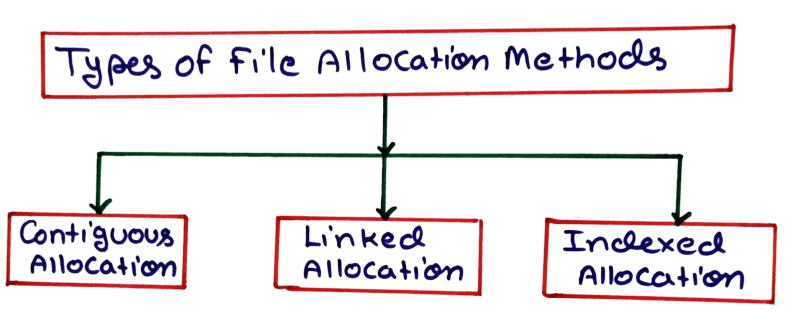
- Contiguous Allocation
- Linked Allocation
- Indexed Allocation
1. Contiguous Allocation
Contiguous allocation is one of the simplest file allocation techniques used by an operating system. In this method, all the disk blocks belonging to a file are placed next to each other in consecutive memory locations. The directory entry for each file stores two important pieces of information: the starting block address and the total number of blocks occupied by the file.
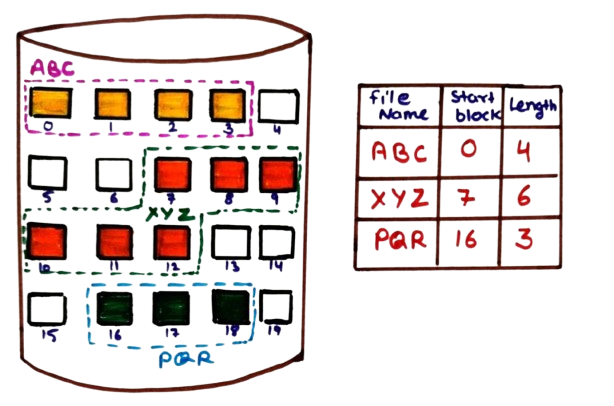
As shown in the diagram, the file ABC starts from block 0 and occupies the next three blocks continuously, forming a single uninterrupted block sequence. Similarly, the files XYZ and PQR are also stored in continuous disk blocks, with no gaps between the blocks of the same file.
Because all blocks of a file are stored together, the disk head does not need to move frequently while accessing the file. This results in very fast access time and efficient sequential as well as direct access. However, this method requires sufficient contiguous free space at the time of file creation, which can be difficult to manage as the disk becomes fragmented over time.
Advantages of Contiguous Allocation
-
Fast File Access:
Since all blocks of a file are stored in consecutive disk locations, the operating system can access any part of the file directly without searching for the next block. This results in very fast read and write operations, especially for large files. -
Simple Implementation:
Contiguous allocation is easy to implement and manage because the directory needs to store only the starting block address and the length of the file. This simplicity reduces overhead in file management. -
Efficient Sequential Access:
Sequential access is highly efficient because the disk head moves smoothly across adjacent blocks. This makes contiguous allocation ideal for applications that read files in order, such as media playback. -
Supports Direct Access:
Any block of the file can be accessed directly by calculating its address using the starting block number. This enables faster random access compared to linked allocation. -
Low Seek Time:
Minimal disk head movement is required because all file blocks are adjacent. This reduces seek time and improves overall disk performance.
Disadvantages of Contiguous Allocation
-
External Fragmentation:
Over time, free disk space becomes scattered into small pieces. Even if enough total space is available, a file may not be stored because a single contiguous block of sufficient size is not free. -
File Size Must Be Known in Advance:
The operating system must know the size of the file at the time of creation. If the file grows beyond its allocated space, it cannot expand easily. -
Difficult File Expansion:
If additional contiguous space is not available next to the file, the file must be relocated entirely to a new location, which is time-consuming and inefficient. -
Wastage of Disk Space:
To allow future expansion, systems may allocate extra blocks that remain unused, leading to internal space wastage. -
Poor Performance Over Time:
As more files are created and deleted, fragmentation increases, reducing the effectiveness and reliability of contiguous allocation in long-term system use.
2. Linked Allocation
Linked allocation is a file allocation technique in which the blocks of a file are stored at different locations on the disk and are connected using pointers. Each disk block contains a pointer that stores the address of the next block belonging to the same file. The directory entry of a file keeps track of the starting block and sometimes the ending block of the file.
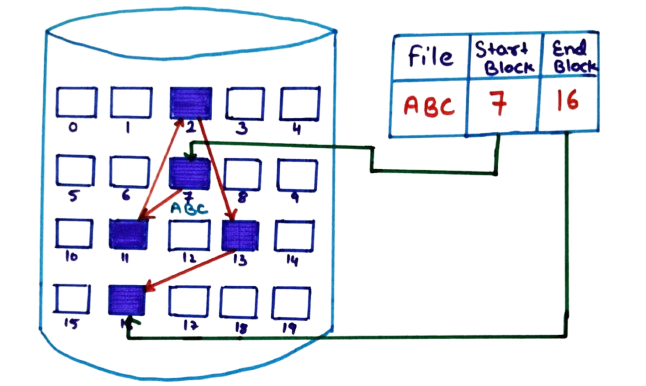
In the given diagram, the file ABC begins at disk block 7 and ends at block 16. The arrows between the blocks represent pointers that link one block to the next, even though the blocks are physically scattered across the disk. This clearly shows that the file does not require continuous disk space.
Because blocks can be stored anywhere on the disk, linked allocation allows files to grow easily without facing external fragmentation. New blocks can simply be added by updating the pointer of the last block. However, accessing a specific block requires traversing the list from the beginning, which makes random access slower compared to contiguous allocation.
Advantages of Linked Allocation
-
No External Fragmentation:
Since file blocks can be stored anywhere on the disk, linked allocation completely eliminates the problem of external fragmentation. A file does not require contiguous free space, making storage utilization more efficient. -
Easy File Expansion:
Files can grow dynamically as new data is added. When a file needs more space, a free block can be allocated anywhere on the disk and linked to the existing file without relocating the entire file. -
Efficient Use of Disk Space:
Disk blocks are allocated only when required. This avoids unnecessary pre-allocation of space and reduces internal wastage of storage. -
Simple File Allocation Strategy:
The operating system does not need to search for large contiguous blocks. It only needs to find a free block and update pointers, simplifying allocation management. -
Suitable for Sequential Access:
Linked allocation works well for files that are accessed sequentially, such as log files or text files, because blocks are read one after another following the pointer chain.
Disadvantages of Linked Allocation
-
Slow Random Access:
To access a specific block, the system must start from the first block and follow each pointer sequentially. This makes random access operations inefficient and time-consuming. -
Pointer Overhead:
Each disk block must store a pointer to the next block. This reduces the effective storage capacity because part of each block is used to store pointer information instead of actual data. -
Risk of Pointer Corruption:
If a pointer is damaged due to disk errors or system crashes, the remaining part of the file may become inaccessible, leading to possible data loss. -
Poor Performance for Large Files:
Large files with many blocks require long pointer chains, increasing access time and reducing overall system performance. -
Limited Direct Access Support:
Linked allocation does not support efficient direct or random access, making it unsuitable for applications that frequently access files at arbitrary locations.
3. Indexed Allocation
Indexed allocation is a modern file allocation technique designed to overcome the limitations of both contiguous and linked allocation methods. In this approach, each file is associated with a special disk block known as an index block. This index block stores the addresses of all the disk blocks that contain the actual data of the file.
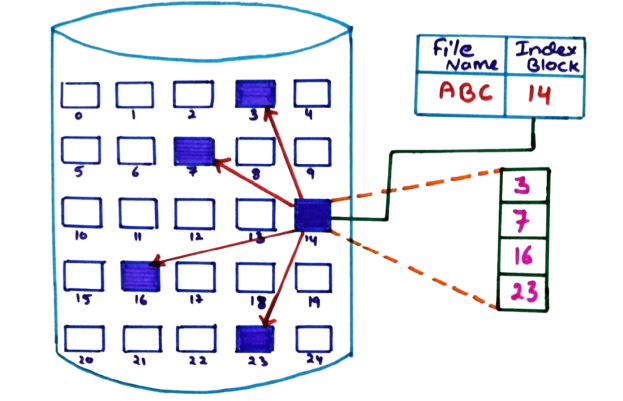
As illustrated in the diagram, the file ABC has its index block located at disk block 14. Instead of pointing directly to data blocks, the directory entry of the file points to this index block. The index block then maintains a list of pointers to all the data blocks used by the file, which may be stored at any free location on the disk.
This structure allows the operating system to access any block of the file directly by first reading the index block and then following the required pointer. As a result, indexed allocation supports fast random access and eliminates external fragmentation. However, it requires additional storage space for index blocks and becomes more complex for very large files that need multiple levels of indexing.
Advantages of Indexed Allocation
-
Supports Fast Random Access:
Indexed allocation allows the operating system to directly access any block of a file by referring to the index block. This eliminates the need for sequential traversal and significantly improves access speed for large files. -
No External Fragmentation:
Since file blocks can be stored at any free location on the disk, indexed allocation completely avoids external fragmentation, leading to better utilization of disk space. -
Easy File Expansion:
Files can grow dynamically without relocating existing blocks. When additional space is required, new block addresses are simply added to the index block, making file expansion simple and efficient. -
Efficient Disk Space Management:
Only the required number of disk blocks are allocated to a file. This prevents unnecessary pre-allocation and reduces internal wastage compared to contiguous allocation. -
Suitable for Large and Complex Files:
Indexed allocation works well for large files and databases that require frequent direct access to different parts of a file, making it suitable for modern file systems.
Disadvantages of Indexed Allocation
-
Extra Storage Overhead:
Each file requires at least one additional index block to store pointers. For small files, this overhead can result in inefficient use of disk space. -
Index Block Wastage:
If a file uses only a few data blocks, most of the index block may remain unused, leading to internal fragmentation within the index block itself. -
Complex Implementation:
Managing index blocks and pointer structures makes this method more complex to implement compared to contiguous and linked allocation. -
Multiple Indexing for Large Files:
Very large files may require multi-level indexing, which increases system complexity and may slightly reduce performance due to additional disk accesses. -
Additional Access Time for Index Block:
Before accessing file data, the system must first read the index block. This extra disk access can introduce slight overhead compared to contiguous allocation in certain cases.
Comparison of File Allocation Methods
Different file allocation methods offer different levels of performance, flexibility, and storage efficiency. The choice of an allocation method depends on factors such as file size, access pattern, and system requirements. The table below provides a detailed comparison of contiguous, linked, and indexed allocation methods.
| Allocation Method | Access Speed | Fragmentation | File Growth | Storage Efficiency | Access Type Supported |
|---|---|---|---|---|---|
| Contiguous Allocation | Very Fast | External Fragmentation | Difficult | Low (due to wastage) | Sequential & Direct |
| Linked Allocation | Slow | No Fragmentation | Easy | Moderate | Sequential Only |
| Indexed Allocation | Fast | No Fragmentation | Easy | High | Sequential & Direct |
From the comparison, it is clear that contiguous allocation provides excellent speed but suffers from fragmentation and inflexible file growth. Linked allocation offers flexibility and eliminates fragmentation but results in slower access time. Indexed allocation provides a balanced solution by supporting fast access, flexible file expansion, and efficient disk utilization, which is why it is widely used in modern file systems.
Conclusion
Each file allocation method has its own advantages and limitations. Contiguous allocation is simple but inflexible, linked allocation supports dynamic growth, and indexed allocation provides the best balance between performance and flexibility.