Introduction to Data Structure
In the field of computer science, data is the foundation on which every program and application operates. Whether it is a small calculator program or a large-scale software system, data is continuously created, processed, and stored. As software systems become more complex, handling data in a random or unorganized manner becomes inefficient and error-prone.
This is where the concept of Data Structure becomes important. A data structure is a systematic way of storing and organizing data in computer memory so that it can be accessed, modified, and processed efficiently. Instead of focusing only on data itself, data structures emphasize how data is arranged and how operations are performed on it.
Data structures help programmers manage large amounts of data effectively by providing logical methods for storage and retrieval. Proper use of data structures can significantly improve the performance of a program in terms of speed, memory usage, and scalability.
Why Data Structure Is Needed
Modern applications handle massive volumes of data, such as user information, transactions, multimedia content, and real-time updates. Without proper organization, searching, inserting, or deleting data would take excessive time and resources.
Data structures offer optimized techniques to perform these operations efficiently. They allow developers to choose the most suitable structure based on the type of problem being solved.
- Helps in efficient data storage and retrieval
- Improves overall performance of programs
- Reduces memory wastage
- Makes complex problem-solving easier
- Supports scalable application development
Role of Data Structure in Programming
Data structures act as building blocks for designing efficient algorithms. An algorithm combined with a suitable data structure results in a powerful solution to computational problems.
For example, searching for an element in an unordered list is slow, but using a well-structured data structure can make the same task much faster. Thus, understanding data structures is essential for writing optimized and reliable programs.
What is Data?
Data refers to basic facts, observations, or measurements collected from real-world activities. It can exist in many forms such as numbers, text, symbols, images, audio, or video. On its own, data does not convey a clear meaning because it is unprocessed and unorganized.
For example, marks obtained by students, temperature readings, customer names, or transaction amounts are all considered data. When this raw data is arranged, analyzed, or interpreted, it becomes useful information that supports decision-making and problem-solving.
In computer systems, data is the foundation of all operations. Programs, software applications, and digital services depend on accurate and well-managed data to function correctly and deliver reliable results.
What is Structure?
Structure means an organized framework or arrangement that defines how different components are related to each other. In the context of computer science, structure determines how data elements are grouped, ordered, and connected.
A well-defined structure makes data easier to understand, access, and manage. Without structure, data becomes scattered and difficult to handle, leading to inefficiency and errors. Structure brings clarity by defining rules and patterns for storing and accessing data.
In programming, structure plays a vital role in improving code readability, reducing complexity, and enhancing overall system performance.
What is Data Structure?
A data structure is a specialized way of organizing and storing data in computer memory so that it can be used efficiently. It provides a logical method to manage large amounts of data and supports various operations such as insertion, deletion, searching, updating, and sorting.
Different data structures are designed for different purposes. Some are optimized for fast access, while others are better suited for dynamic data manipulation. Choosing the right data structure helps in reducing memory usage and improving program execution speed.
Data structures are an essential concept in computer science because they form the backbone of software development, databases, operating systems, and modern applications. A strong understanding of data structures enables developers to design efficient, scalable, and reliable solutions.
Importance of Data Structure
Data structures play a fundamental role in computer science and software development. They define how data is organized, stored, and accessed in memory, directly affecting the performance, reliability, and scalability of a program. A strong understanding of data structures allows developers to build efficient and maintainable systems.
- Improves Program Efficiency: Data structures organize data in a logical and systematic manner, enabling algorithms to process information more efficiently. Proper organization reduces unnecessary computations and allows faster execution of operations such as searching, sorting, insertion, and deletion.
- Optimizes Memory Utilization: Efficient data structures ensure that memory resources are used wisely. By allocating only the required amount of memory and avoiding redundancy, they help reduce memory wastage and improve overall system performance, especially in large-scale applications.
- Minimizes Execution Time: The choice of an appropriate data structure significantly reduces time complexity. Programs can handle large volumes of data smoothly and deliver faster results, which is critical for performance-sensitive applications.
- Simplifies Data Management: Data structures provide a clear framework for storing and manipulating data. This structured approach makes programs easier to understand, debug, and modify, leading to better maintainability and cleaner code.
- Supports Development of Complex Systems: Modern applications such as database systems, operating systems, artificial intelligence tools, and real-time applications rely heavily on advanced data structures to manage complex and interconnected data efficiently.
- Enhances Logical Thinking and Problem-Solving: Learning data structures strengthens analytical skills by encouraging programmers to break problems into smaller components and choose the most effective way to store and process data.
- Forms the Foundation of Algorithm Design: Many algorithms are built around specific data structures. Selecting the right data structure ensures that algorithms function correctly, efficiently, and consistently under different conditions.
- Improves Code Reusability and Scalability: Well-designed data structures promote reusable code components and allow applications to scale easily as data size and complexity grow. This makes future enhancements simpler and more cost-effective.
In summary, data structures are essential for building high-quality software solutions. They not only improve program performance but also contribute to better design, easier maintenance, and long-term scalability, making them a core topic in computer science education and professional development.
Types of Data Structure
Data structures are methods used to store and organize data in a computer system so that it can be accessed and modified efficiently. Based on the nature and complexity of data, data structures are classified into different types.
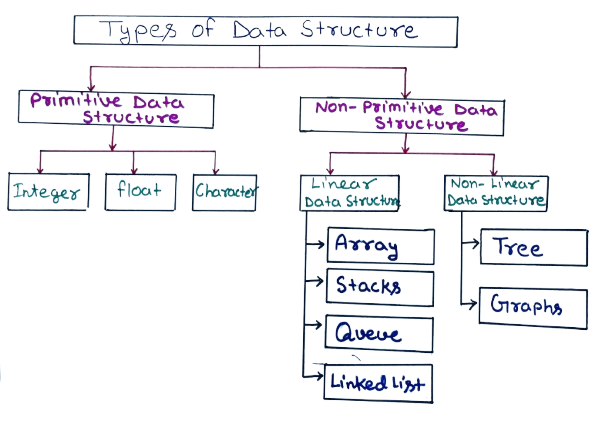
1. Primitive Data Structure
Primitive data structures represent the most basic and fundamental form of data storage in computer systems. They are built-in data types that are directly supported by programming languages and are used to store simple, single-valued data. These data structures act as the building blocks for creating more complex and advanced data structures.
Primitive data types store data in a fixed memory location and usually hold only one value at a time. Because of their simplicity, operations performed on primitive data structures are fast and efficient. Almost every program, regardless of its complexity, relies on primitive data types at its core.
These data structures are commonly used to represent basic information such as counters, flags, numerical values, and individual symbols. Understanding primitive data structures is essential for learning programming logic and memory management.
- Integer: Used to store whole numbers without any decimal part. Integers are commonly applied in counting, indexing, and arithmetic operations. Examples include negative values, zero, and positive numbers such as -10, 0, and 250.
- Float: Used to store numbers that contain decimal points or fractional values. Floating-point data types are widely used in scientific calculations, measurements, and financial applications where precision is required, such as 3.14, 0.75, or 99.99.
- Character: Used to store a single symbol or letter. Characters can include alphabets, digits, or special symbols and are typically enclosed within single quotes. Examples include 'A', 'z', '5', or '@'.
2. Non-Primitive Data Structure
Non-primitive data structures are advanced data structures that can store multiple values and represent complex relationships among data elements. Unlike primitive data types, these structures are not limited to a single value and are capable of handling large and structured datasets efficiently.
These data structures are widely used in real-world applications where data organization, flexibility, and scalability are required. They allow programmers to store related data together and perform complex operations with better control and efficiency.
Non-primitive data structures are broadly classified into linear and non-linear data structures based on the way data elements are organized in memory.
2.1 Linear Data Structure
In a linear data structure, data elements are arranged in a sequential order, where each element is connected to its previous and next elements (except the first and last elements). Data traversal in linear structures follows a single path, making them simple and easy to implement.
Linear data structures are commonly used when data needs to be processed in a specific order. They are efficient for sequential access and are widely used in memory management, scheduling, and data processing applications.
- Array: An array stores multiple elements of the same data type in continuous memory locations. It allows fast access using index values and is commonly used when the size of data is fixed and known in advance.
- Stack: A stack follows the Last In First Out (LIFO) principle, where the last inserted element is the first one to be removed. Stacks are widely used in function calls, recursion, expression evaluation, and undo/redo operations.
- Queue: A queue follows the First In First Out (FIFO) principle, where the first inserted element is the first to be removed. Queues are commonly used in scheduling algorithms, buffering, printer queues, and task management systems.
- Linked List: A linked list stores data in the form of nodes, where each node contains data and a reference to the next node. Unlike arrays, linked lists do not require contiguous memory and allow dynamic insertion and deletion of elements.
2.2 Non-Linear Data Structure
In a non-linear data structure, data elements are not arranged in a sequential manner. Instead, they form hierarchical or interconnected relationships, allowing multiple paths for data traversal.
Non-linear data structures are ideal for representing complex systems where relationships between data elements are not one-to-one. These structures are extensively used in modern applications such as artificial intelligence, databases, and networking systems.
- Tree: A tree represents data in a hierarchical structure consisting of nodes connected by edges. Each tree has a root node, and every node can have multiple child nodes. Trees are commonly used in file systems, database indexing, and decision making processes.
- Graph: A graph represents a collection of nodes (vertices) connected by edges. Graphs are used to model real-world networks such as social networks, road maps, communication networks, and routing algorithms.
Overall, non-primitive data structures provide the flexibility and power required to manage complex data efficiently. They form the backbone of modern software systems and play a crucial role in designing optimized and scalable applications.
Operations on Data Structure
Operations on data structures describe the different actions that can be performed on stored data to create, access, modify, and manage it effectively. These operations are the backbone of all computer programs because they directly affect performance, memory usage, and reliability of applications.
Every software system—whether simple or complex—relies on these operations to process data correctly. Selecting the right operation and applying it efficiently helps in managing large datasets, reducing execution time, and improving user experience.
-
Insertion:
Insertion is the operation of adding a new data element into a data structure at a specific position. The complexity of insertion depends on the type of data structure used.
Example: In an array, inserting a new element at the beginning requires shifting existing elements to the right. In a linked list, insertion can be performed efficiently by updating pointers without shifting data. -
Deletion:
Deletion involves removing an existing element from a data structure. After deletion, the structure must remain valid and organized.
Example: Deleting an element from an array may require shifting elements to fill the empty space, whereas deleting a node from a linked list only requires changing links between nodes. -
Traversal:
Traversal is the process of accessing each element of a data structure one by one. It is commonly used to display data or perform operations on all elements.
Example: Printing all elements of an array from index 0 to the last index or visiting each node in a linked list sequentially. -
Searching:
Searching is the operation of locating a specific element within a data structure. It determines whether the required data exists and retrieves it if found.
Example: Finding a student’s roll number in a list. Linear search checks elements one by one, while binary search works efficiently on sorted data. -
Sorting:
Sorting arranges data elements in a particular order, such as ascending or descending. Sorted data enhances readability and speeds up searching operations.
Example: Sorting marks of students from lowest to highest to determine rankings. -
Updating:
Updating refers to modifying the value of an existing data element without changing its position in the data structure.
Example: Updating a customer’s phone number in a database or changing a student’s grade in a record system.
In conclusion, operations on data structures define how data is handled inside a program. Efficient use of these operations leads to faster execution, better memory utilization, and more reliable software systems, making them an essential concept in computer science.
All these operations together make data structures powerful tools for solving real-world computational problems. Choosing the right data structure and performing operations efficiently plays a crucial role in developing optimized and scalable software systems.
Conclusion
Data Structure is a foundational concept in computer science that enables efficient data organization and processing. A strong understanding of data structures helps programmers design optimized and high-performance software systems.